
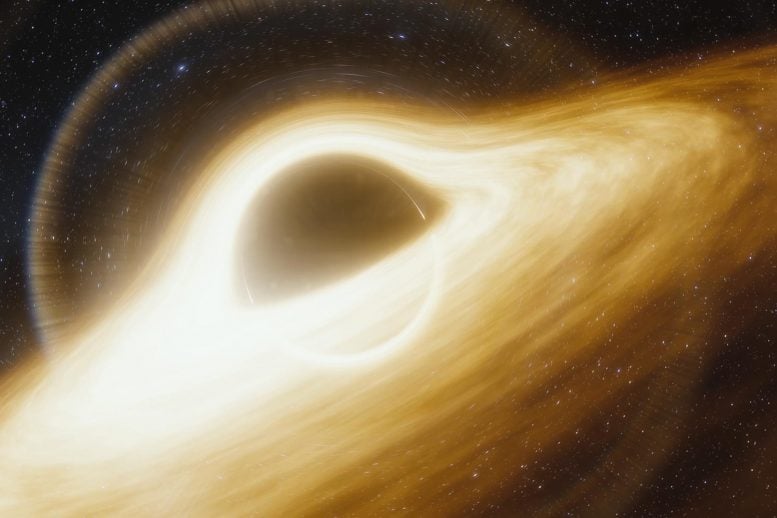
Researchers have discovered that black holes exert pressure as well as temperature, unveiling new quantum complexities in these mysterious cosmic objects.
Physicists at the University of Sussex have discovered that black holes exert a pressure on their environment, in a scientific first.
In 1974 Stephen Hawking made the seminal discovery that black holes emit thermal radiation. Previous to that, black holes were believed to be inert, the final stages of a dying heavy star.
The University of Sussex scientists have shown that they are in fact even more complex thermodynamic systems, with not only a temperature but also a pressure.
The serendipitous discovery was made by Professor Xavier Calmet and Folkert Kuipers in the Department of Physics and Astronomy at the University of Sussex, and is published on September 9, 2021, in Physical Review D.
Calmet and Kuipers were perplexed by an extra figure that was presenting in equations that they were running on quantum gravitational corrections to the entropy of a black hole.
During a discussion on this curious result on Christmas Day 2020, the realization that what they were seeing was behaving as a pressure dawned. Following further calculations they confirmed their exciting finding that quantum gravity can lead to a pressure in black holes.
Implications for Quantum Gravity and Physics
Xavier Calmet, Professor of Physics at the University of Sussex, said: “Our finding that Schwarzschild black holes have a pressure, as well as a temperature, is even more exciting given that it was a total surprise. I’m delighted that the research that we are undertaking at the University of Sussex into quantum gravity has furthered the scientific communities’ wider understanding of the nature of black holes.
“Hawking’s landmark intuition that black holes are not black but have a radiation spectrum that is very similar to that of a black body makes black holes an ideal laboratory to investigate the interplay between quantum mechanics, gravity, and thermodynamics.
“If you consider black holes within only general relativity, one can show that they have a singularity in their centers where the laws of physics as we know them must break down. It is hoped that when quantum field theory is incorporated into general relativity, we might be able to find a new description of black holes.
“Our work is a step in this direction, and although the pressure exerted by the black hole that we were studying is tiny, the fact that it is present opens up multiple new possibilities, spanning the study of astrophysics, particle physics, and quantum physics.”
Folkert Kuipers, doctoral researcher in the School of Mathematical and Physical Science at the University of Sussex, said: “It is exciting to work on a discovery that furthers our understanding of black holes – especially as a research student.
“The pin-drop moment when we realized that the mystery result in our equations was telling us that the black hole we were studying had a pressure – after months of grappling with it – was exhilarating.
“Our result is a consequence of the cutting-edge research that we are undertaking into quantum physics at the University of Sussex and it shines a new light on the quantum nature of black holes.’’
Reference: “Quantum gravitational corrections to the entropy of a Schwarzschild black hole” by Xavier Calmet and Folkert Kuipers, 9 September 2021, Physical Review D.
DOI: 10.1103/PhysRevD.104.066012
Never miss a breakthrough: Join the SciTechDaily newsletter.
Follow us on Google and Google News.
10 Comments
But quantum gravity is a hypothesis that attempts to combine General Relativity and Quantum Mechanics. General Relativity is a proven theory. Quantum Mechanics is well established as a collection of experiments and effects that provide a collection of laws regarding how quantum objects behave. Work is being done to combine these laws into a comprehensive theory, such as QFT and String Theory, themselves actually being hypothetical and not fully established theories such as are General Relativity and Thermodynamics. So, it is a stretch to claim that a “discovery” has been made in the equations combining the hypothesis of Quantum Gravity from one of multiple hypothesis of Quantum Mechanics with two established Theories of Thermodynamics and General Relativity.
It is great that they have found, within the hypothetical equations of quantum gravity, the implication that black holes exert some sort of “pressure” on the environment. It isn’t, though, of the order of magnitude as, for instance, the discovery that Maxwell’s Equations imply the speed of light is constant.
What would be nice is if the article explained what is meant by “pressure”. After all, the term “pressure” is typically used for “air pressure”, “water pressure”, and other descriptions of a mechanical force exerted by one body on another in Newtonian Mechanics. Is it being used here to label a mechanical force of gravity that is exerted on an object in the vicinity of the black hole? Is this then an adjustment to the gravitational force which pulls a physical body towards the black hole? Or is the analogy of “pressure” being used some other fashion?
Thanks
Black holes does nt exist
The black hole attempted to eat the star and when the whole star didn’t fit into it’s mouth all at once the two were forced to reject each other. We should now be able to find out, not only the exact rate at which black holes are capable to eat (dependant on their size), but also this should help illuminate the paradox involving BH proportionally small numbers as well as eventually answer the double paradox regarding the absolute and finite size (relative shape) of this universe too. WTG!
This is not a new phenomena.The final effect of black hole is quantum in nature,as atom and subatomic particles are described by only quantum physics only.
Did Hawking make a discovery or postulate a theory that was later proved? Or is the theory the same as a discovery. (I need to get a a hobby:)
The first poster (John Fitzgerald) is correct. This is a press release that has been posted with little analysis. The concept of pressure has not been explained.
While I agree with the idea that this is not actually a “discovery”, it is an interesting development. I am guessing now… this “pressure” could be a lot of things. Assuming it is Lorentz Covariant, one of these things might be the associated Noether Current might be conserved across the Event Horizon into the Ergodic Region outside that barrier as a net negative flow outwards of Noether Current & expanding the local metric between the global distributions of Black Holes in the outer expanding Universe.
Something like when you take a balloon(of the twistable kind), grab one end and squeeze it “empty”, collapsing it “to a singularity”, the rest of the balloon outside the singularity expands away from the horizon due to an expansive increase in locally disturbed global metric pressure… this could be one form of “Dark Energy”, that “anti-gravitational energy” appearing between the Galaxies causing them to expands away from all other galaxies at an ever increasing speed.
In the beginning, all current theories suggest there was no time, and on the horizon of the Black Hole there was only space (initial entropy of the newly arrived Universe), this expansive process might generate an additional orthogonal current in the space between all black holes & the clumps of matter (which might themselves be tiny “electromagnetic” black holes in their own right) mass, spin and charge, leading to an overall increase in the rapidity of the gradient of time around these effective sources that are responsible for emergent gravitation in the AdS/CFT.
Sorry for the length.
The pressure exerted by the super massive black hole as formulated by Quantum physics is quite up to possible value.So this can be granted,but theory is not explained añd ìs to be comleted.Success to corelate relativity with quantum physics in SMBH is accepted with a thanks to the authors.
… gosh, noting is on its own…
A black hole exerting a pressure might be the force that leads to rotation outwards..