
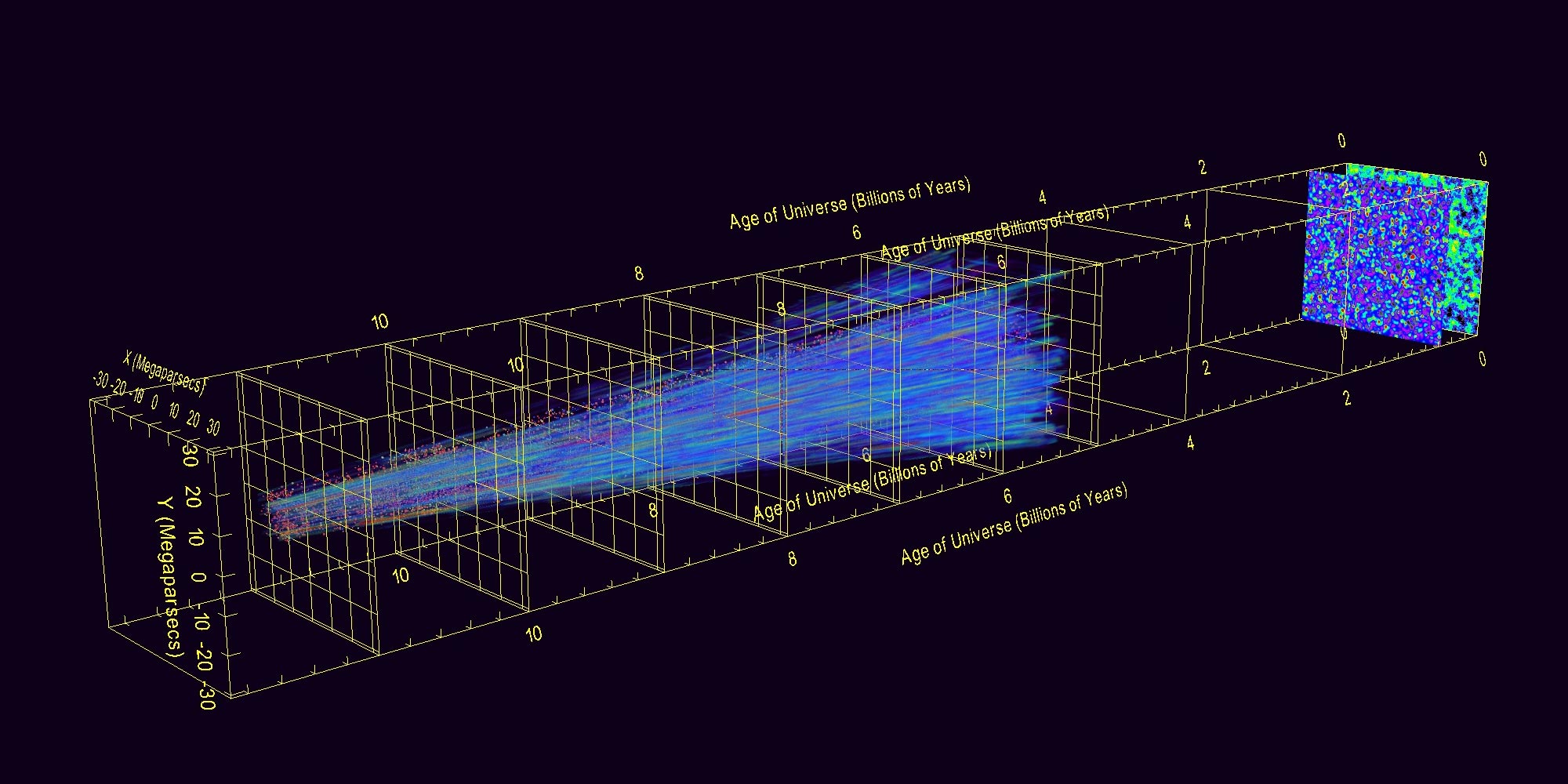
A direct, observation-based test of one of the pillars of cosmology.
The universe is full of billions of galaxies — but their distribution across space is far from uniform. Why do we see so much structure in the universe today and how did it all form and grow?
A 10-year survey of tens of thousands of galaxies made using the Magellan Baade Telescope at Carnegie’s Las Campanas Observatory in Chile provided a new approach to answering this fundamental mystery. The results, led by Carnegie’s Daniel Kelson, are published in Monthly Notices of the Royal Astronomical Society.
“How do you describe the indescribable?” asks Kelson. “By taking an entirely new approach to the problem.”
“Our tactic provides new — and intuitive — insights into how gravity drove the growth of structure from the universe’s earliest times,” said co-author Andrew Benson. “This is a direct, observation-based test of one of the pillars of cosmology.”
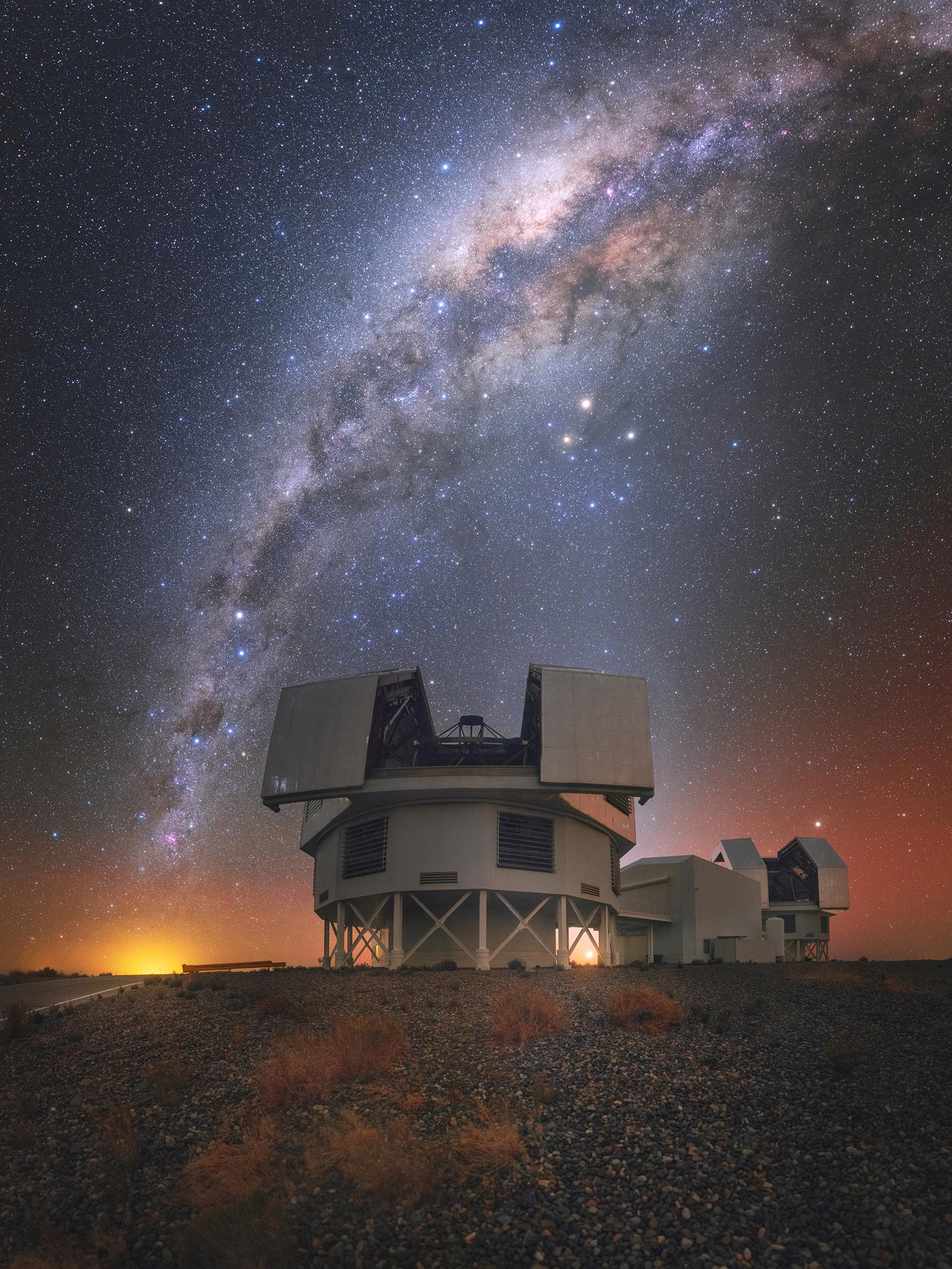
The Carnegie-Spitzer-IMACS Redshift Survey was designed to study the relationship between galaxy growth and the surrounding environment over the last 9 billion years, when modern galaxies’ appearances were defined.
The first galaxies were formed a few hundred million years after the Big Bang, which started the universe as a hot, murky soup of extremely energetic particles. As this material expanded outward from the initial explosion, it cooled, and the particles coalesced into neutral hydrogen gas. Some patches were denser than others and, eventually, their gravity overcame the universe’s outward trajectory and the material collapsed inward, forming the first clumps of structure in the cosmos.
The density differences that allowed for structures both large and small to form in some places and not in others have been a longstanding topic of fascination. But until now, astronomers’ abilities to model how structure grew in the universe over the last 13 billion years faced mathematical limitations.
“The gravitational interactions occurring between all the particles in the universe are too complex to explain with simple mathematics,” Benson said.
So, astronomers either used mathematical approximations — which compromised the accuracy of their models — or large computer simulations that numerically model all the interactions between galaxies, but not all the interactions occurring between all of the particles, which was considered too complicated.
“A key goal of our survey was to count up the mass present in stars found in an enormous selection of distant galaxies and then use this information to formulate a new approach to understanding how structure formed in the universe,” Kelson explained.
The research team — which also included Carnegie’s Louis Abramson, Shannon Patel, Stephen Shectman, Alan Dressler, Patrick McCarthy, and John S. Mulchaey, as well as Rik Williams, now of Uber Technologies — demonstrated for the first time that the growth of individual proto-structures can be calculated and then averaged over all of space.
Doing this revealed that denser clumps grew faster, and less-dense clumps grew more slowly.
And it’s just so simple, with a real elegance to it.” Daniel Kelson
They were then able to work backward and determine the original distributions and growth rates of the fluctuations in density, which would eventually become the large-scale structures that determined the distributions of galaxies we see today.
In essence, their work provided a simple, yet accurate, description of why and how density fluctuations grow the way they do in the real universe, as well as in the computational-based work that underpins our understanding of the universe’s infancy.
“And it’s just so simple, with a real elegance to it,” added Kelson.
The findings would not have been possible without the allocation of an extraordinary number of observing nights at Las Campanas.
“Many institutions wouldn’t have had the capacity to take on a project of this scope on their own,” said Observatories Director John Mulchaey. “But thanks to our Magellan Telescopes, we were able to execute this survey and create this novel approach to answering a classic question.”
“While there’s no doubt that this project required the resources of an institution like Carnegie, our work also could not have happened without the tremendous number of additional infrared images that we were able to obtain at Kit Peak and Cerro Tololo, which are both part of the NSF’s National Optical-Infrared Astronomy Research Laboratory,” Kelson added.
Reference: “Gravity and the non-linear growth of structure in the Carnegie-Spitzer-IMACS Redshift Survey” by Daniel D Kelson, Louis E Abramson, Andrew J Benson, Shannon G Patel, Stephen A Shectman, Alan Dressler, Patrick J McCarthy, John S Mulchaey and Rik J Williams, 15 January 2020, Monthly Notices of the Royal Astronomical Society.
DOI: 10.1093/mnras/staa100
Never miss a breakthrough: Join the SciTechDaily newsletter.
Follow us on Google and Google News.
15 Comments
Is it just me, or have science’s creationist adherents just gone into “Quick, invent something” overdrive?
It’s not just you, lol. And I think you give them a little too much credit including the word “science” there. Big Bang mythology is their hammer, everything in the universe their nail.
Creationism is a form of organized superstition, not science.
The inflationary big bang universe cosmology describes a process and its outcome, it is entirely natural. The work here is not inventing “something” as much as developing a new method – read the paper and check that (I have)!
If you have any questions about cosmology, just ask instead of trolling senseless comments.
No! It certainly isn’t just you, John C! The problem is, there are all too many who fall into the trap they weave due to ignorance of the subjects involved.
Religion posing as science.
Even if the data showing the universe isn’t isotropic is correct, it’s no big deal. All of that is based on the idea that the Big Bang banged out a perfect sphere, but what if that Big Bang wasn’t the first and the universe it banged was a bit non-spherical. This can be the case from a novel possibility from String Theory concepts and has nothing to do with Dark Energy or Dark Matter. Surely you didn’t think all of the matter and energy we see now was stuffed in a single Big Bang!
As you may know, quantum mechanics proposes a roiling quantum foam energy field everywhere in the universe, and the right kind of energy spikes creates string/anti-string pairs. These pairs immediately annihilate each other, but I suggest a process similar to Hawking radiation that form permanent strings that are the basis of all the matter and energy we have. This is a Big Bang/Big Crunch cycle, over and over. Interestingly, this same process can be used to form the galaxies we see. Gravity is far too weak to cause anything to combine rather than flying apart from the enormous force of the Big Bang. Specifics for the physical creation of the universe and the galaxies are shown in my YouTube
https://www.youtube.com/watch?v=cQUMq2Z11Jc&t=3s
Also, the amazing structure of the universe suggested in this article may be a more complicated version of the same process I speculate forms dwarf galaxies in thin planes like those seen around the Andromeda galaxy and our own Milky Way. That process is described in this other YouTube https://www.youtube.com/watch?v=uuG4yy-vW84&t=6s
– “Even if the data showing the universe isn’t isotropic is correct, it’s no big deal. ”
If the universe isn’t isotropic, it is a very big deal!
First, the cosmic background radiation tells us it is homogeneous and isotropic to 1 part in 100,000 [!].
Second, our models can’t handle it. “An anisotropic universe would shake the pillars of physics, demanding major revisions to current thinking about cosmic evolution. “If [the universe’s growth] is indeed different in different directions, that brings a whole new wrinkle into a cosmological assumption about homogeneity of the expansion over sufficiently large regions of space,” says Megan Donahue, a Michigan State University astrophysicist who was not involved in the study. A lopsided expansion “would be astonishing and depressing,” she adds, because it would suggest our understanding of the universe’s large-scale structure and evolution is profoundly—perhaps permanently—incomplete.” [ https://www.scientificamerican.com/article/do-we-live-in-a-lopsided-universe1/ ; the “lopsidedness” discussed there was “suspicious” accoring to a Nobel Rize winner, see the link.]
– ” String Theory”. Opinions differ of course, but I don’t think anyone denies that string (and GUT) theories are in deep doodoo after the asked for proton decays, natural energy scale WIMPs, axions/axion like particles and electron asymmetries never showed themselves!
My opinion is that string theory is dead.
– “a roiling quantum foam energy field everywhere in the universe, and the right kind of energy spikes creates string/anti-string pairs”.
This seems confused.
The “quantum foam” was a hypothesis of quantized spacetime, which breaks Lorentz invariance and is generally seen as dead.
Spacetime is neither an energy nor a field – an “energy field” is a scifi conceit – even though you can write low energy gravity as a field theory [ http://www.scholarpedia.org/article/Quantum_gravity_as_a_low_energy_effective_field_theory ] – which by the way obey Lorentz invariance, so no “foam”.
Matter/antimatter particle pairs can be caused by everyday quantum fields, we need no string theory. Either as non-resonant ripples (“virtual particles”, which aren’t particles but has imaginary mass if you try to calculate it) or resonant ripples (which we call “particles” or “wave packets” depending on the observations). In the latter case you need to input energy since it is the reverse of matter/antimatter annihilation.
– Bouncing universes is a hypothesis that has problems with the ever increasing entropy. That is fringe cosmology – a very small fringe.
– “Gravity is far too weak to cause anything to combine rather than flying apart from the enormous force of the Big Bang.”
That isn’t what LCDM cosmology has found. Structure formation under general relativity (gravity) is part of the model.
– The universe isn’t “created” in the strict sense, see my comments on anti-science creationism elsewhere in this thread. What we see is a natural process and its outcome. Furthermore, since space is flat, the entire universe is average zero energy density so is classically eternal – which LCDM is in future direction and the seen slow roll inflation in the past direction – so what we see is internal changes. (Which is what a general relativistic LCDM says anyway.)
– Self promotion. That is analogous to an example of Godwin’s law, the comment was lost right there and then. References should be sourced in peer reviewed published science.
[q]The Standard Model of Cosmology may not be wrong, but it is definitely oversimplified. The universe is not just expanding; it is collapsing, locally, at the same time.[/q]
It cannot collapse from the physics and we see that it doesn’t from the cosmic background radiation. I don’t grok what you mean by “sans distance” here, but the LCDM model is self consistent so nothing is lacking or need to be added.
You also link to an odd pseudoscience video which try to make science out as a she-said-but-she-said theological argument – why? A “Peter Wilson” is trolling the web with anti-dark energy comments since many years (and of course meanwhile – as the work here shows by relying on LCDM – dark energy has been ever more tested). He reminds me of the blocked troll Paul Wilson – same bufoonery, same initials – that has bombarded the web with the same blatantly wrong big bang description as Moebius and returns here.
Reading the paper it strikes me as very elegant whether or not you like math.
The context of the work is the process where early universe density fluctuations forms structures, which starts out as dominated by global expansion and later becomes – depending on fluctuation size – decoupled from expansion and instead dominated by local gravity. The first phase is linear (as long recognized by e.g. clearheaded George Efstathiou of Planck observatory fame) and the latter is nonlinear.
The general problem with the nonlinear phase – and never mind the complications of the switch over regime – is that gravity makes fluctuations interact. Which means it is an undetermined problem (degeneracies of many reasonable theories predicting the same thing) and becomes a noise amplifying stochastic process.
Here is where they do an inroad of general uncluttering. Usually models try to study the density variations by them now being smaller perturbations. But that means keeping fluctuations modes that eventually leave the expansion Hubble horizon and do not matter. Instead they volume average the Lagrangian continuity equation describing density and momentum, so the decoupled, non-sourced modes disappear by Gauss divergence theorems.
As a result they get a distribution of sums over underdensity and overdensity fluctuations (that they can assemble from observation). It behaves non-linearly and describe a quadratic (not linear), in size and time, growth of overdensities. They use the observations of both types of fluctuations and show that they fit the model very well.
That suggest really simple growth physics, since a lognormal size distribution is what you get from random nucleation and growth [ http://web.csulb.edu/~abill/research/articles/bergmannJCG08.pdf ]. Since the stochastic process here has explicit self interaction it is not a Markov process. So instead of the lognormal accretion rate going as t^(1/2) of random, independent accretion it goes as t^1.
Oops, C&P error. I try again:
Reading the paper it strikes me as very elegant whether or not you like math.
The context of the work is the process where early universe density fluctuations forms structures, which starts out as dominated by global expansion and later becomes – depending on fluctuation size – decoupled from expansion and instead dominated by local gravity. The first phase is linear (as long recognized by e.g. clearheaded George Efstathiou of Planck observatory fame) and the latter is nonlinear.
The general problem with the nonlinear phase – and never mind the complications of the switch over regime – is that gravity makes fluctuations interact. Which means it is an undetermined problem (degeneracies of many reasonable theories predicting the same thing) and becomes a noise amplifying stochastic process.
Here is where they do an inroad of general uncluttering. Usually models try to study the density variations by them now being smaller perturbations. But that means keeping fluctuations modes that eventually leave the expansion Hubble horizon and do not matter. Instead they volume average the Lagrangian continuity equation describing density and momentum, so the decoupled, non-sourced modes disappear by Gauss divergence theorems.
As a result they get a distribution of sums over underdensity and overdensity fluctuations (that they can assemble from observation). It behaves non-linearly and describe a quadratic (not linear), in size and time, growth of overdensities. They use the observations of both types of fluctuations and show that they fit the model very well.
That suggest really simple growth physics, since a lognormal size distribution is what you get from random nucleation and growth [ http://web.csulb.edu/~abill/research/articles/bergmannJCG08.pdf ].
FWIW, since the stochastic process has explicit self interaction it is not a Markov process. So instead of the lognormal accretion rate going as t^(1/2) of random, independent accretion it goes as t^1.
The creationists have definitely gone into overdrive. Once they decided that empty space could expand and had the properties of an aether, the big bang theory was saved.
Awareness is known by awareness alone.
Nice job on the webpage layout geniuses.
Unfortunately we can’t see the entire universe so most of what I’m reading is speculation based on nothing. What I believe is what I see if it was a bouncing universe the bounces are over as all the fuel is being used up. What would really help is to see further into deep space and then we will see who’s close and who’s not. Relying on the math is great BUT when you start adding to make it look right it’s wrong. Now gravity if their was such a thing would be equal regardless of size and mass same pull hence the feather and the hammer just because something is falling dont mean it’s gravity it just means it’s falling. Someone asked once about the moon and I said no gravity and I will stand with that as the moon is moving away from us however slow when it should be coming toward us if the force of gravity differed but it doesn’t. There’s a lot more going on out there than any of us know or ever will maybe? But it sure is interesting stuff and I personally love to go back and forth so keep up the speculation cause it’s a blast. p.S NO BIG BANG. And the snowy start to the universe is very interesting and no it doesn’t have to fall to the bottom it just has to gather and be moving. Size does matter.
Neutron decay cosmology. The neutrons which invert at Neutron star collapse into black hole fall through time and re emerge in lowest energy regions where they decay into atomic hydrogen. This decay creates commune increase of 10^14 times. This is lambda. The atomic hydrogen is dark matter.
If actually there was a big bang! The expansion won’t be unidirectional it would have been multidirectional. If it is natural then, possibly we could repeat the big bang! Right here in our world.