
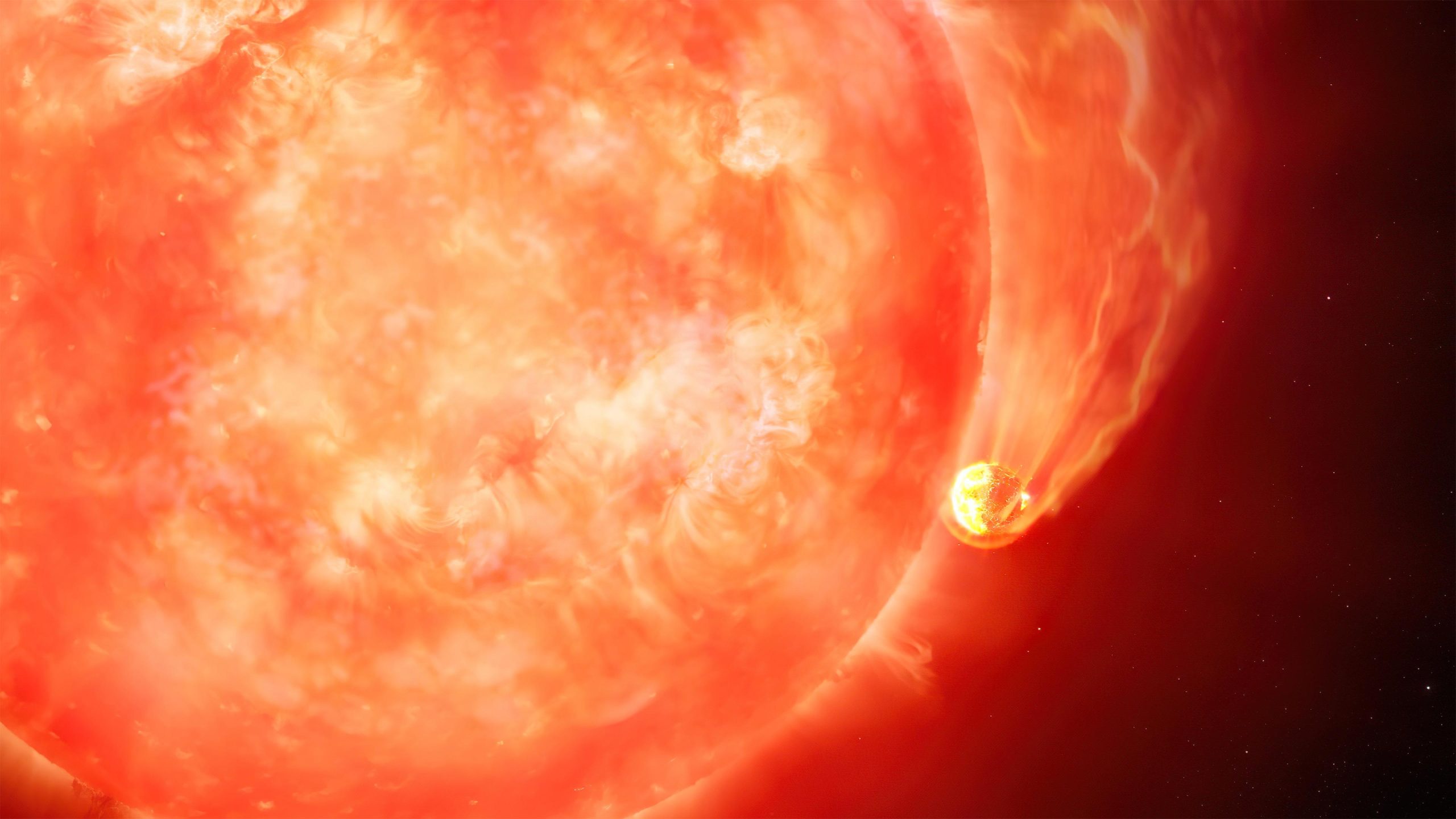
As stars age into red giants, they can destroy nearby giant planets through powerful tidal forces.
The discovery offers a glimpse into the Sun’s eventual transformation and its possible impact on our Solar System.
Dying Stars and Devoured Worlds
When stars like the Sun exhaust their supply of hydrogen, they begin to cool and swell, transforming into enormous red giants. For our own Sun, this transformation is expected to occur in roughly five billion years.
In a new study published in the Monthly Notices of the Royal Astronomical Society, scientists examined nearly 500,000 stars that had recently entered this “post-main sequence” stage of their lives.
Through this extensive analysis, the team identified 130 planets and planet candidates (i.e., that still need to be confirmed) orbiting close to these aging stars, including 33 that had never been seen before.
The researchers noticed that close-in planets were much less common around stars that had expanded and cooled enough to become red giants (i.e. that were further on in their post-main sequence evolution). This pattern suggests that many of these planets may have already been destroyed as their host stars evolved.
A Deadly Gravitational Dance
Lead author Dr. Edward Bryant (Mullard Space Science Laboratory at UCL and the University of Warwick) explained: “This is strong evidence that as stars evolve off their main sequence they can quickly cause planets to spiral into them and be destroyed. This has been the subject of debate and theory for some time but now we can see the impact of this directly and measure it at the level of a large population of stars.
“We expected to see this effect but we were still surprised by just how efficient these stars seem to be at engulfing their close planets.
“We think the destruction happens because of the gravitational tug-of-war between the planet and the star, called tidal interaction. As the star evolves and expands, this interaction becomes stronger. Just like the Moon pulls on Earth’s oceans to create tides, the planet pulls on the star. These interactions slow the planet down and causing its orbit to shrink, making it spiral inwards until it either breaks apart or falls into the star.”
What This Means for Our Solar System’s Future
Co-author Dr. Vincent Van Eylen (Mullard Space Science Laboratory at UCL) said: “In a few billion years, our own Sun will enlarge and become a red giant. When this happens, will the solar system planets survive? We are finding that in some cases planets do not.
“Earth is certainly safer than the giant planets in our study, which are much closer to their star. But we only looked at the earliest part of the post-main sequence phase, the first one or two million years of it – the stars have a lot more evolution to go.
“Unlike the missing giant planets in our study, Earth itself might survive the Sun’s red giant phase. But life on Earth probably would not.”
Hunting Lost Giants With NASA’s TESS
For their study, the researchers used data from NASA’s Transiting Exoplanet Survey Satellite (TESS). They used a computer algorithm to search for the repeated dips in brightness that indicate an orbiting planet is passing in front of the star, focusing on giant planets with short orbital periods (i.e., that took no more than 12 days to orbit their star).
The team began with more than 15,000 possible signals, and applied rigorous tests to rule out false signals, eventually whittling this number down to 130 planets and planet candidates. Of these, 48 were already known, 49 were already identified as planet candidates (i.e., they still need to be confirmed), and 33 were new candidates detected for the first time.
The team found that the more advanced a star’s evolution, the less likely it was to host a nearby giant planet. The overall occurrence rate of such planets was measured at just 0.28%, with the youngest post-main sequence stars showing a higher rate (0.35%) similar to that of main sequence stars, and the most evolved stars, which had cooled and swelled enough to be classed as red giants, dropping to 0.11%. (For this analysis, the researchers excluded the smallest 12 of the 130 identified planets.)
Measuring the Final Moments of Planets
Using data from NASA’s TESS mission, scientists can estimate the size (radius) of potential planets orbiting distant stars. However, to verify that these objects are truly planets and not low-mass stars or brown dwarfs (“failed stars” whose core pressure is not high enough to start nuclear fusion), researchers must also determine their mass.
Astronomers achieve this by carefully tracking the motion of the host stars. Tiny, rhythmic shifts in a star’s position reveal the gravitational influence of orbiting planets, allowing scientists to calculate how massive those planets are.
Dr. Bryant explained: “Once we have these planets’ masses, that will help us understand exactly what is causing these planets to spiral in and be destroyed.”
Reference: “Determining the impact of post-main-sequence stellar evolution on the transiting giant planet population” by Edward M Bryant and Vincent Van Eylen, 15 October 2025, Monthly Notices of the Royal Astronomical Society.
DOI: 10.1093/mnras/staf1771
The researchers received funding from the UK Science and Technology Facilities Council (STFC).
Never miss a breakthrough: Join the SciTechDaily newsletter.
Follow us on Google and Google News.