
Swiss Scientists Develop Autonomous Multi-Robot Teams for Lunar Exploration
The Moon holds untapped resources that humans may eventually extract and utilize. Organizations like the European Space Agency (ESA) are gearing up to delve deeper into our celestial neighbor to identify these minerals.
To effectively scout the lunar surface, a team of Swiss scientists from ETH Zurich envisions not just dispatching a single rover, but a coordinated fleet of vehicles and flying devices that can work in tandem.
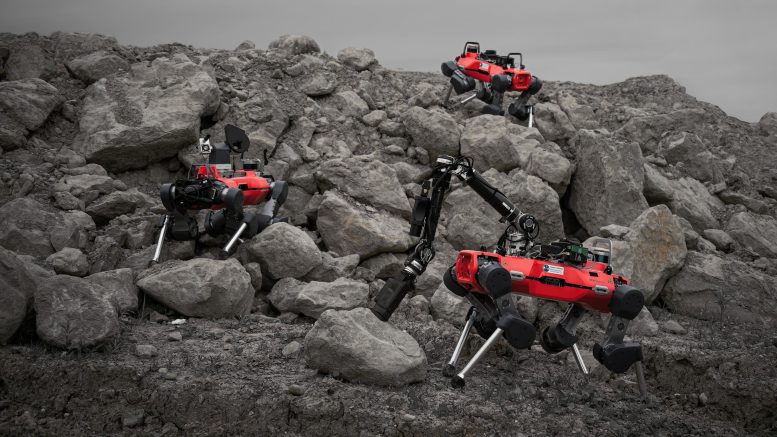
The researchers equipped three ANYmal – a type of legged robot developed at ETH – with a range of measuring and analysis instruments that would potentially make them suitable exploration devices in the future. They tested these robots on various terrains in Switzerland and at the European Space Resources Innovation Centre (ESRIC) in Luxembourg, where, a few months ago, the Swiss team won a European competition for lunar exploration robots together with colleagues from Germany.
The competition involved finding and identifying minerals on a test site modeled after the surface of the Moon. In a recent paper published in the journal Science Robotics, the scientists describe how they go about exploring an unknown terrain using a team of robots.
Insurance Against Failure
“Using multiple robots has two advantages,” explains Philip Arm, a doctoral student in the group led by ETH Professor Marco Hutter. “The individual robots can take on specialized tasks and perform them simultaneously. Moreover, thanks to its redundancy, a robot team is able to compensate for a teammate’s failure.” Redundancy in this case means that important measuring equipment is installed on several robots. In other words, redundancy and specialization are opposing goals. “Getting the benefits of both is a matter of finding the right balance,” Arm says.
Swiss engineers are making robots fit for future lunar missions to search for minerals and raw materials. To ensure that the machines can continue to work even if one of them fails, the researchers are teaching them teamwork. Credit: University of Zurich / Central IT – MELS
The researchers at ETH Zurich and the Universities of Basel, Bern, and Zurich solved this problem by equipping two of the legged robots as specialists. One robot was programmed to be particularly good at mapping the terrain and classifying the geology. It used a laser scanner and several cameras – some of them capable of spectral analysis – to gather initial clues about the mineral composition of the rock. The other specialist robot was taught to precisely identify rocks using a Raman spectrometer and a microscopy camera.
The third robot was a generalist: it was able to both map the terrain and identify rocks, which meant that it had a broader range of tasks than the specialists. However, its equipment meant that it could perform these tasks with less precision. “This makes it possible to complete the mission should any one of the robots malfunction,” Arm says.
Combination Is Key
At the ESRIC and ESA Space Resources Challenge, the jury was particularly impressed that the researchers had built redundancy into their exploration system to make it resilient to potential failures. As a prize, the Swiss scientists and their colleagues from the FZI Research Center for Information Technology in Karlsruhe, were awarded a one-year research contract to further develop this technology. In addition to legged robots, this work will also involve robots with wheels, building on the FZI researchers’ experience with such robots.
“Legged robots like our ANYmal cope well in rocky and steep terrain, for example when it comes to climbing down into a crater,” explains Hendrik Kolvenbach, a senior scientist in Professor Hutter’s group. Robots with wheels are at a disadvantage in these kinds of conditions, but they can move faster on less challenging terrain. For a future mission, it would therefore make sense to combine robots that differ in terms of their mode of locomotion. Flying robots could also be added to the team.
The researchers also plan to make the robots more autonomous. Presently, all data from the robots flows into a control center, where an operator assigns tasks to the individual robots. In the future, semi-autonomous robots could directly assign certain tasks to each other, with control and intervention options for the operator.
Reference: “Scientific exploration of challenging planetary analog environments with a team of legged robots” by Philip Arm, Gabriel Waibel, Jan Preisig, Turcan Tuna, Ruyi Zhou, Valentin Bickel, Gabriela Ligeza, Takahiro Miki, Florian Kehl, Hendrik Kolvenbach and Marco Hutter, 12 July 2023, Science Robotics.
DOI: 10.1126/scirobotics.ade9548
Never miss a breakthrough: Join the SciTechDaily newsletter.
Follow us on Google and Google News.