
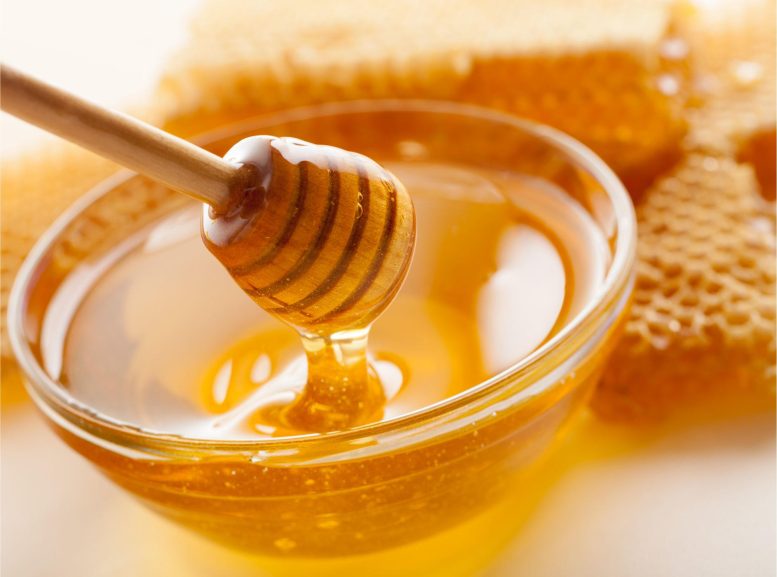
Could a blend of honey and vinegar serve as a traditional yet innovative approach to addressing persistent infections?
The mixture of honey and vinegar, also known as oxymel, has been used as a medical treatment throughout history. Now, contemporary science is acknowledging its potential utility in wound care applications.
A study recently published in the journal Microbiology, is the first comprehensive exploration of how the ancient mixture could be applied to modern medicine and improve treatments for infections.
Bacterial infections can be difficult to treat, particularly when they are protected within a biofilm. A biofilm is a complex system of bacteria that can attach tightly to surfaces, like flesh in a wound infection. Bacteria that are protected in a biofilm are difficult to kill, and treatments today are not always effective at removing them.
The Antimicrobial Properties of Honey and Vinegar
Previous research has shown how effective some natural remedies can be at treating infections. Manuka honey has been proven to possess antimicrobial properties and aid wound healing and vinegar is also proven to be a useful antiseptic.
Doctors have utilized this information in medicine today. While they use manuka honey to treat antibiotic-resistant infections they only use acetic acid, the active component of vinegar, and do not currently combine the two.
A video summary of the research. Credit: Microbiology Society Fourth image adapted from Garcia Maset et al. 2023 Figure Fig. 4D
Dr. Erin Connelly, Dr. Freya Harrison, and their team from the University of Warwick are the first to explore what happens when both honey and vinegar are combined and applied to biofilms of bacteria grown in the laboratory.
Having identified the gap, researchers began by investigating the effects of combinations of two medical-grade honey ointments with natural vinegar or acetic acid. They wanted to find out how effective the treatment is at killing microbes, and which combination worked best.
They were also curious to know if whole vinegar is more antibacterial than just acetic acid. Dr Erin Connelly, a researcher on the study, said, “In our survey of premodern recipes we noticed a pattern of combining honey and vinegar to wash or dress wounds and swellings, and this inspired us to focus on that combination in our analysis.”
By comparing the use of vinegar and acetic acid alone, then in combination with medical-grade honey, the researchers found that it was specifically the combination of the two substances that was best. “We applied a low dose of honey, that alone didn’t kill the bacteria, and a low dose of acetic acid that also could not kill the bacteria alone,” according to Dr Harrison. “These doses are lower than those that wound care nurses currently use on patients. But when we put these low doses together, we saw a large number of bacteria dying which is really exciting. We really need to investigate whether combining these substances could help patients who are not responding to either substance used alone.”
The Unexpected Power of Natural Vinegar Over Acetic Acid
The researchers also found that some natural vinegar had a greater ability to kill bacteria than an equivalent dose of pure acetic acid. In particular, pomegranate vinegars are interesting candidates for further study; these had strong antibacterial activity and, like acetic acid, had activity when combined with honey.
Whilst more research needs to take place to understand the mechanism and best dose combinations of the combined honey and vinegar, these promising results have proved exciting enough that the researchers now propose to take a modern version of oxymel into the clinical trial stage.
Professor Joseph Hardwicke, Consultant Plastic and Reconstructive Surgeon at University Hospitals Coventry and Warwickshire explains “This is an exciting area of research to use traditional remedies in the modern NHS. The burden of wound care and infections is increasing year by year, with causative conditions such as diabetes on the rise. Maybe the knowledge of our ancestors can be used to enhance the current care we can provide to our patients, at a lower cost.”
Reference: “Sweet and sour synergy: exploring the antibacterial and antibiofilm activity of acetic acid and vinegar combined with medical-grade honeys” by Freya Harrison, Anisa Blower1, Christopher de Wolf and Erin Connelly, 12 July 2023, Microbiology.
DOI: 10.1099/mic.0.001351
Never miss a breakthrough: Join the SciTechDaily newsletter.
Follow us on Google and Google News.