
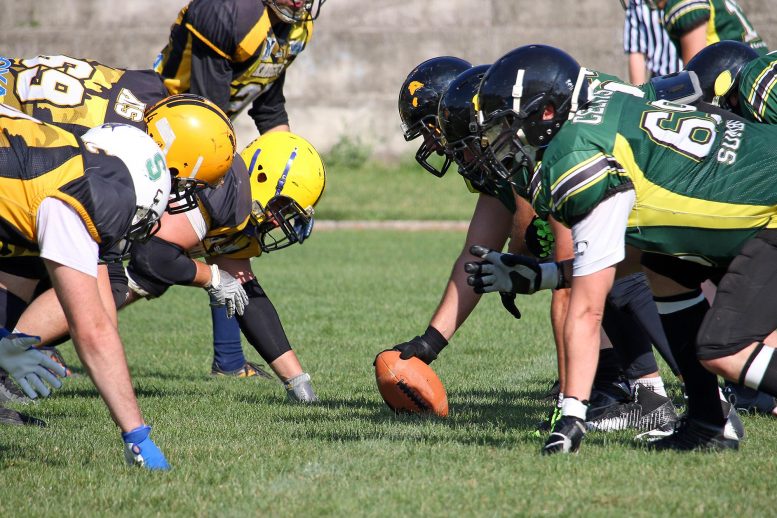
There have been many headlines in recent years about the potentially negative impacts contact sports can have on athletes’ brains. But a new Northwestern University study shows that, in the absence of injury, athletes across a variety of sports — including football, soccer, and hockey — have healthier brains than non-athletes.
“No one would argue against the fact that sports lead to better physical fitness, but we don’t always think of brain fitness and sports,” said senior author Nina Kraus, the Hugh Knowles Professor of Communication Sciences and Neurobiology and director of Northwestern’s Auditory Neuroscience Laboratory (Brainvolts). “We’re saying that playing sports can tune the brain to better understand one’s sensory environment.”
Athletes have an enhanced ability to tamp down background electrical noise in their brain to better process external sounds, such as a teammate yelling a play or a coach calling to them from the sidelines, according to the study of nearly 1,000 participants, including approximately 500 Northwestern Division I athletes.
Kraus likens the phenomenon to listening to a DJ on the radio.
“Think of background electrical noise in the brain like static on the radio,” Kraus said. “There are two ways to hear the DJ better: minimize the static or boost the DJ’s voice. We found that athletes’ brains minimize the background ‘static’ to hear the ‘DJ’ better.”
The study was published today (December 9, 2019) in the journal Sports Health.
“A serious commitment to physical activity seems to track with a quieter nervous system,” Kraus said. “And perhaps, if you have a healthier nervous system, you may be able to better handle injury or other health problems.”
The findings could motivate athletic interventions for populations that struggle with auditory processing. In particular, playing sports may offset the excessively noisy brains often found in children from low-income areas, Kraus said.
This is the latest study from the neural processing of sound in sports concussions and contacts sports partnership, a five-year, National Institutes of Health-funded research collaboration between Brainvolts and Northwestern University Athletics, which launched last year. The study examined the brain health of 495 female and male Northwestern student athletes and 493 age- and sex-matched control subjects.
Kraus and her collaborators delivered speech syllables to study participants through earbuds and recorded the brain’s activity with scalp electrodes. The team analyzed the ratio of background noise to the response to the speech sounds by looking at how big the response to sound was relative to the background noise. Athletes had larger responses to sound than non-athletes, the study showed.
Like athletes, musicians and those who can speak more than one language also have an enhanced ability to hear incoming sound signals, Kraus said. However, musicians’ and multilinguals’ brains do so by turning up the sound in their brains versus turning down the background noise in their brains.
“They all hear the ‘DJ’ better but the musicians hear the ‘DJ’ better because they turn up the ‘DJ,’ whereas athletes can hear the ‘DJ’ better because they can tamp down the ‘static,'” Kraus said.
Reference: “Play Sports for a Quieter Brain: Evidence From Division I Collegiate Athletes” by Jennifer Krizman, PhD; Tory Lindley, ATC; Silvia Bonacina, MS; Danielle Colegrove, ATC; Travis White-Schwoch, BA and Nina Kraus, PhD, 9 December 2019, Sports Health.
DOI: 10.1177/1941738119892275
Jennifer Krizman, research assistant professor and Brainvolts member, is the study’s first author. Other authors on the study include Tory Lindley, Silvia Bonacina, Danielle Colegrove and Travis White-Schwoch, all of Northwestern.
Never miss a breakthrough: Join the SciTechDaily newsletter.
Follow us on Google and Google News.