
Close Menu
    Facebook X (Twitter) Instagram
    SciTechDaily
    • Biology
    • Chemistry
    • Earth
    • Health
    • Physics
    • Science
    • Space
    • Technology
    Facebook X (Twitter) Pinterest YouTube RSS
    SciTechDaily
    Home»Earth»Popigai: Russia’s Crater of Diamonds – Estimated To Contain “Trillions of Carats”
    Earth

    Popigai: Russia’s Crater of Diamonds – Estimated To Contain “Trillions of Carats”

    By Kasha Patel, NASA Earth ObservatoryJune 9, 20211 Comment3 Mins Read
    Facebook Twitter Pinterest Telegram LinkedIn WhatsApp Email Reddit
    Share
    Facebook Twitter LinkedIn Pinterest Telegram Email Reddit
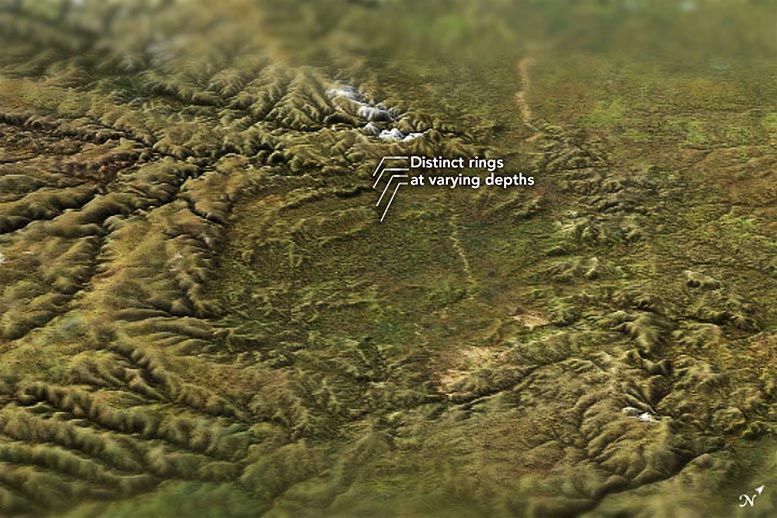
    Popigai Crater Annotated
    Popigai is the fourth largest verified impact crater on Earth and among the most well-preserved craters.

    Popigai Is One of the Largest and Most Well-Preserved Impact Craters on Earth

    About 36 million years ago, an asteroid slammed into northern Siberia and created one of the largest craters on Earth. Streaking in at an estimated speed of 20 kilometers (12 miles) per second, the asteroid made an impact that ejected millions of metric tons of material into the air. The asteroid—between 5 and 8 kilometers (3 to 5 miles) wide—created a crater nearly 100 kilometers (60 miles) in diameter.

    Popigai crater is the fourth largest verified impact crater on Earth, tying the Manicouagan Reservoir in Canada. The three larger craters are either buried (Chicxulub), deformed (Sudbury), or severely eroded and deformed (Vredefort). Popigai has only been slightly modified by erosion, leaving it as one of the most well-preserved craters in the world.
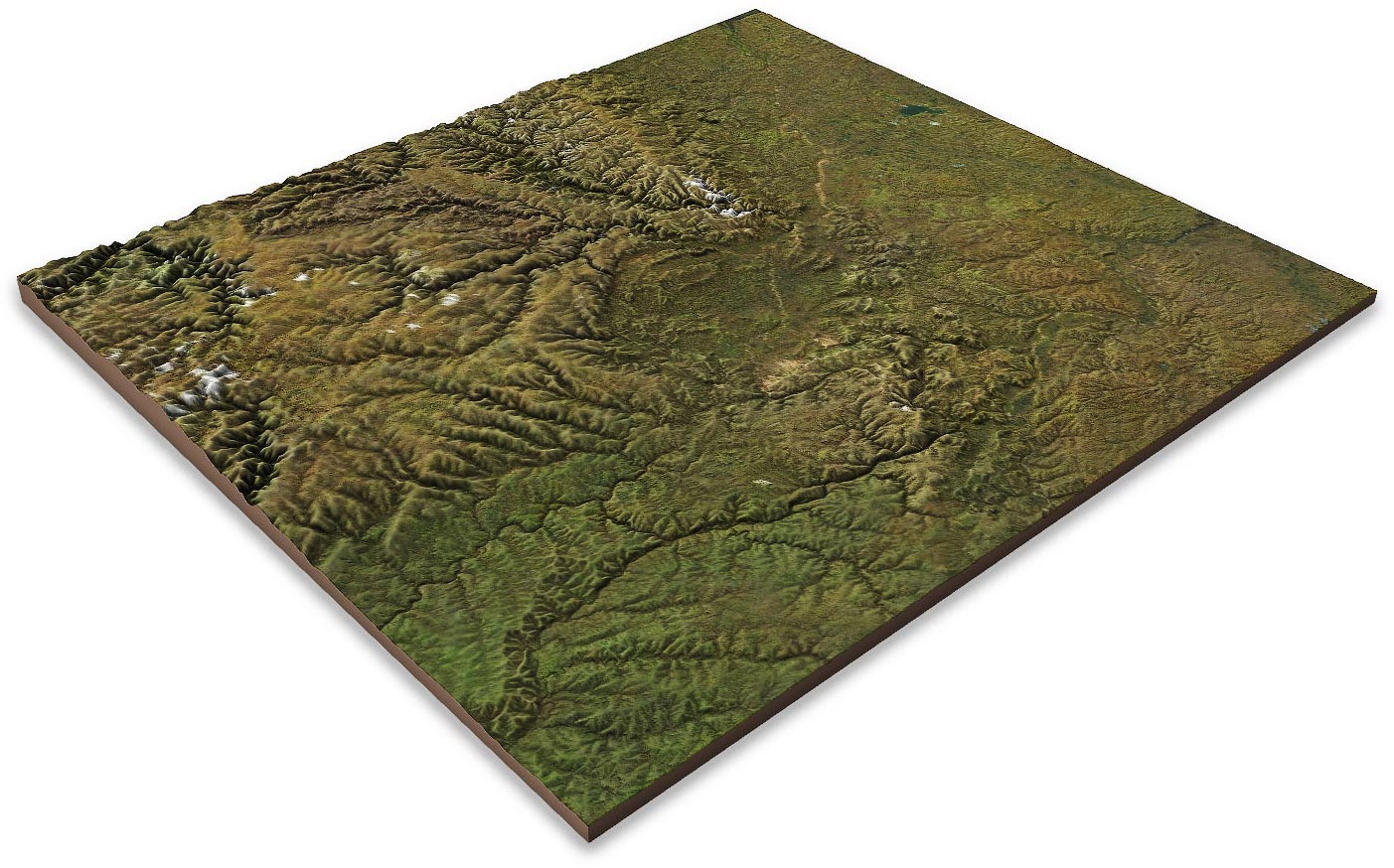
    Popigai Crater

    The images on this page show Popigai crater, named for a nearby river. The images were created using Blue Marble data, a cloud-free composite of monthly observations from NASA’s Moderate Resolution Imaging Spectroradiometer (MODIS) observations. The data was draped over an ASTER-derived global digital elevation model, which shows the topography of the area.

    Located about 100 kilometers (62 miles) from the Laptev Sea coast, the round depression dives about 150 to 200 meters (500 to 650 feet) below the surrounding land. Geological mapping and field observations show a central depression at the bottom of the crater, surrounded by a peak ring of about 45 kilometers (30 miles) wide. The ring gradually passes outwards into a ring-shaped trough, which is surrounded by a flat annular terrace.
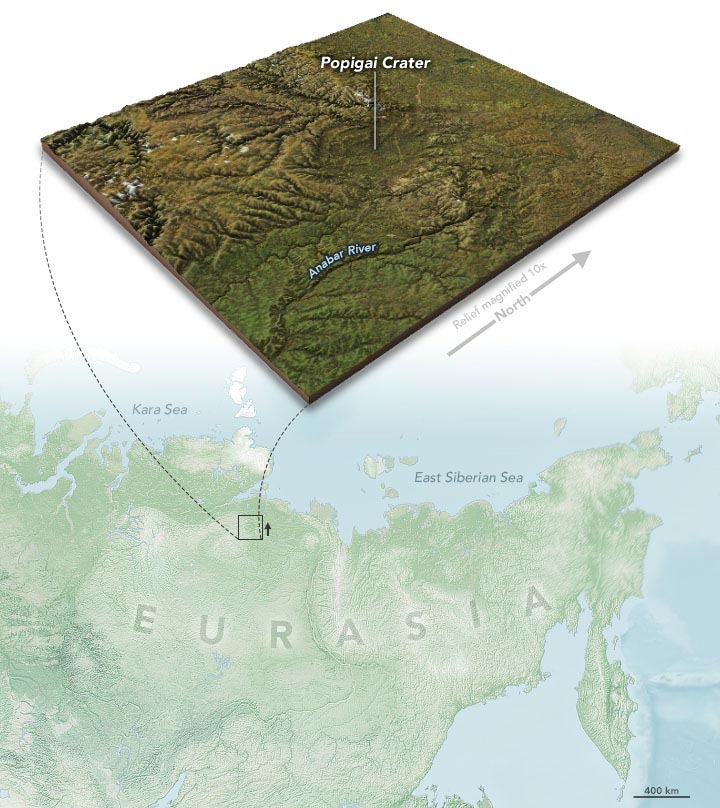
    Popigai Crater Map

    The crater sits on the northeastern margin of the Anabar shield, which contains a mix of graphite-bearing rocks and sedimentary rocks. The impact from the asteroid melted 1,750 cubic kilometers (420 cubic miles) of rocks and instantly transformed the flakes of graphite into diamonds. Diamonds formed in a hemispherical shell about 1.6 kilometers (a mile) thick and about 12 to 13 kilometers (7.5 to 8 miles) away from the impact site. Scientists estimate that diamonds did not form at the impact site because the collision’s heat and pressure were likely too great to survive there.

    Popigai crater is the site of one of the largest diamond fields in the world today, estimated to contain “trillions of carats.” Because they were formed instantly, the “impact diamonds” did not have time to develop as large, single gemstones. Most are polycrystalline stones smaller than two millimeters and with low purity, making them better for industrial uses than for jewelry.

    NASA Earth Observatory images by Joshua Stevens, using data from NASA/METI/AIST/Japan Space Systems, and the U.S./Japan ASTER Science Team, and Blue Marble data from NASA Earth Observatory.

    Never miss a breakthrough: Join the SciTechDaily newsletter.
    Follow us on Google and Google News.

    Diamonds Geography NASA NASA Earth Observatory Popular
    Share. Facebook Twitter Pinterest LinkedIn Email Reddit

    Related Articles

    From Russia With Questions: Distinctive Striping Pattern in Siberia Puzzles Researchers

    A Geologist’s Dream: A Short Journey to the Center of the Earth

    Spied by Satellite: Phytoplankton Factory in the Argentine Sea

    Elephant Island: The Incredible Survival Story of Ernest Shackleton and the Crew of HMS Endurance

    Robinson Crusoe Island Captured by Landsat 8 Satellite

    Huacachina: The Only Natural Oasis in South America

    NASA Picturing Earth: Astronaut Photography In Focus [Video]

    NASA Scientists Map Beirut Blast Damage – Devastating Explosion Rocked Port Area

    NASA Advanced Rapid Imaging Satellite Maps Blast Damage: Beirut Explosion Aftermath

    1 Comment

    1. david ferrin on June 9, 2021 12:57 pm

      Can’t pin point the spot on Goolge earth, can find the general spot, BUT the ground looks wrong !!!

      Reply
    Leave A Reply Cancel Reply

    • Facebook
    • Twitter
    • Pinterest
    • YouTube

    Don't Miss a Discovery

    Subscribe for the Latest in Science & Tech!

    Trending News

    Bone-Strengthening Discovery Could Reverse Osteoporosis

    Scientists Uncover Hidden Trigger Behind Stem Cell Aging

    Scientists Find Way to Reverse Fatty Liver Disease Without Changing Diet

    Could Humans Regrow Limbs? New Study Reveals Promising Genetic Pathway

    Scientists Reveal Eating Fruits and Vegetables May Increase Your Risk of Lung Cancer

    Scientists Reverse Brain Aging With Simple Nasal Spray

    Scientists Uncover Potential Brain Risks of Popular Fish Oil Supplements

    Scientists Discover a Surprising Way To Make Bread Healthier and More Nutritious

    Follow SciTechDaily
    • Facebook
    • Twitter
    • YouTube
    • Pinterest
    • Newsletter
    • RSS
    SciTech News
    • Biology News
    • Chemistry News
    • Earth News
    • Health News
    • Physics News
    • Science News
    • Space News
    • Technology News
    Recent Posts
    • Wind Farms Are Disrupting Ocean Currents, Moving Millions of Tons of Mud Each Year
    • Scientists Discover Massive Magma Reservoir Beneath Tuscany
    • Scientists Create “Neurobots” – Living Machines With Their Own Nervous Systems
    • Europe’s Most Active Volcano Just Got Stranger – Here’s Why Scientists Are Rethinking It
    • Why Are Giant Ants Letting Tiny Ants Crawl All Over Them?
    Copyright © 1998 - 2026 SciTechDaily. All Rights Reserved.
    • Science News
    • About
    • Contact
    • Editorial Board
    • Privacy Policy
    • Terms of Use

    Type above and press Enter to search. Press Esc to cancel.