
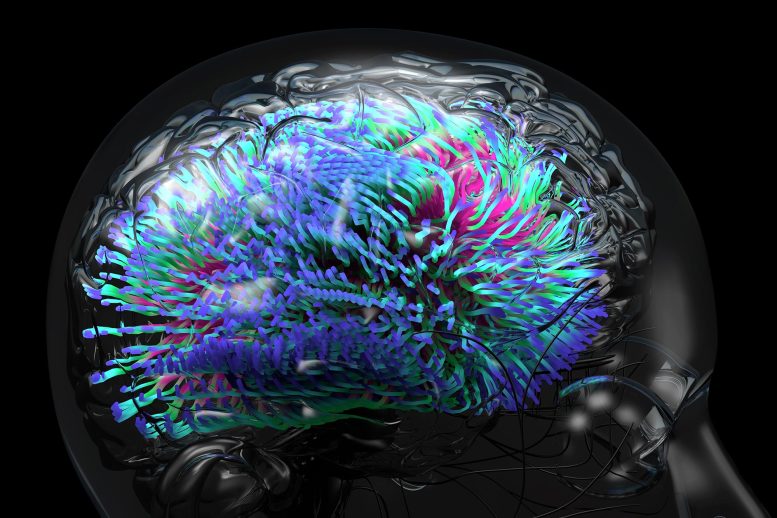
New research pinpoints three brain regions with signature connections in autistic individuals.
USC scientists identify patterns of white matter connectivity exclusive to core autistic symptoms, pointing out a potential flaw in previous autism neuroscience research.
Scientists have identified a signature pattern of white matter connectivity exclusive to the brains of autistic people distinct from that in the brains of people with developmental coordination disorder (DCD).
These new study results were obtained from an international research team led by the University of Southern California (USC). Their findings were published today (November 14) in the journal Scientific Reports.
Developmental Coordination Disorder (DCD) is a neurodevelopmental disorder described in the DSM-V characterized by motor coordination problems which significantly interfere with daily living activities and participation. The problems cannot be explained by another disorder and are already present in early life. It is a chronic disability that affects coordination and is sometimes called “clumsy child syndrome.”
It is also known as developmental motor coordination disorder, developmental dyspraxia or dyspraxia. Around 2-6% of people have DCD, with around four times as many males than females suffering from the disorder.
High Prevalence of DCD in Autistic Individuals
Approximately 85 percent of autistic people have been, or likely could be, diagnosed with DCD, a condition that interferes with learning and motor control. DCD can impair everyday activities such as typing, dressing, or walking, which can subsequently diminish one’s social participation and satisfaction.
Distinguishing between the brain activity patterns of autism spectrum disorder (ASD) and DCD populations is critical because the widespread comorbidity of ASD and DCD confounds previous autism research which, at the time it was conducted, was understood to be exclusively investigating its core social–communication symptoms.
“As the scientific community has learned more and more about DCD, we’ve realized that white matter differences previously identified in the autism literature could actually be attributed to this underlying motor comorbidity,” said Lisa Aziz-Zadeh, the study’s senior author. “In fact, that’s exactly what our team found — that many prior research findings are probably not actually reflecting autism’s core symptoms, but are more likely a reflection of co-occurring DCD.”
Aziz-Zadeh is an associate professor at the USC Chan Division of Occupational Science and Occupational Therapy, with joint appointments at the USC Dornsife College of Letters, Arts and Sciences’ Brain and Creativity Institute, and the Department of Psychology. She is the director of the USC Center for the Neuroscience of Embodied Cognition, which is managing research projects funded by the National Institutes of Health, U.S. Department of Defense, and the Office of the Director of National Intelligence’s Intelligence Advanced Research Projects Activity.
Aziz-Zadeh and colleagues used diffusion-weighted MRI, a technique for observing functional brain connectivity, in children and teens from 8 to 17 years old assigned to one of three study groups: those with ASD; those with probable DCD; and typically-developing individuals. The images were analyzed, compared, and correlated to motor and social behavior assessments which the participants had also completed.
Key White Matter Pathways Specific to Autism
The researchers found that many structural brain connectivity patterns previously believed to be related to autism also overlap with DCD. The team was able to pinpoint three white matter pathways demonstrating distinctly different connectivity, unique to the research participants with autism, as compared to the DCD and typically developing groups: the longitudinal fibers and u-fibers of the mid-cingulum, the corpus callosum forceps minor/anterior commissure and the left middle cerebellar peduncle. These differences also correlated with autistic participants’ measures of emotional performance and/or autism severity. The brains of children with DCD demonstrated unique white matter patterns in the left cortico-spinal and cortico-pontine tracts.
“These results show that we can use advanced imaging to distinguish between autism’s hallmark social symptoms and other motor-related symptoms at the level of brain anatomy,” said Emily Kilroy, the publication’s first author and former post-doctoral scholar in Aziz-Zadeh’s lab during the study’s data collection period. “Of course, people are so much more than their brain anatomy, but this degree of clarity and specificity at the anatomical level gets us one step closer to understanding the biological basis and expression of autism.”
Reference: “Specific tractography differences in autism compared to developmental coordination disorder” by Emily Kilroy, Marzio Gerbella, Lei Cao, Peter Molfese, Christiana Butera, Laura Harrison, Aditya Jayashankar, Giacomo Rizzolatti and Lisa Aziz-Zadeh, 14 November 2022, Scientific Reports.
DOI: 10.1038/s41598-022-21538-0
The publication’s co-authors include Marzio Gerbella and Giacomo Rizzolatti, faculty at the University of Parma (Italy), and Peter Molfese, staff scientist at the NIH National Institute of Mental Health (Bethesda, Md.). USC imaging scientist Lei Cao, post-doctoral scholar Laura Harrison and USC Chan occupational science doctoral students Christiana Butera and Aditya Jayashankar were also co-authors.
This publication is part of “The Neurobiological Basis of Heterogeneous Social and Motor Deficits in ASD,” a $2.15 million grant project from the NIH Eunice Kennedy Shriver National Institute of Child Health and Human that ran from 2015-2021 (R01 HD079432-01; PI: Aziz-Zadeh).
Never miss a breakthrough: Join the SciTechDaily newsletter.
Follow us on Google and Google News.
3 Comments
Is it really so difficult to create a medicine that lowers sensitivity to global stimulation? Please stop our pain, I can’t go on much longer. I’m sure I’m not alone.
This article states “Approximately 85 percent of autistic people have been, or likely could be, diagnosed with DCD” while the scientific article it describes starts with “About 85% of children with autism spectrum disorder (ASD) experience comorbid motor impairments”.
This is an important inaccuracy. Many autistic people are not discovered until adulthood and these people are not included in the statistic.
Sempre me achei diferente de todo mundo. Agora ao 51anos e 6 meses perguntei a minha neurologista se tinha como descobrir se era esquisiita de graça ou se tinha um motivo pra isso. Ela me encaminhou para um avaliação neuropsicológica e o resultado foi o autismo. Já tem mais de 30 anos que tenho recorrentes crises de depressão e síndrome do pânico decorrentes da tentativa de me encaixar no mundo.(tentativas frustadas uma após outra) Um chuva de acontecimentos da minha vida despencaram na memória depois que recebi o diagnóstico.
Agora sei que não sou esquisita de graça: tem um motivo para que meu comportamento ser tão diferente de todas as outras pessoas.
Já faço acompanhamento com uma psicóloga e vou tb ao psiquiatra.