
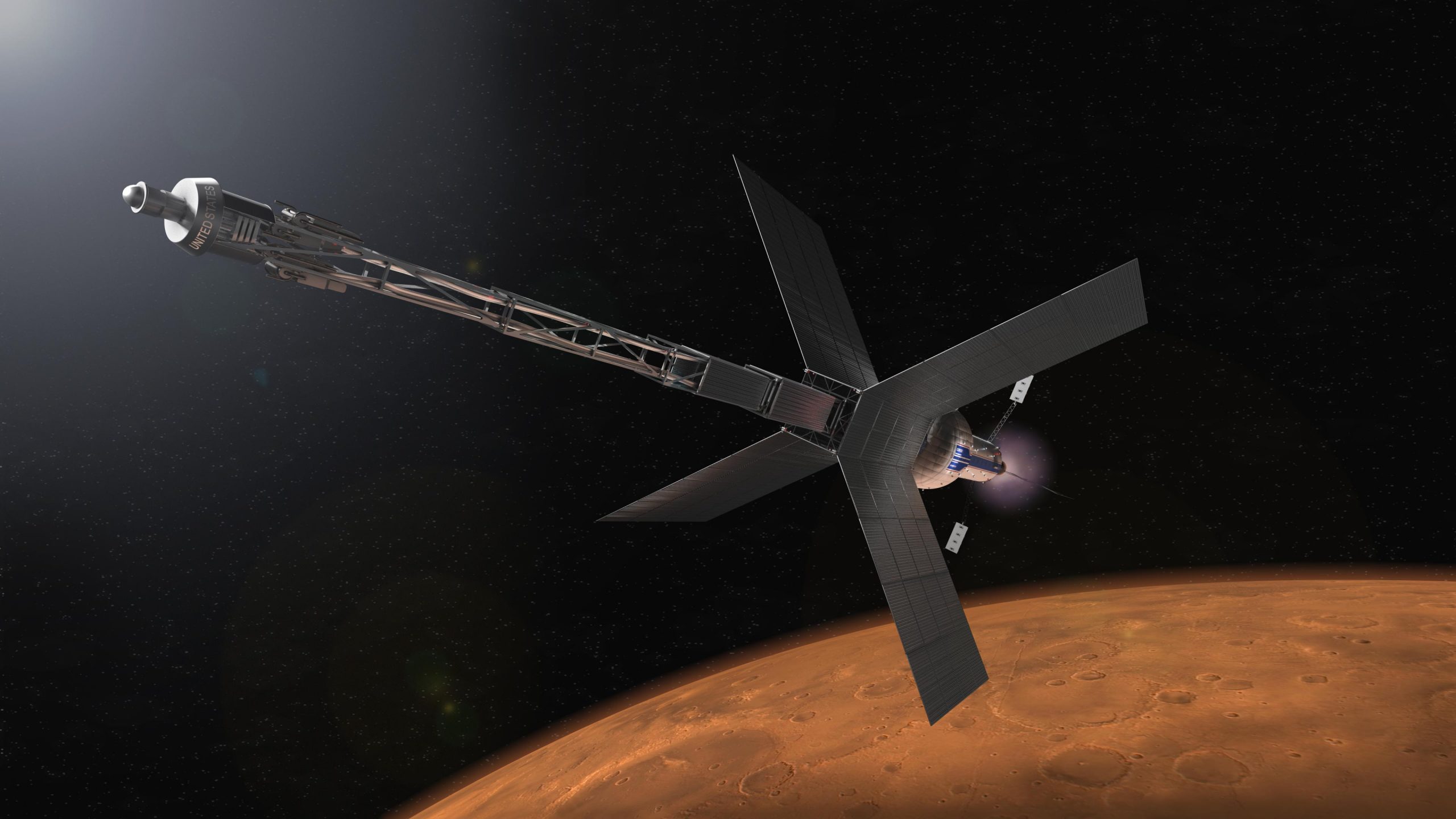
President Donald Trump has issued a new Space Policy Directive that will help propel NASA and humanity’s next giant leap – creating a sustainable presence on the Moon and sending astronauts to Mars.
The president issued Space Policy Directive-6 (SPD-6), the Nation’s Strategy for Space Nuclear Power and Propulsion (SNPP), Wednesday, December 16, 2020. Space nuclear systems power spacecraft for missions where alternative power sources are inadequate, such as environments that are too dark for solar power or too far away to carry sufficient quantities of chemical fuels. Space nuclear systems include radioisotope power systems and nuclear reactors used for power, heating, or propulsion. SPD-6 establishes high-level goals, principles, and a supporting roadmap that demonstrate the U.S. commitment to using SNPP systems safely, effectively, and responsibly.
“NASA strongly supports the White House’s continued leadership on the agency’s Artemis program, which includes landing the first woman and next man on the Moon in 2024. At the Moon we will prepare for new science and human missions deeper into the solar system,” said NASA Administrator Jim Bridenstine. “SPD-6 bolsters the agency’s efforts to develop affordable, safe, and reliable nuclear systems, including technology capable of continuously powering operations on other worlds and propelling future human missions to Mars.”
In support of SPD-6, NASA’s near-term priority is to mature and then demonstrate a fission surface power system on the Moon. NASA, the Department of Energy, and industry will design, fabricate, and test a 10-kilowatt class fission surface power system. NASA plans to demonstrate the system on the Moon in the late 2020s, providing power for sustainable lunar surface operations and testing its potential for use on Mars.
The space agency is also advancing nuclear thermal and nuclear electric propulsion capabilities. Nuclear propulsion can enable robust human exploration beyond the Moon. For crewed missions to the Red Planet, a traditional chemical propulsion system would require a prohibitively high propellant mass. In addition to reducing risk and maturing reactor designs, NASA is part of an effort with the Department of Energy and Department of Defense to develop technologies and nuclear fuel production capabilities for propulsion systems.
SPD-6 establishes the following principles:
- The United States will pursue goals for SNPP development and utilization that are both enabling and ambitious:
- Develop capabilities that enable production of fuel suitable to a range of planetary surface and in-space SNPP applications;
- Demonstrate a fission power system on the Moon;
- Establish technical foundations and capabilities that will enable options for in-space nuclear propulsion; and
- Develop advanced radioisotope power systems to enable survivable surface systems and extend robotic exploration of the solar system.
- The United States will adhere to principles of safety, security, and sustainability in its development and utilization of SNPP systems.
- The United States will pursue a coordinated roadmap for Federally supported SNPP activities and a framework to encourage commercial activities to achieve goals and uphold the principles established in the directive.
For a fact sheet on Space Policy Directive-6, visit:
Never miss a breakthrough: Join the SciTechDaily newsletter.
Follow us on Google and Google News.
4 Comments
I wonder what will happen to the NASA programs after Trump leaves the White House? Will we go back to paying Russia for a lift to the Space Station?
Elon Musk is now taking being paid for transporting supplies and astronauts to the ISS. Obama privatized space operations so the most innovative engineers are able build companies to do this at a fraction of the cost. With SpaceX’s invention of reusable self-landing rockets it’s become a non-issue.
The Trump …man that guy can make things happen . probably will go down as the greatest american president of all time. I wonder why everyone hates the guy . true American through and through. The Trumpster! Someone show me a president who has done more.Dare i say American hero?!
Tanto o que fazer na terra e gastao bilhões num planeta enferrujado com temperatura média de menos 60 graus Celsius….