
Close Menu
    Facebook X (Twitter) Instagram
    SciTechDaily
    • Biology
    • Chemistry
    • Earth
    • Health
    • Physics
    • Science
    • Space
    • Technology
    Facebook X (Twitter) Pinterest YouTube RSS
    SciTechDaily
    Home»Biology»Primitive “Nervous System” Found in Closest Relatives of Animals
    Biology

    Primitive “Nervous System” Found in Closest Relatives of Animals

    By University of BergenJanuary 11, 2025No Comments3 Mins Read
    Facebook Twitter Pinterest Telegram LinkedIn WhatsApp Email Reddit
    Share
    Facebook Twitter LinkedIn Pinterest Telegram Email Reddit
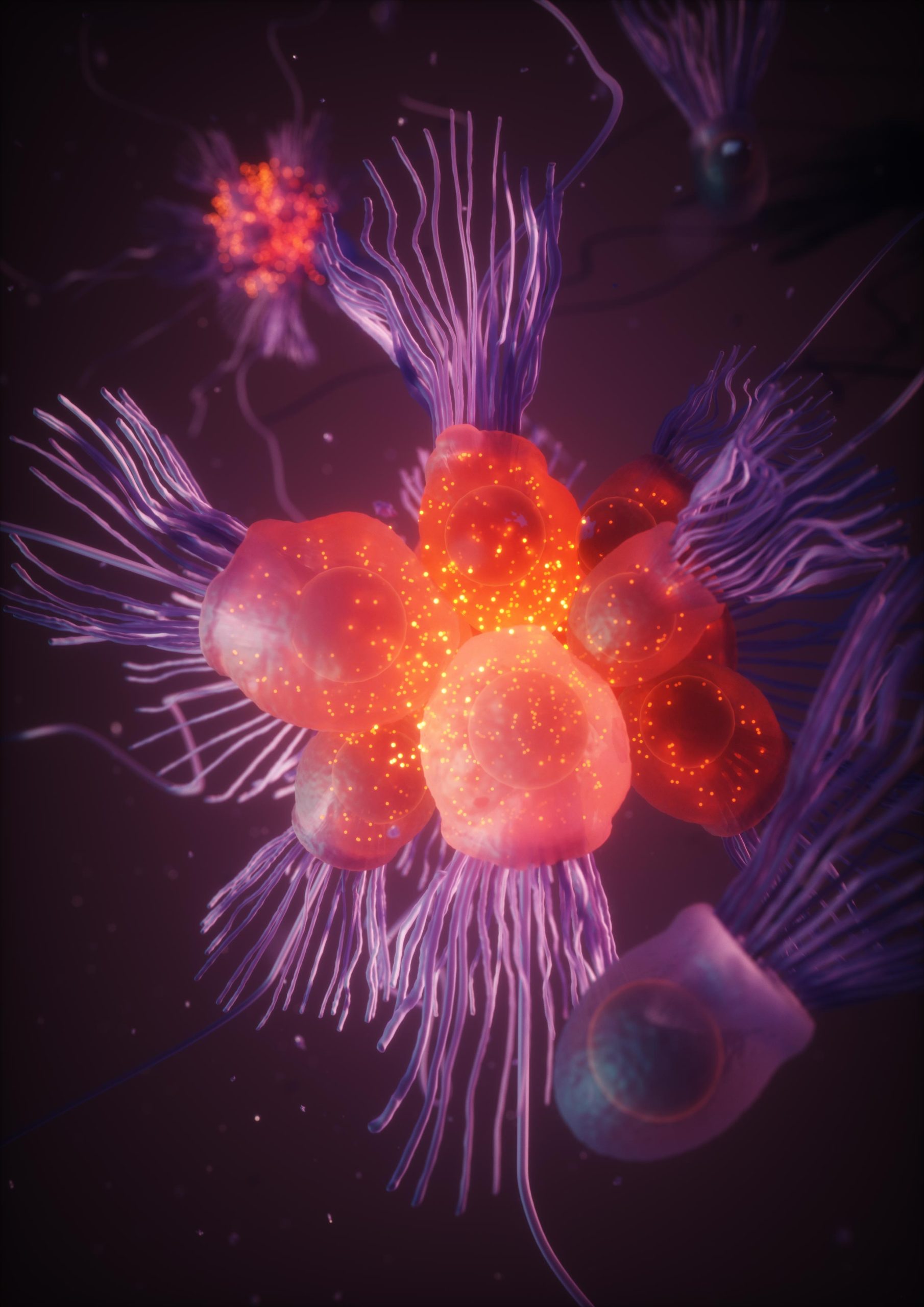
    Artwork Representing Calcium Signalling in a Rosette Colony of the Choanoflagellate S. rosetta
    Artwork representing calcium signalling in a rosette colony of the choanoflagellate S. rosetta. Credit: Davis Laundon, Ella Maru Studio and Kate Zvorykina (Ella Maru Studio, Inc.)

    Scientists discovered that choanoflagellates coordinate their movements through electrical signaling via voltage-gated calcium channels, offering key insights into the early evolution of multicellularity and nervous systems.

    A recent study published in Science Advances provides compelling evidence of electrical signaling and coordinated behavior in choanoflagellates, the closest living relatives of animals. This discovery sheds light on the early evolution of multicellular communication and the origins of animal nervous systems.

    Researchers from the Burkhardt group at the Michael Sars Centre, University of Bergen, uncovered a remarkable diversity of behaviors within the rosette-shaped colonies of the choanoflagellate Salpingoeca rosetta – and the small organisms held even more surprises.

    “We found communication among the cells of the colonies, which regulates shape and ciliary beating across the rosette,” explains first author Jeffrey Colgren. “We didn’t have clear expectations of what we would see in the cultures before putting them under the microscope, but when we did, it was very exciting.”

    Multicellularity and Early Animal Evolution

    Multicellularity is a defining characteristic of all animals, enabling them to interact with their environment in unique ways by integrating the input of highly specialized cell types, such as neurons and muscle cells. For choanoflagellates, flagellated organisms found in marine and aquatic environments all over the globe, the boundary between uni- and multicellularity is less distinct.

    A Rosette Shaped Colony of S. rosetta
    A rosette-shaped colony of S. rosetta, a microscopic marine organism that is part of the sister group to all animals. Credit: Jeffrey Colgren

    Some species, including S.rosetta, exhibit complex life cycles that include colonial stages. While the colonies are formed through cell divisions, much like the developing embryos of animals, they lack specialized cell types and are more akin to a group of individual cells than a cohesive organism.

    “S. rosetta is a powerful model for investigating the emergence of multicellularity during animal evolution,” says last author Pawel Burkhardt. “Since our study reveals that colonial choanoflagellates coordinate their movements through shared signaling pathways, it offers fascinating insights into early sensory-motor systems.”

    Discovery of Voltage-Gated Calcium Channels

    Using a newly developed genetic tool that enables visualization of calcium activity in S. rosetta, the team found that the cells synchronize their behavior through voltage-gated calcium channels, the same type of channels used by animal neurons and muscle cells.

    “This evidence of how information flows between cells in choanoflagellate colonies demonstrates cell-cell signaling at the cusp of multicellularity,” says Colgren. Strikingly, the discovery suggests that the ability to coordinate movement at the cellular level predates the first animals.

    Moving forward, the team plans to further investigate how signals propagate between cells and whether similar mechanisms exist in other choanoflagellate species. “The tools developed and findings from this study open up a lot of new and interesting questions.”

    Colgren concludes. “We’re really excited to see where ourselves and others take this in the future.”

    Reference: “Electrical signaling and coordinated behavior in the closest relative of animals” by Jeffrey Colgren and Pawel Burkhardt, 8 January 2025, Science Advances.
    DOI: 10.1126/sciadv.adr7434

    Never miss a breakthrough: Join the SciTechDaily newsletter.
    Follow us on Google and Google News.

    Cells Evolutionary Biology Microbes Popular
    Share. Facebook Twitter Pinterest LinkedIn Email Reddit

    Related Articles

    Discovery of Ancient Giant Virus Remnants Offers New Clues to the Origins of Complex Life

    A Billion-Year Evolutionary Tale – Biologists Trace Cell Division Back to Its Roots

    Primordial Fuel: Uncovering Hydrogen’s Role at the Origin of Life

    CFP mTurquoise2 Shines Bright

    Researchers Use Microfluidic Device to Monitor Sickle Cell Disease

    Researchers Induce Magnetism to a Non-Magnetic Organism

    UCLA Discovery Suggests a Mechanism and Design Principle for the Engineering of Tissue

    World’s Smallest Primate Issues High-Frequency Calls Like Bats

    Researchers Complete Genome Sequence of a Denisovan Human Finger Bone

    Leave A Reply Cancel Reply

    • Facebook
    • Twitter
    • Pinterest
    • YouTube

    Don't Miss a Discovery

    Subscribe for the Latest in Science & Tech!

    Trending News

    New Study Reveals Why Ozempic Works Better for Some People Than Others

    Climate Change Is Altering a Key Greenhouse Gas in a Way Scientists Didn’t Expect

    New Study Suggests Gravitational Waves May Have Created Dark Matter

    Scientists Discover Why the Brain Gets Stuck in Schizophrenia

    Scientists Engineer “Tumor-Eating” Bacteria That Devour Cancer From Within

    Even “Failed” Diets May Deliver Long-Term Health Gains, Study Finds

    NIH Scientists Discover Powerful New Opioid That Relieves Pain Without Dangerous Side Effects

    Collapsing Plasma May Hold the Key to Cosmic Magnetism

    Follow SciTechDaily
    • Facebook
    • Twitter
    • YouTube
    • Pinterest
    • Newsletter
    • RSS
    SciTech News
    • Biology News
    • Chemistry News
    • Earth News
    • Health News
    • Physics News
    • Science News
    • Space News
    • Technology News
    Recent Posts
    • The Surprising Reason You Might Want To Sleep Without a Pillow
    • Household Cats Could Hold the Secret to Fighting Breast Cancer
    • Scientists Say This Natural Hormone Reverses Obesity by Targeting the Brain
    • This 15,000-Year-Old Discovery Changes What We Know About Early Human Creativity
    • 35-Million-Year-Old Mystery: Strange Arachnid Discovered Preserved in Amber
    Copyright © 1998 - 2026 SciTechDaily. All Rights Reserved.
    • Science News
    • About
    • Contact
    • Editorial Board
    • Privacy Policy
    • Terms of Use

    Type above and press Enter to search. Press Esc to cancel.