
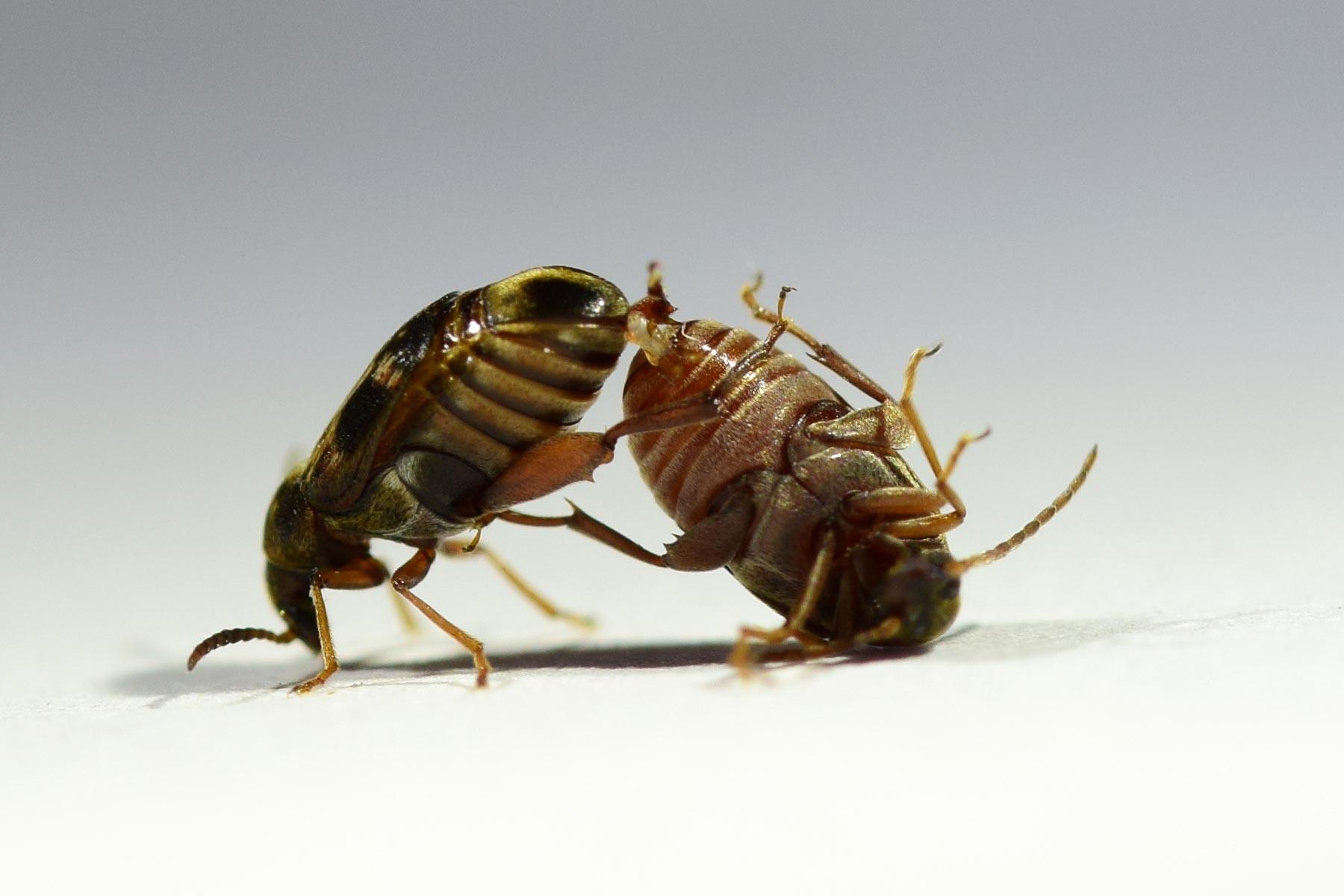
The number of males has little bearing on a population’s growth, but they are important for purging bad mutations from the population.
A few males are enough to fertilize all the females. The number of males, therefore, has little bearing on a population’s growth. However, they are important for purging bad mutations from the population. This is shown by a new Uppsala University study providing in-depth knowledge of the possible long-term genetic consequences of sexual selection. The results are published in the scientific journal Evolution Letters.
The study supports the theory that in many animal species selection acting on males can impose the fortuitous benefit to the population of causing offspring to inherit healthy genes. Stiff competition among males results in selective elimination of individuals with many deleterious mutations, preventing them from passing on said mutations. This may exert positive long-term effects on a sexually reproducing population’s growth and persistence.
Male Selection Minimizes Reproductive Costs
“When deleterious mutations are purged from a population through rigorous selection in males, resulting in fewer males reproducing, the process can take place with little or no effect on population growth. This is because relatively few males suffice to fertilize all the females in a population, hence, whether those females are fertilized by few males or many males makes little or no difference to the number of offspring those females can produce, especially in species where the male doesn’t look after its own offspring. By contrast, such rigorous selection in females would result in fewer females reproducing, hence fewer offspring produced, which could lead to a massive population decline or even extinction,” says Karl Grieshop, evolutionary biologist at Canada’s University of Toronto and the study’s lead author.

The researchers used 16 genetic strains of seed beetle (Callosobruchus maculatus) to investigate how the inferred number of deleterious mutations in each affected the reproductive ability (fitness) of females and males. Through intensive inbreeding of strains followed by crosses among them, it was possible to quantify the cumulative effects of each strain’s unique set of mutations. By comparing the inbred strains to the crosses among them, the scientists were able to see that these mutations harmed both females and males nearly equally. However, when looking only at the crosses among strains, which is the more genetically variable setting that is more relevant to how selection would act in nature, these mutational effects were only manifest in male fitness. In the females, the deleterious effects of the mutations they carried were not detectable in this more genetically variable background, and would therefore not be purged effectively via female-specific selection in nature.
Males as More Effective Genetic Filters
“This indicates that although these mutations do have a detrimental effect on females’ reproduction, they are more effectively removed from the population by selection acting on male carriers than female carriers. Previous research from our group and others has succeeded in showing this effect by artificially inducing mutations, but this is the first direct evidence that it ensues for naturally occurring variants of genes,” Grieshop says.
In the researchers’ view, their study sheds new light on the old question of why so many multicellular organisms use sexual reproduction.
“Production of males causes a decrease in the reproductive capacity of a species, since males themselves contribute less than females to the production of offspring. The question, then, is why a species evolves to reproduce sexually, instead of just producing females through asexual reproduction. Our study shows that production of males, which may engage in intense competition for the chance to mate, enables faster purging of deleterious mutations from the population, which could thereby enable a healthier set of genes and higher reproductive capacity relative to asexual reproduction,” says David Berger, researcher and team leader at Uppsala University’s Department of Ecology and Genetics.
Reference: “Selection in males purges the mutation load on female fitness” by Karl Grieshop, Paul L. Maurizio, Göran Arnqvist and David Berger, 26 June 2021, Evolution Letters.
DOI: 10.1002/evl3.239
Never miss a breakthrough: Join the SciTechDaily newsletter.
Follow us on Google and Google News.
7 Comments
Can this be applied widely to all sexual reproduction or does it apply only for bugs/invertebrates?
This is dangerously close to eugenics and that should bother everyone.
So now even natural evolution is Eugenics? That’s absurd. Unless you went the government to select women’s partners this is naturally happening everyday. You can’t appointment a woman her mate, so I guess by having standards women are practicing Eugenics. You need to stop being offended by everything.
I don’t think that you really understand the difference between eugenics and natural selection.
This to kind of strange! Shouldn’t a specie allow for more evolution this sounds like a bottle neck for evolution? Did the mentioned specie reach a steady state of its evolution or have reached peak evolution and wants to keep it that way and survive?
If this held any merit of truth it would show bee’s as a paradox to this theory as recent evidence proves they have developed cloning mechanisms within their biological processes, and have a completely sexual reproduction process.
For the commenter mentioning Eugenics. This may be the evolutionary form of the engineering rule “if it ain’t broke don’t fix it”. A little competition can be healthy, not everyone or thing needs to mate and have offspring if you’re just disadvantaging future generations.