
Close Menu
    Facebook X (Twitter) Instagram
    SciTechDaily
    • Biology
    • Chemistry
    • Earth
    • Health
    • Physics
    • Science
    • Space
    • Technology
    Facebook X (Twitter) Pinterest YouTube RSS
    SciTechDaily
    Home»Science»Purifying Carbon Nanotubes Using Dietary Fiber Is Cheap and Effective
    Science

    Purifying Carbon Nanotubes Using Dietary Fiber Is Cheap and Effective

    By Nagoya UniversityNovember 1, 2019No Comments3 Mins Read
    Facebook Twitter Pinterest Telegram LinkedIn WhatsApp Email Reddit
    Share
    Facebook Twitter LinkedIn Pinterest Telegram Email Reddit
    Separation of Carbon Nanotubes
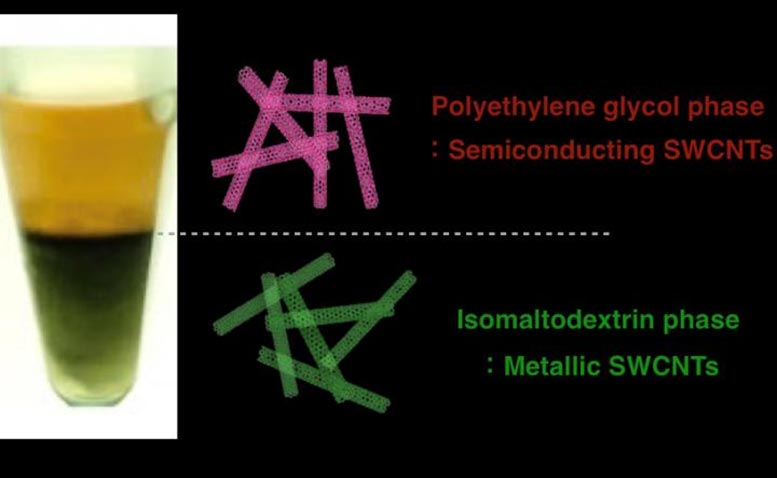
    The unwanted metallic SWCNTs deposited at the bottom of the solution, while the wanted semiconducting ones floated to the top. Credit: Haruka Omachi

    A new, cheaper method easily and effectively separates two types of carbon nanotubes. The process, developed by Nagoya University researchers in Japan, could be up-scaled for manufacturing purified batches of single-wall carbon nanotubes that can be used in high-performance electronic devices. The findings were published in the journal Applied Physics Express.

    Single-wall carbon nanotubes (SWCNTs) have excellent electronic and mechanical properties, making them ideal candidates for use in a wide range of electronic devices, including the thin-film transistors found in LCD displays. A problem is that only two-thirds of manufactured SWCNTs are suitable for use in electronic devices. The useful semiconducting SWCNTs must be separated from the unwanted metallic ones. But the most powerful purification process, known as aqueous two-phase extraction, currently involves the use of a costly polysaccharide, called dextran.

    Organic chemist Haruka Omachi and colleagues at Nagoya University hypothesized that dextran’s effectiveness in separating semiconducting from metallic SWCNTs lies in the linkages connecting its glucose units. Instead of using dextran to separate the two types of SWCNTs, the team tried the significantly cheaper isomaltodextran, which has many more of these linkages.

    A batch of SWCNTs was left for 15 minutes in a solution containing polyethylene glycol and isomaltodextrin and then centrifuged for five minutes. Three different types of isomaltodextrin were tried, each with a different number of linkages and a different molecular weight. The team found that metallic SWCNTs separated to the bottom isomaltodextrin part of the solution, while the semiconducting SWCNTs floated to the top polyethylene glycol part.

    The type of isomaltodextrin with high molecular weight and the most linkages was the most (99%) effective in separating the two types of SWCNTs. The team also found that another polysaccharide, called pullulan, whose glucose units are connected with different kinds of linkages, was ineffective in separating the two types of SWCNTs. The researchers suggest that the number and type of linkages present in isomaltodextrin play an important role in their ability to effectively separate the carbon nanotubes.

    The team also found that a thin-film transistor made with their purified semiconducting SWCNTs performed very well.

    Isomaltodextrin is a cheap and widely available polysaccharide produced from starch that is used as a dietary fiber. This makes it a cost-effective alternative for the SWCNT extraction process. Omachi and his colleagues are currently in discussions with companies to commercialize their approach. They are also working on improving the performance of thin-film transistors using semiconducting SWCNTs in flexible displays and sensor devices.

    ###

    Reference: “Aqueous two-phase extraction of semiconducting single-wall carbon nanotubes with isomaltodextrin and thin-film transistor applications” by Haruka Omachi, Tomohiko Komuro, Kaisei Matsumoto, Minako Nakajima, Hikaru Watanabe, Jun Hirotani, Yutaka Ohno and Hisanori Shinohara, 14 August 2019, pplied Physics Express.
    DOI: https://doi.org/10.7567/1882-0786/ab369e

    Never miss a breakthrough: Join the SciTechDaily newsletter.
    Follow us on Google and Google News.

    Carbon Nanotubes Materials Science Nagoya University Nanotechnology
    Share. Facebook Twitter Pinterest LinkedIn Email Reddit

    Related Articles

    Combining Graphene and TMDC Could Lead to the Next Generation of Solar Cells

    Scientists Control Chirality in Carbon Nanotubes

    PGClear Uses a Palladium-Gold Catalyst to Break Down Hazardous Compounds

    Scientists Produce a Ceramic Paper Consisting of Conductive Nanofibers

    Nanocrystalline Alloys That Meet Operational Requirements

    Hybrid Crystalline/Amorphous Material Capable of Indenting Diamonds

    Microstructures of Plants May Lead to New Bio-Inspired Materials

    Optically Switchable Chiral THz Metamolecules

    Researchers Uncover Why Lithium Iron Phosphate Works So Well

    Leave A Reply Cancel Reply

    • Facebook
    • Twitter
    • Pinterest
    • YouTube

    Don't Miss a Discovery

    Subscribe for the Latest in Science & Tech!

    Trending News

    Scientists Say This Natural Hormone Reverses Obesity by Targeting the Brain

    35-Million-Year-Old Mystery: Strange Arachnid Discovered Preserved in Amber

    Is AI Really Just a Tool? It Could Be Altering How You See Reality

    JWST Reveals a “Forbidden” Planet With a Baffling Composition

    The Protein “Sabotaging” Aging Muscle Recovery Could Be Key to Surviving Aging

    This Diet–Gut Interaction Could Transform Fat Into a Calorie-Burning Machine

    Scientists Discover Hidden Virus Linked to Colorectal Cancer

    Scientists Discover 132-Million-Year-Old Dinosaur Tracks on South Africa’s Coast

    Follow SciTechDaily
    • Facebook
    • Twitter
    • YouTube
    • Pinterest
    • Newsletter
    • RSS
    SciTech News
    • Biology News
    • Chemistry News
    • Earth News
    • Health News
    • Physics News
    • Science News
    • Space News
    • Technology News
    Recent Posts
    • 5 Things Experts Say You’re Getting Wrong About Protein
    • Scientists Create “Optical Tornadoes” That Twist Light Into a Swirling Vortex
    • Scientists Uncover Hidden Superconductivity in Material Once Thought Only Magnetic
    • Scientists Baffled by Bizarre “Living Fossil” From 275 Million Years Ago
    • 500 Million Years Ago, Life Changed Forever: Scientists Reveal the DNA Changes That Helped Animals Move Onto Land
    Copyright © 1998 - 2026 SciTechDaily. All Rights Reserved.
    • Science News
    • About
    • Contact
    • Editorial Board
    • Privacy Policy
    • Terms of Use

    Type above and press Enter to search. Press Esc to cancel.