
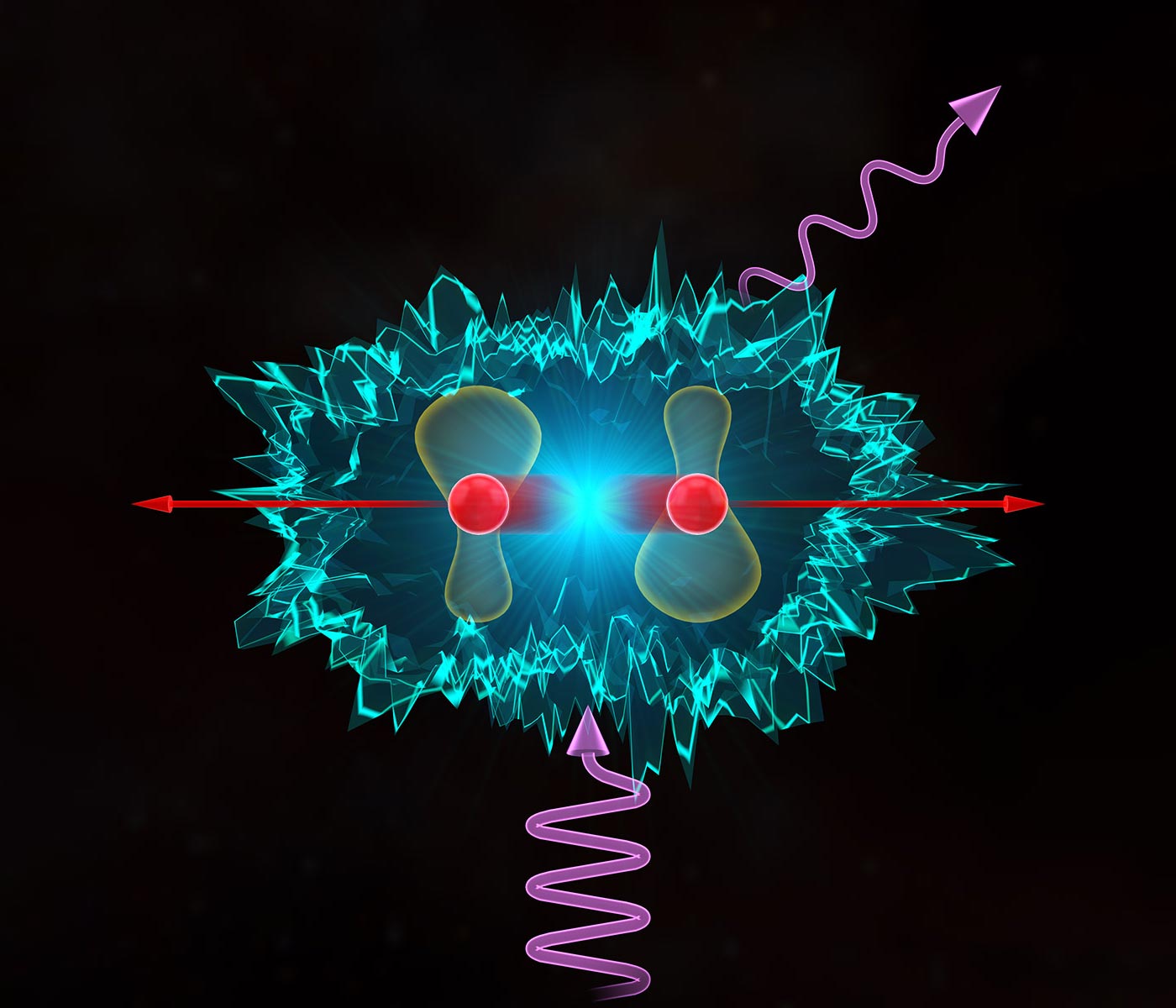
In a groundbreaking study, scientists developed new ways to control atom collisions using optical tweezers, offering insights that could advance quantum computing and molecular science.
By manipulating light frequencies and atomic energy levels, they mapped out how specific atomic characteristics influence collision outcomes, paving the way for more precise quantum manipulation.
Quantum Surprises at Ultra-Cold Temperatures
When atoms collide, their structure—such as the number of electrons they carry or the quantum spin of their nuclei—determines how they interact. This effect becomes even more pronounced at ultra-cold temperatures near absolute zero, where quantum mechanics plays a dominant role. In these extreme conditions, atoms can sometimes collide due to laser light, briefly forming a molecular state before breaking apart and releasing a significant burst of energy. These light-assisted collisions happen rapidly and influence a wide range of quantum science applications, yet the details of how they occur remain poorly understood.
In a new study published in Physical Review Letters, JILA Fellow and University of Colorado Boulder physics professor Cindy Regal, along with former JILA Associate Fellow Jose D’Incao (now at the University of Massachusetts, Boston), and their teams developed innovative experimental and theoretical methods to measure the rates of light-assisted collisions in the presence of small atomic energy splittings. Their research relies on optical tweezers—highly focused laser beams that can trap individual atoms—allowing the team to isolate and examine the interactions of specific atom pairs with unprecedented precision.
By uncovering new insights into these specialized atomic collisions, the researchers are helping to improve control over atomic interactions, a crucial step for advancing quantum simulations that use arrays of atoms and molecules to model complex quantum systems.
Advancements in Optical Tweezer Research
As physicists work to improve control over atoms in optical tweezer experiments, JILA graduate student Steven Pampel, the paper’s first author, wanted to better understand how the rate at which light-assisted collisions occur changes under a range of circumstances. Light can create a wild array of outcomes, depending mostly on its frequency with respect to atomic transitions.
“Light-assisted collisions can generate large amounts of energy compared to what is often tolerated in the world of ultracold atomic gases,” Regal elaborates. “This energy is imparted to the colliding atoms, which can be considered bad as they are large enough to cause atoms to escape from typical traps. But these collisions can also be useful when that energy can be controlled.”
In fact, the Regal group and other groups worldwide have previously used this energy to study how to load atoms into optical tweezers. However, a more comprehensive theoretical understanding of the collision process leading to such energy release was hard to come by, especially when considering atomic hyperfine structure—small energy shifts resulting from the coupling between an atom’s nuclear spin and angular momentum from the atom’s electrons.
The basic model for light-assisted collisions has been understood for decades. In fact, the go-to model was developed by JILA Fellow Allan Gallagher and collaborator Prof. David Pritchard of MIT. But until recently, our understanding of light-assisted collisions came from very large optical traps that contain millions of atoms where the same light that confines the atoms also drives collisions, limiting control over the frequency of the light and information someone could obtain.
Precise Manipulation of Quantum States
To determine how fast the collisions occur, the researchers in Regal’s laboratory began their experiment by preparing exactly two rubidium atoms in an optical tweezer. To accomplish this, the team harnessed a technique where single atoms are loaded into two separate optical tweezers and then the atoms are merged into a single optical trap. After merging, a carefully controlled pulse of laser light was applied to drive collisions between the two atoms.
This collisional laser light excites the atoms, creating a quantum superposition state where either atom could have absorbed a photon, but it is unclear which one. In this state, electronic forces act at much larger distances than they otherwise would and give the atoms such a large amount of kinetic energy that they escape the trap. In this game of “quantum billiard balls,” the photon is like the cue ball that smashes into two other balls (the atoms) simultaneously, sending them flying off the table.
The team then varied the frequency of the collisional light, i.e., the energy of the photon “cue,” and measured how quickly atom-pairs escaped the optical tweezer.
“We set the laser at a certain frequency, then varied the duration of the collisional light to see how many atoms remained in the trap,” Pampel adds. “From this, we could determine how quickly the atoms collided and gained enough energy to escape. By repeating this process at different frequencies, we could map out the influence of hyperfine structure in these collisions.”
This process allowed the researchers to measure the loss rates of the atoms quantitatively and in relation to the hyperfine effects, something that had never been done before.
Breakthrough in Collision Imaging Techniques
During the experiments, the team developed a novel imaging technique to accurately determine if both atoms remained in the trap after a collision. This technique was crucial because standard imaging methods in optical tweezers would inadvertently kick both atoms out of the trap during the collision, making it impossible to tell whether the collisional light or the imaging light kicked out the atoms.
“We came up with a method that uses a special type of light-assisted collisions where only one atom gets kicked out most of the time,” Pampel explains. “This allowed us to identify the presence of two atoms by detecting a single atom. This mechanism is commonly used for loading single atoms in tweezers, but we showed it can be used in a more controlled setting for two-atom detection purposes as well.”
The researchers also developed a theoretical model to understand their experimental results, particularly why setting the light frequency to be close to that of certain hyperfine states resulted in different rates than other hyperfine states.
“Mapping out the potential energy curves for two colliding atoms in the presence of light and the hyperfine interaction required more complex analysis than previous works that had only taken into account the atomic fine structure—the interaction between electron’s spin and angular momentum,” D’Incao says.
“In addition, we built a collisional model that allows us to gain a better understanding of how the many hyperfine-dependent molecular states give rise to collision rates and the amount of energy released,” Pampel adds. This model could also be extended beyond rubidium atoms, helping to predict how other atomic elements might behave in similar situations.
Insights into Quantum Interactions and Future Applications
Beyond shedding new light on a long-standing puzzle, these findings could influence various endeavors with trapped neutral atoms such as quantum computing, metrology, and many-body physics, where controlling atomic collisions is essential for success. The ability to predict how atomic collisions will behave based on their hyperfine structure will likely be useful for advancing laser-cooling techniques, molecular quantum science, and the next generation of quantum-based technologies.
Reference: “Quantifying Light-Assisted Collisions in Optical Tweezers across the Hyperfine Spectrum” by Steven K. Pampel, Matteo Marinelli, Mark O. Brown, José P. D’Incao and Cindy A. Regal, 10 January 2025, Physical Review Letters.
DOI: 10.1103/PhysRevLett.134.013202
This research was supported by the Office of Naval Research, the National Science Foundation, the Department of Energy, the Quantum Systems Accelerator and the Swiss National Science Foundation.
Never miss a breakthrough: Join the SciTechDaily newsletter.
Follow us on Google and Google News.
2 Comments
Quantum Billiards: Cracking the Code of Light-Assisted Atomic Collisions。
GOOD.
Ask the researchers:
1. Is it appropriate for you to understand quantum with billiards?
2. Is Physical Review Lettersit a publication that respects science?
Scientific research guided by correct theories can enable researchers to think more. Can you get an Interpretation of Quantum Theory within the Framework of Topological Vortex Theory (TVT)? (https://scitechdaily.com/microscope-spacecrafts-most-precise-test-of-key-component-of-the-theory-of-general-relativity/#comment-875168).
A topological vortex is a concept in physics that describes the natural gravitational field or the fluid-body coupled system. A topological vortex is formed by the interaction and balance of vortex and anti-vortex field pairs, which can be set into resonance by the body motion and interaction.
Topological Vortex Theory (TVT) treats space as an ideal fluid, posits that the topological vortex gravitational field is fundamental to the structure of the universe, and emphasizes the importance of topological phase transitions in understanding mass, inertia, and energy.
According to the Topological Vortex Theory (TVT), spins create everything, spins shape the world. There are substantial distinctions between Topological Vortex Theory (TVT) and traditional physical theories. Grounded in the inviscid, incompressible, and isotropic spaces, TVT introduces the concept of topological phase transitions and employs topological principles to elucidate the formation and evolution of matter in the universe, as well as the impact of interactions between topological vortices and anti-vortices on spacetime dynamics and thermodynamics.
Within TVT, low-dimensional spacetime matter serves as the foundation for high-dimensional spacetime matter, and the hierarchical structure of matter and its interaction mechanisms challenge conventional macroscopic and microscopic interpretations. The conflict between Quantum Physics and Classical Physics can be attributed to their differing focuses: Quantum Physics emphasizes low-dimensional spacetime matter, whereas Classical Physics centers on high-dimensional spacetime matter.
Subatomic particles in the quantum world often defy the familiar rules of the physical world. The fact repeatedly suggests that the familiar rules of the physical world are pseudoscience. In the familiar rules of the physical world, two sets of cobalt-60 can form the mirror image of each other by rotating in opposite directions, and should receive the Nobel Prize for physics.
Please witness the grand performance of some so-called peer review publications (including PRL, PNAS, Nature, Science, etc.). https://scitechdaily.com/microscope-spacecrafts-most-precise-test-of-key-component-of-the-theory-of-general-relativity/#comment-854286. Some so-called academic publications (including PRL, PNAS, Nature, Science, etc.) are addicted to their own small circles and have deviated from science for a long time.
As the background of various material interactions and movements, space exhibits inviscid, absolutely incompressible and isotropic physical characteristics. It may form various forms of spacetime vortices through topological phase transitions. Hence, vortex phenomena are ubiquitous in cosmic space, from vortices of quantum particles and living cells to tornados and black holes. Stars and radioactive elements are one of the most active topological nodes in spacetime. Utilizing them is more valuable and meaningful than simulating them. Small or micro power topology intelligent batteries may be the direction of future energy research and development for human society.
Under the topological vortex architecture, science and pseudoscience are clear at a glance. Topological Vortex Theory (TVT) can play a crucial role in elucidating the foundations of physics, establishing its principles, and combating pseudoscience. Therefore, TVT has been strongly opposed and boycotted by traditional so-called peer review publications (such as PRL, PNAS, Nature, Science, etc.).
These so-called peer review publications (including PRL, PNAS, Nature, Science, etc.) mislead the direction of science and are known for their various absurdities and wonders. They collude together, reference each other, and use so-called Impact Factor (IF) or the Nobel Prize to deceive people around.
Ask the so-called peer review publications (including PRL, PNAS, Nature, Science, etc.):
1. What are your criteria for distinguishing science from pseudoscience?
2. Is your Impact Factor (IF) the standard for distinguishing science from pseudoscience?
3. Is the Nobel Prize the standard for distinguishing science from pseudoscience?
4. What is the most important aspect of academic publications?
5. Is the most important aspect of academic publications being flashy and impractical articles?
Pseudo academic publications (including PRL, PNAS, Nature, Science, etc.) are neither inclusivity nor openness, nor transparency and fairness, and have already had a serious negative impact on the progress of science and technology. Some so-called peer review publications (including PRL, PNAS, Nature, Science, etc.) are addicted to their own small circle and no longer know what science is. They hardly know what is dirty and ugly.
Publications that mislead the public under the guise of scholarship are more reprehensible than ordinary publications. The field of physics faces an ongoing challenge in maintaining scientific rigor and integrity in the face of pervasive pseudoscientific claims. Fighting against rampant pseudoscience, physics still has a long way to go.
While my comments may be lengthy, they are necessary to combat the proliferation of rampant pseudoscience and to promote the advancement of science and technology, and also is all I can do.
Appreciate the SciTechDaily for its inclusivity, openness, transparency, and fairness. If the researchers are truly interested in cosmic matter, please read: A Brief History of the Evolution of Cosmic Matter (https://scitechdaily.com/microscope-spacecrafts-most-precise-test-of-key-component-of-the-theory-of-general-relativity/#comment-873523).
Topological Vortex Theory (TVT) is based on topology and fluid dynamics, which have solid mathematical and physical foundations. Under the topological vortex architecture, science and pseudoscience are clear at a glance. Topological Vortex Theory (TVT) can play a crucial role in elucidating the foundations of physics, establishing its principles, and combating pseudoscience.
However, some individuals, some AI (https://zhuanlan.zhihu.com/p/23079945169), and some so-called peer review publications (including PRL, PNAS, Nature, Science, etc.) stubbornly believe that two sets of cobalt-60 can form the mirror image of each other by rotating in opposite directions (https://scitechdaily.com/microscope-spacecrafts-most-precise-test-of-key-component-of-the-theory-of-general-relativity/#comment-854286), and stubbornly believe that the Topological Vortex Theory (TVT) currently lacks validation. This is because they have been misled by pseudoscientific information.
Vortex phenomena are ubiquitous in cosmic space, from vortices of quantum particles and living cells to tornados and black holes. The inviscid and incompressible spaces have been widely used in engineering simulation (https://scitechdaily.com/microscope-spacecrafts-most-precise-test-of-key-component-of-the-theory-of-general-relativity/#comment-870077). These all are the most powerful verification and validation.
Ask some so-called peer review publications (including PRL, PNAS, Nature, Science, etc.) again:
1. Does space not exist?
2. Does time not exist?
3. Does the ideal fluid not exist?
4. Do scientific experiments require time and space?
5. Do certain engineering simulations require ideal fluids?
6. If non-existent things are applied to scientific experiments and engineering simulations, and good results can be achieved. So, what is the difference between the non-existent thing and God?
Some individuals and some so-called peer review publications (including PRL, PNAS, Nature, Science, etc.) have been misleading the public with confusing concepts (https://pic2.zhimg.com/v2-4127b0b58fe8b88feb27c189fb705029_1440w.jpg?source=172ae18b), unscientific logic and reasoning, and self righteous Impact Factor (IF), hindering the progress of science and technology.
Fighting against rampant pseudoscience, physics still has a long way to go.