
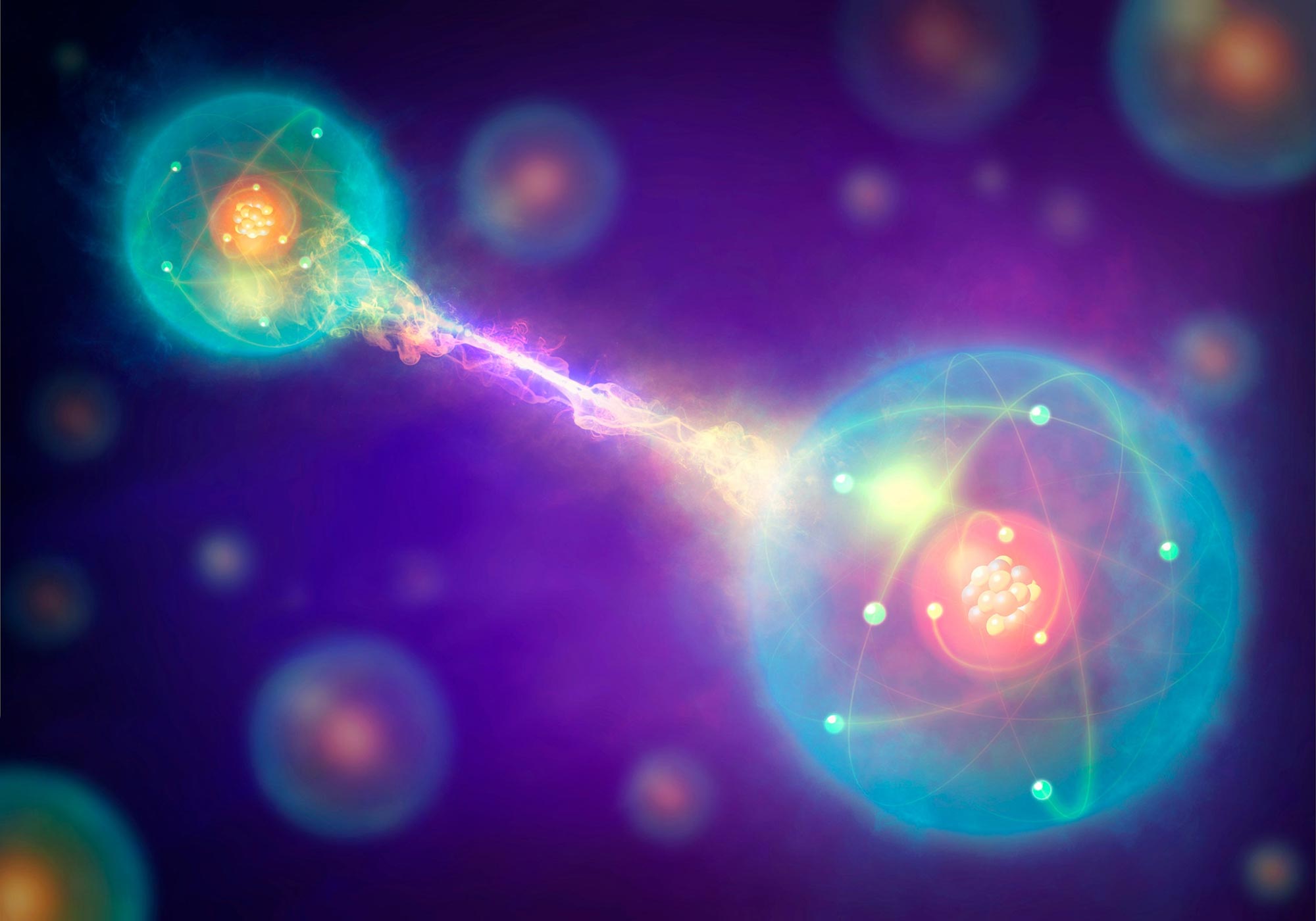
A new study suggests that some of the most counterintuitive features of quantum physics may not need to be engineered at all.
At the most fundamental level of physics, nature does not behave locally. Particles separated by vast distances can act not as independent objects, but as components of a single quantum system. Researchers in Poland have now demonstrated that this kind of nonlocal behavior, which stems from the simple fact that particles of the same type are indistinguishable, can be observed experimentally for nearly all possible states of identical particles.
According to quantum mechanics, every particle of a given type, such as photons or electrons, is inherently entangled with every other particle of that same type, whether it is nearby or located in a distant galaxy. This counterintuitive idea follows directly from a core principle of the theory: particles of the same type are fundamentally identical.
This suggests the existence of a universal source of entanglement that underlies the strange nonlocal properties of the quantum world. It also raises a deeper question of whether this resource can be accessed or tested, despite the strict limits imposed by quantum theory.
Two theorists from the Institute of Nuclear Physics of the Polish Academy of Sciences (IFJ PAN) in Cracow and the Institute of Theoretical and Applied Informatics of the Polish Academy of Sciences (IITiS PAN) in Gliwice have now addressed these questions. Their results, published in npj Quantum Information (Nature Publishing Group), show that the identity of particles alone can give rise to experimentally detectable quantum nonlocality.
Identity turns the universe nonlocal
To reach this conclusion, the researchers examined the most basic form of entanglement between identical particles using the concept of nonlocality introduced by physicist John Bell. While entanglement is a central idea in quantum theory, the notion of locality is more familiar and intuitive.
It reflects the everyday expectation that causes and effects spread through space at a limited speed, never exceeding the speed of light. When no such explanation can account for observed correlations, the phenomenon is described as nonlocal. This distinction lies at the heart of Bell’s work, in which he proposed experiments that cannot be explained by any local theory. These experiments rely on entangled systems shared between two distant observers, traditionally called Alice and Bob, who can each perform independent measurements on their respective systems.
“At first glance, the problem seems simple: entangled systems violate Bell’s inequalities, so all you need to do is perform a well-designed experiment. Indeed, but this applies only to distinguishable systems that can be labelled and sent to two distant laboratories. With identical particles, this framework breaks down,” says Dr. Pawel Blasiak (IFJ PAN), and goes on to explain: “Quantum mechanics is clear: identical particles are indistinguishable by their very nature. In practice, we do not measure ‘this particular’ particle, but ‘some’ particle at a given location. Quantum physics consistently resists any attempt to assign them individual labels — and that is precisely why the classical Bell scenario cannot be applied here.”
Dr. Marcin Markiewicz (IITiS PAN), co-author of the article, clarifies: “This seemingly subtle difference introduces new ground rules for describing the world: it requires the symmetrization or antisymmetrization of the wave function in systems with multiple particles. It is precisely the principle of particle identity that leads to the division into fermions and bosons — two worlds that underpin the structure of atoms and their nuclei, and determine the nature of interactions. Indistinguishability also blurs the very concept of entanglement: in the case of identical particles, it no longer behaves as we are used to — and loses some of its practical meaning. This is where the real challenge lies in addressing the question of nonlocality arising from the fundamental indistinguishability of particles.”
Why standard entanglement tests break down
Contemporary experiments on entanglement typically involve its artificial creation through interactions between particles within a quantum system. Yet quantum mechanics also points to another, more fundamental mechanism: entanglement — and perhaps nonlocality itself — may arise directly from the identical nature of particles of the same type. From this perspective, nonlocality could even manifest between particles that have never interacted with one another before.
It is this primordial form of nonlocality that captured the interest of physicists from the IFJ PAN and the IITiS PAN. They set out to determine whether it could be demonstrated in experiments composed solely of simple, passive linear optical elements: mirrors, beam splitters, and particle detectors. Such systems can be arranged so that the propagating particles never meet at any point. Yet if Bell’s inequalities could still be violated under these conditions, it would imply that the observed nonlocality is not a by-product of experimental interactions, but a manifestation of something truly fundamental.
Revealing nonlocality without interaction
The researchers posed a simple yet remarkably general question: for which quantum states of identical particles can one identify a classical optical system in which nonlocal correlations become manifest? The challenge lies in the fact that both the number of possible optical configurations and the diversity of identical-particle states appear virtually limitless.
The scientists managed to tame this complexity using an arsenal of sophisticated tools: the Yurke-Stoler interferometer, clever post-selection, the concept of ‘quantum erasure’, mathematical induction, and extensive experience in constructing hidden-variable models.
In their article, the Polish theorists presented a criterion that enables the clear identification of nonlocality for any state containing a fixed number of identical particles.
The conclusions are surprising: all fermionic states and almost all bosonic states turn out to be nonlocal resources (in the latter case, except for a narrow class of so-called states reducible to a single mode). Notably, the proof is entirely constructive: it demonstrates, step by step, how to design optical experiments that reveal the nonlocality of the state under investigation.
Almost all identical particles are nonlocal
“Our research reveals that the very indistinguishability of particles hides a source of entanglement we can access. Could nonlocality, then, be woven into the fabric of the Universe itself? Everything seems to suggest that this is indeed the case, with the source of this extraordinary property lying in the seemingly simple postulate of the identical nature of particles of the same type,” concludes Dr. Blasiak, whose research was co-funded by a Fulbright Senior Award (2022-23) at the Institute for Quantum Studies (IQS), Chapman University, California.
As always, much remains to be understood, and questions about the nature of reality and the interpretation of quantum mechanics gain new resonance.
Physicists Charles W. Misner, John A. Wheeler, and future Nobel laureate Kip S. Thorne expressed this insight eloquently in their 1973 book Gravitation: “No acceptable explanation for the miraculous identity of particles of the same type has ever been put forward. That identity must be regarded, not as a triviality, but as a central mystery of physics.”
This enduring puzzle will likely continue to inspire researchers for many decades to come.
Reference: “Identical particles as a genuine non-local resource” by Pawel Blasiak, and Marcin Markiewicz, 5 November 2025, npj Quantum Information.
DOI: 10.1038/s41534-025-01086-x
PB acknowledges support from the Polish-U.S. Fulbright Commission.
Never miss a breakthrough: Join the SciTechDaily newsletter.
Follow us on Google and Google News.
12 Comments
This enduring puzzle will likely continue to inspire researchers for many decades to come.
WHY?
Puzzles based on pseudoscience.
Ignoring pseudoscience will only make so-called science more hypocritical and contemptible.
The value of scientific theory lies in revealing truth rather than maintaining dogma. In today’s physics, some so-called peer-reviewed publications — including the Proceedings of the National Academy of Sciences, Physical Review Letters, Science, Nature, and others—stubbornly insist on and promote the following:
1. Even though θ and τ particles exhibit differences in experiments, physics can claim they are the same particle. This is science.
2. Even though topological vortices and antivortices have identical structures and opposite rotational directions, physics can define their structures and directions as entirely different. This is science.
3. Even though two sets of cobalt-60 rotate in opposite directions and experiments reveal asymmetry, physics can still define them as mirror images of each other. This is science.
4. Even though vortex structures are ubiquitous—from cosmic accretion disks to particle spins—physics must insist that vortex structures do not exist and require verification. Only the particles that like God, Demonic, or Angelic are the most fundamental structures of the universe. This is science.
5. Even though everything occupies space and maintains its existence in time, physics must still debate and insist on whether space exists and whether time is a figment of the human mind. This is science.
6. Even though space, with its non-stick, incompressible, and isotropic characteristics, provides a solid foundation for the development of physics, physics must still insist that the ideal fluid properties of space do not exist. This is science.
and so on.
Contemporary physics and so-called peer-reviewed publications (including the Proceedings of the National Academy of Sciences, Physical Review Letters, Science, Nature, Science Bulletin, etc.) stubbornly believe that two sets of counter rotating cobalt-60 are two mirror images of each other, constructing a more shocking pseudoscientific theoretical framework in the history of science than the “geocentric model”. This pseudo scientific framework and system have seriously hindered scientific progress and social development.
These guys and the so-called peer-reviewed publications they manipulate no longer know what shame is:
Example 1
Two sets of cobalt-60 are manually rotated in opposite directions, and even without detection, people around the world know that they will not be symmetrical because these two objects are not mirror images of each other at all. However, a group of so-called physicists and so-called academic publications do not believe it. They conducted experiments and the results were indeed asymmetric, but they still firmly believed that these two objects were mirror images of each other, and the asymmetry was due to a violation of the previous natural laws (CP violation). In the history of science, there can never be a dirtier and uglier operation and explanation than this.
—— Excerpted from https://scitechdaily.com/what-happens-when-light-gains-extra-dimensions/#comment-947619.
Example 2
Please see how the so-called “mystery of θ – τ” is explained: θ and τ are completely identical in all measurable physical properties such as mass, lifetime, charge, spin, etc. However, experimental observations have shown that the θ meson decays into two π mesons, while the τ meson decays into three π mesons, making it difficult for physicists to explain why they are so similar. Physicist Martin Block proposed a highly challenging idea: θ and τ are the same particle, but in weak interactions, parity is not conserved. An easy to understand explanation is the following analogy:: There are two boxes of apples with identical weight, color, and taste. However, when one box is opened, there are two apples, while when the other box is opened, there are three apples. This confuses the old farmer who buys apples. He circled around the orchard and came up with a highly challenging idea: these two boxes of apples are not from the same tree, so they are the same.
—— Excerpted from https://scitechdaily.com/what-happens-when-light-gains-extra-dimensions/#comment-947686.
Any so-called evidence tainted by human intervention risks distorting our understanding and cognition of the intrinsic dynamics of natural laws.
—— Excerpted from https://zhuanlan.zhihu.com/p/1996561896279667777.
I love how, after every article about some cutting-edge scientific theory or another, there’s always one commenter who “knows” it’s all nonsense and can “prove” it.
Shame nobody ever thinks to ask them before embarking on all that science.
Absolute cinema.
The guy makes some wild claims. haha
VERY GOOD!
Example 1
Two sets of cobalt-60 are manually rotated in opposite directions, and even without detection, people around the world know that they will not be symmetrical because these two objects are not mirror images of each other at all. However, a group of so-called physicists and so-called academic publications do not believe it. They conducted experiments and the results were indeed asymmetric, but they still firmly believed that these two objects were mirror images of each other, and the asymmetry was due to a violation of the previous natural laws (CP violation). In the history of science, there can never be a dirtier and uglier operation and explanation than this.
—— Excerpted from https://scitechdaily.com/what-happens-when-light-gains-extra-dimensions/#comment-947619.
Example 2
Please see how the so-called “mystery of θ – τ” is explained: θ and τ are completely identical in all measurable physical properties such as mass, lifetime, charge, spin, etc. However, experimental observations have shown that the θ meson decays into two π mesons, while the τ meson decays into three π mesons, making it difficult for physicists to explain why they are so similar. Physicist Martin Block proposed a highly challenging idea: θ and τ are the same particle, but in weak interactions, parity is not conserved. An easy to understand explanation is the following analogy:: There are two boxes of apples with identical weight, color, and taste. However, when one box is opened, there are two apples, while when the other box is opened, there are three apples. This confuses the old farmer who buys apples. He circled around the orchard and came up with a highly challenging idea: these two boxes of apples are not from the same tree, so they are the same.
—— Excerpted from https://scitechdaily.com/what-happens-when-light-gains-extra-dimensions/#comment-947686.
Science should place greater value on observing phenomena in their natural state, understanding laws from a holistic, self-organizing perspective. Artificial evidence must be grounded in nature, avoiding the direct equating of phenomena under extreme conditions with nature’s essence. Only in this way can humanity move closer to the profound and self-consistent truth of nature.
—— Excerpted from https://zhuanlan.zhihu.com/p/2002360899126724079.
Excellent posts. Hell, I’m still calculating the BIG BANG THEORY!!! 😅🤣
Repeating your stupidity doesn’t magically make it come true, Xiao Bao.
Thank you for browsing and commenting.
Physics needs more people who care about physics and science, rather than so-called peer-reviewed publications — including the Proceedings of the National Academy of Sciences, Physical Review Letters, Science, Nature, and others — their imitators (small followers) — such as Science Bulletin, etc.
Hahaha… because your so-called “theories” get laughed at by real physicists. Wallow in your persecution complex, Neinstein.
Thank you for browsing and commenting.