
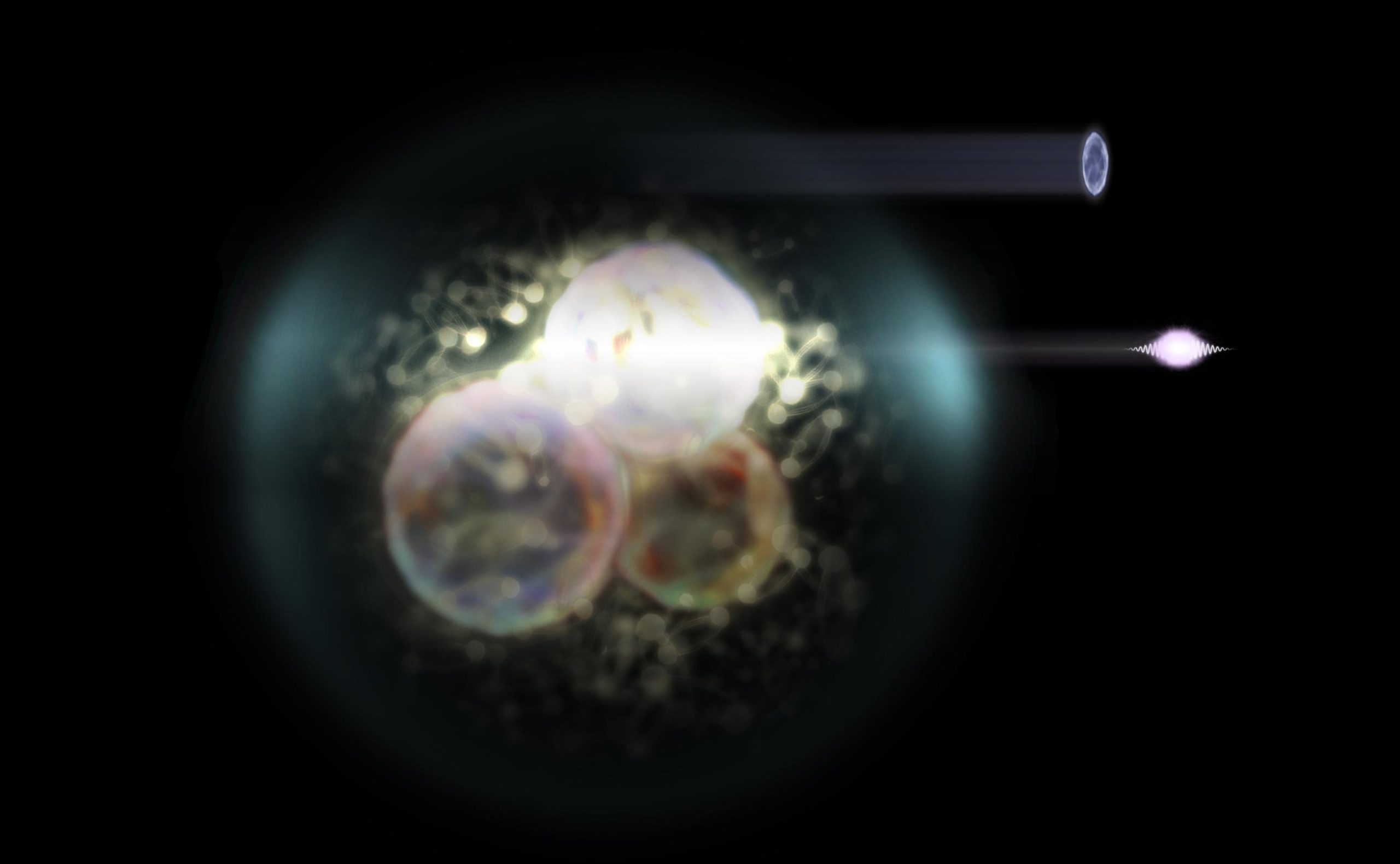
Protons are far from simple particles — they are swirling cauldrons of quarks, gluons, and quantum entanglement.
Scientists have used this entanglement to develop a universal model explaining how particles emerge from high-energy collisions. Their predictions align with past experimental data, and future colliders will put their theory to the ultimate test, possibly reshaping our understanding of nuclear physics.
Peering Inside the Proton
The inside of a proton is one of the most dynamic yet elusive realms in physics. Within this tiny particle, quarks and gluons interact in a constantly shifting sea of virtual particles. Now, using quantum information theory and the concept of quantum entanglement, scientists have developed a new framework to describe these interactions with unprecedented clarity.
For the first time, this approach successfully explains data from all available experiments involving the scattering of secondary particles in deep inelastic collisions between electrons and protons. The breakthrough comes from an international team of theorists from Brookhaven National Laboratory (BNL) and Stony Brook University (SBU) in New York, Universidad de las Américas Puebla (UDLAP) in Mexico, and the Institute of Nuclear Physics of the Polish Academy of Sciences (IFJ PAN) in Cracow.
How Do We Study the Proton’s Interior?
“If we want to learn about the phenomena taking place inside a proton, we first have to get there somehow. At present, collisions between protons and electrons are the best way to do this, because the latter are not only much smaller in size than protons, but, above all, they are elementary particles, so we have a guarantee that they themselves will not decay into anything else,” says Prof. Krzysztof Kutak (IFJ PAN), one of the authors of the article published in Reports on Progress in Physics.
A Sea of Quarks and Gluons
The proton is not an elementary particle. In the simplest terms, it is assumed to consist of three valence quarks (two up and one down) ‘stuck together’ by means of gluons, i.e. particles carrying strong interactions. These interactions are so powerful that, inside the proton, pairs of virtual quarks and anti-quarks (even as massive as charm) and pairs of virtual gluons (which is possible because these particles are antiparticles to each other) constantly appear and disappear.
Quantum Entanglement in the Proton
In the research described here, the key assumption was that, despite the extremely small size of the proton, the quarks and gluons that make it up – collectively called partons – are quantum entangled. We speak of entanglement between quantum objects when the values of a feature of one object react to its changes in another object, despite the fact that the information about the change has not had time to be transmitted between them by any carrier transported through space.
“In the case of the interior of the proton, entanglement occurs at difficult-to-imagine distances of one quadrillionth of a meter or less and is a collective feature. As we have shown in our earlier publications, it affects not a few, but all partons in the proton,” says Prof. Martin Hentschinski (UDLAP).
The Role of High-Energy Collisions
When, in an attempt to explore the maximally entangled interior of a proton, an electron strikes it, an electromagnetic interaction occurs between the two particles, the carrier of which is a photon. In deeply inelastic collisions, the energy of the exchanged photon is so high that the associated electromagnetic wave begins to ‘fit’ inside the proton and ‘see’ details of its internal structure.
As a result of the interaction with the photon, the proton can then decay producing numerous secondary particles. Entanglement will manifest itself here in the fact that the number of secondary particles emitted from the part of the proton ‘noticed’ by the photon will determine the number of particles that will be produced as observed hadrons.
Measuring Entanglement with Entropy
“This is how we arrive at the concept of entropy, which is particularly important in the study of highly complex systems and in quantum information. If, thanks to deeply inelastic collisions, we had access to the full entanglement information in the proton, we could speak of an entanglement entropy of zero.
However, a photon penetrating the inside of a proton ‘sees’ only part of the proton’s interior, the rest remains hidden to it – and this means that the entanglement entropy is nonzero. We therefore have a convenient measure of the amount of entanglement in the proton,” explains Prof. Dmitri Kharzeev (SBU, BNL).
Experimental Confirmation and Data Analysis
In the paper in question, the international team of physicists proved that based on entanglement entropy, the entropy of hadrons produced in an electron-proton collision can be predicted. As a result, the maximal entanglement of quarks and gluons in a proton manifests itself in the impossibility of determining how many particles will be produced in a particular collision. These predictions have now been verified for all variants of the measurements carried out in 2006-2007 in the H1 experiment at the HERA particle accelerator at the DESY center in Hamburg, where single protons collided with positrons, the antiparticles of electrons.
“We have been working on entanglement inside the proton for several years now. While we verified our previous theoretical work by confronting measurements from specific measurement sessions, we have now managed to describe all the experimental deep inelastic scattering entropy data within a single universal formalism,” emphasizes Dr. Zhoudunming Tu (BNL).
Future Colliders and New Discoveries
The team of physicists involved in the project anticipates that it is the generalized formalism that will enable easier and more accurate interpretation of measurements from future colliders, such as the Electron-Ion Collider (EIC), which will be launched at Brookhaven Laboratory early next decade. Here, electrons will collide not only with individual protons, but with ions. Combined with new experimental data, the proposed theoretical approach should then help to unravel important problems in modern nuclear physics.
A New Path in Nuclear Physics
“Today, we have a strong indication that our new formalism taking entanglement entropy into account is not randomly correlated with some particular way of measuring nuclear phenomena, but has a real ability to explain the nature of observed events. We are convinced that by studying entanglement entropy, we will be able to better understand how strong interactions bind quarks and gluons in protons or answer the question of how belonging to a larger atomic nucleus affects the properties of a single proton,” concludes Prof. Kutak.
Reference: “QCD evolution of entanglement entropy” by Martin Hentschinski, Dmitri E Kharzeev, Krzysztof Kutak and Zhoudunming Tu, 2 December 2024, Reports on Progress in Physics.
DOI: 10.1088/1361-6633/ad910b
Never miss a breakthrough: Join the SciTechDaily newsletter.
Follow us on Google and Google News.
15 Comments
Physicists Uncover a Hidden Quantum World Inside the Proton – And It’s Wilder Than We Thought。
VERY GOOD!
Ask the physicists:
1. What is the relationship between the proton and the quantum world?
2. How do you understand the particle physics and the quantum physics?
Scientific research guided by correct theories can enable researchers to think more.
According to the Topological Vortex Theory (TVT), spins create everything, spins shape the world. There are substantial distinctions between Topological Vortex Theory (TVT) and traditional physical theories. Grounded in the inviscid and absolutely incompressible spaces, TVT introduces the concept of topological phase transitions and employs topological principles to elucidate the formation and evolution of matter in the universe, as well as the impact of interactions between topological vortices and anti-vortices on spacetime dynamics and thermodynamics.
Within TVT, low-dimensional spacetime matter serves as the foundation for high-dimensional spacetime matter, and the hierarchical structure of matter and its interaction mechanisms challenge conventional macroscopic and microscopic interpretations. The conflict between Quantum Physics and Classical Physics can be attributed to their differing focuses: Quantum Physics emphasizes low-dimensional spacetime matter, whereas Classical Physics centers on high-dimensional spacetime matter.
Subatomic particles in the quantum world often defy the familiar rules of the physical world. The fact repeatedly suggests that the familiar rules of the physical world are pseudoscience. In the familiar rules of the physical world, two sets of cobalt-60 can form the mirror image of each other by rotating in opposite directions, and should receive the Nobel Prize for physics.
Please witness the grand performance of some so-called peer review publications (including PRL, PNAS, Nature, Science, etc.). https://scitechdaily.com/microscope-spacecrafts-most-precise-test-of-key-component-of-the-theory-of-general-relativity/#comment-854286. Some so-called academic publications (including PRL, PNAS, Nature, Science, etc.) are addicted to their own small circles and have deviated from science for a long time.
As the background of various material interactions and movements, space exhibits isotropic physical characteristics. It may form various forms of spacetime vortices through topological phase transitions. Hence, vortex phenomena are ubiquitous in cosmic space, from vortices of quantum particles and living cells to tornados and black holes. Stars and radioactive elements are one of the most active topological nodes in spacetime. Utilizing them is more valuable and meaningful than simulating them. Small or micro power topology intelligent batteries may be the direction of future energy research and development for human society.
Under the topological vortex architecture, science and pseudoscience are clear at a glance. Topological Vortex Theory (TVT) can play a crucial role in elucidating the foundations of physics, establishing its principles, and combating pseudoscience. Therefore, TVT has been strongly opposed and boycotted by traditional so-called peer review publications (such as PRL, PNAS, Nature, Science, etc.).
These so-called peer review publications (including PRL, PNAS, Nature, Science, etc.) mislead the direction of science and are known for their various absurdities and wonders. They collude together, reference each other, and use so-called Impact Factor (IF) or the Nobel Prize to deceive people around.
Ask the so-called peer review publications (including PRL, PNAS, Nature, Science, etc.):
1. What are your criteria for distinguishing science from pseudoscience?
2. Is your Impact Factor (IF) the standard for distinguishing science from pseudoscience?
3. Is the Nobel Prize the standard for distinguishing science from pseudoscience?
4. What is the most important aspect of academic publications?
5. Is the most important aspect of academic publications being flashy and impractical articles?
Pseudo academic publications (including PRL, PNAS, Nature, Science, etc.) are neither inclusivity nor openness, nor transparency and fairness, and have already had a serious negative impact on the progress of science and technology. Some so-called peer review publications (including PRL, PNAS, Nature, Science, etc.) are addicted to their own small circle and no longer know what science is. They hardly know what is dirty and ugly.
Publications that mislead the public under the guise of scholarship are more reprehensible than ordinary publications. The field of physics faces an ongoing challenge in maintaining scientific rigor and integrity in the face of pervasive pseudoscientific claims. Fighting against rampant pseudoscience, physics still has a long way to go.
While my comments may be lengthy, they are necessary to combat the proliferation of rampant pseudoscience and to promote the advancement of science and technology, and also is all I can do.
Appreciate the SciTechDaily for its inclusivity, openness, transparency, and fairness. If the researchers are truly interested in science, please read: The Application of Inviscid and Absolutely Incompressible Spaces in Engineering Simulation (https://scitechdaily.com/microscope-spacecrafts-most-precise-test-of-key-component-of-the-theory-of-general-relativity/#comment-870077).
I truly absorb every column I receive from scitechdaily.com. Has educated and changed my thoughts on many topics. You do a excellent job with explaining the unexplainable. “Cheers”-Matt Plourde
Thank you very much for your understanding!
To fight against rampant pseudoscience, we need more upright and honest scholars like you.
So essentially what this article describes is science has no explanation for what actually occurs at the fundamental levels. Therefore, time and time again, they release new theories in which accounts for the misconceptions of the previous. It’s fun to watch mainstream at its best. There are those who by all means avoid it, and those who don’t believe it themselves yet it’s the best framework atm, then those who are adamantly opposed to accepting what these “big heads” say.
I can’t connect all the dots but i don’t need to. As above so below is enough for me. We the micro can’t possibly know. Perhaps until our energy is discharged at “death” and we become a part of the macro.
Thank you for browsing.
If you always think about things from a micro and macro perspective, you may deviate from mathematics. Mathematics is the language of science, and this should not be doubted.
Enjoy your every day.
In the statement “electrons are not only smaller than protons but they are also elementary” electrons do not have a size that we can compare with proton size. The size of the proton is the size of it’s wave function in quark-quark relative coordinates as the size of an hydrogen atom is the extend of the proton-electron bound ground state. Electron does not have a size. Ultimately all really elementary particles like leptons and quarks are not particles at all. They are excitations of the field. The observed particle like behavior is the result of an interaction related localization effect.
It’s like an Island with beach mini proton people having parties for sure 🕺🏝️
As a non-scientist nobody, this still excites (ha) from a purely entertainment perspective, after a certain hard sci-fi series 40 years go which featured an “anti-proton gun” weapon which did exactly the damage the writers intended. That concept always amused me as being both clever and ridiculous at the same time.
Nothing has changed that. But it turns out there is a lot more to protons, and, presumably, anti-protons as well, than even those writers could have imagined.
How do I protect myself from your mistake when it’s gonna happen.your experimenting with unknown possibilities.may I ask what safety measures do people take smashing together DANGER are you scared.?what’s the most important reason to do this ,? You must think or plan that things can’t get into wrong hands right?!!?
What danger do you for see coming from this?
Awww, it’s so cute watching scientists observing how smaller and smaller particles interact. I can’t wait till they split a quark and lose their minds lol.
VERY GOOD!
If the scientists always think about things from a micro or macro perspective, they may deviate from mathematics. Mathematics is the language of science, and this should not be doubted.
Enjoy your every day.
> “We speak of entanglement between quantum objects when the values of a feature of one object react to its changes in another object, despite the fact that the information about the change has not had time to be transmitted between them by any carrier transported through space.“
No, entanglement is NOT a “reaction”. That is a common misconception.
Instead, the two objects are parts of *one* quantum-mechanical system – described by *one* wavefunction that does not allow each of them to have states independent of the state of the other object. We say that these states are “not separable”.
Thus, when we know the geberal form of the wavefunction, and measure/observe the state of one object to be say, state 1, and per the wavefunction the other object can then only be in state 2, and vice-versa, we also know that the other object must be in state 2 (*without* observing it directly).
*That* is why no transfer of information is required: The information is already *there*, encoded in the *composite* wavefunction.
For example, if the composite wavefunction/entangled state is
|Ψ⟩ = 1/√2 [|1⟩₁ |2⟩₂ − |2⟩₁ |1⟩₂],
then the only posssible outcomes are either |1⟩₁ |2⟩₂ or |2⟩₁ |1⟩₂, where the subscript indicates the index of object that is in that state. [The index is chosen here for explanation only. All the other properties of the two objects can be identical, thus they would be indistinguishable. Generally we can only speak of “one” and “the other”, not “one” and “two”.]
HTH
(In this example, each of the two possible combinations must occur with a probability of 50 %.)
VERY GOOD.
The universe is not algebra, formulas, or fractions. The universe is the superposition, deflection, and entanglement of geometric shapes, is the interaction and balance of countless spacetime vortices and their fractal structures, and is the synchronous effect based on topological phase transitions in space. For each vortex, there is a 50% chance that you will see it rotate left or right.