
Breakthrough in Quantum Turbulence
A group of researchers has demonstrated the dissipation of energy in quantum turbulence, providing insights into turbulence across various scales, ranging from microscopic to planetary.
Lancaster University’s Dr. Samuli Autti collaborated with Aalto University researchers on a recent study investigating quantum wave turbulence.
The team’s findings, published in Nature Physics, demonstrate a new understanding of how wave-like motion transfers energy from macroscopic to microscopic length scales, and their results confirm a theoretical prediction about how the energy is dissipated at small scales.
Dr. Autti said: “This discovery will become a cornerstone of the physics of large quantum systems.”
Granularity in Quantum Turbulence
Quantum turbulence at large scales – such as turbulence around moving airplanes or ships – is difficult to simulate. At small scales, quantum turbulence is different from classical turbulence because the turbulent flow of a quantum fluid is confined around line-like flow centers called vortices and can only take certain, quantized values.
This granularity makes quantum turbulence significantly easier to capture in a theory, and it is generally believed that mastering quantum turbulence will help physicists understand classical turbulence too.
In the future, an improved understanding of turbulence beginning on the quantum level could allow for improved engineering in domains where the flow and behavior of fluids and gases like water and air is a key question.
Lead author Dr. Jere Mäkinen from Aalto University said: “Our research with the basic building blocks of turbulence might help point the way to a better understanding of interactions between different length scales in turbulence.
“Understanding that in classical fluids will help us do things like improve the aerodynamics of vehicles, predict the weather with better accuracy, or control water flow in pipes. There is a huge number of potential real-world uses for understanding macroscopic turbulence.”
Dr. Autti said quantum turbulence was a challenging problem for scientists.
“In experiments, the formation of quantum turbulence around a single vortex has remained elusive for decades despite an entire field of physicists working on quantum turbulence trying to find it. This includes people working on superfluids and quantum gases such as atomic Bose-Einstein Condensates (BEC). The theorized mechanism behind this process is known as the Kelvin wave cascade.
“In the present manuscript, we show that this mechanism exists and works as theoretically anticipated. This discovery will become a cornerstone of the physics or large quantum systems.”
The Role of Kelvin Waves
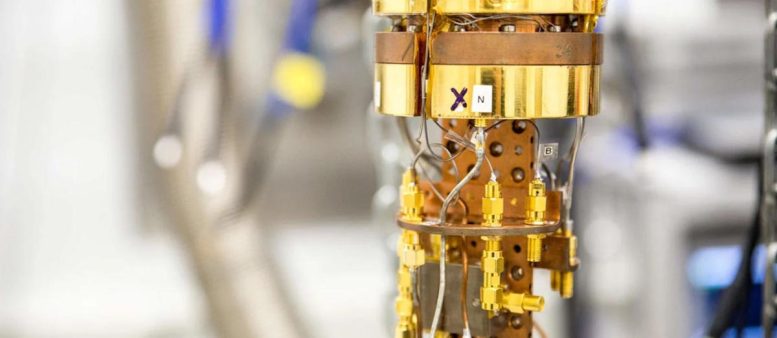
The team of researchers, led by Senior Scientist Vladimir Eltsov, studied turbulence in the Helium-3 isotope in a unique, rotating ultra-low temperature refrigerator in the Low Temperature Laboratory at Aalto. They found that at microscopic scales so-called Kelvin waves act on individual vortices by continually pushing energy to smaller and smaller scales – ultimately leading to the scale at which dissipation of energy takes place.
Dr. Jere Mäkinen from Aalto University said: “The question of how energy disappears from quantized vortices at ultra-low temperatures has been crucial in the study of quantum turbulence. Our experimental set-up is the first time that the theoretical model of Kelvin waves transferring energy to the dissipative length scales has been demonstrated in the real world.”
The team’s next challenge is to manipulate a single quantized vortex using nano-scale devices submerged in superfluids.
Reference: “Rotating quantum wave turbulence” by J. T. Mäkinen, S. Autti, P. J. Heikkinen, J. J. Hosio, R. Hänninen, V. S. L’vov, P. M. Walmsley, V. V. Zavjalov and V. B. Eltsov, 2 March 2023, Nature Physics.
DOI: 10.1038/s41567-023-01966-z
Never miss a breakthrough: Join the SciTechDaily newsletter.
Follow us on Google and Google News.
1 Comment
According to the topological vortex gravitational field theory,the interaction and balance between topological vortex fields, covering all long-distance and short-range contributions of space-time motion, and is the basis for the formation and evolution of cosmic matter.