
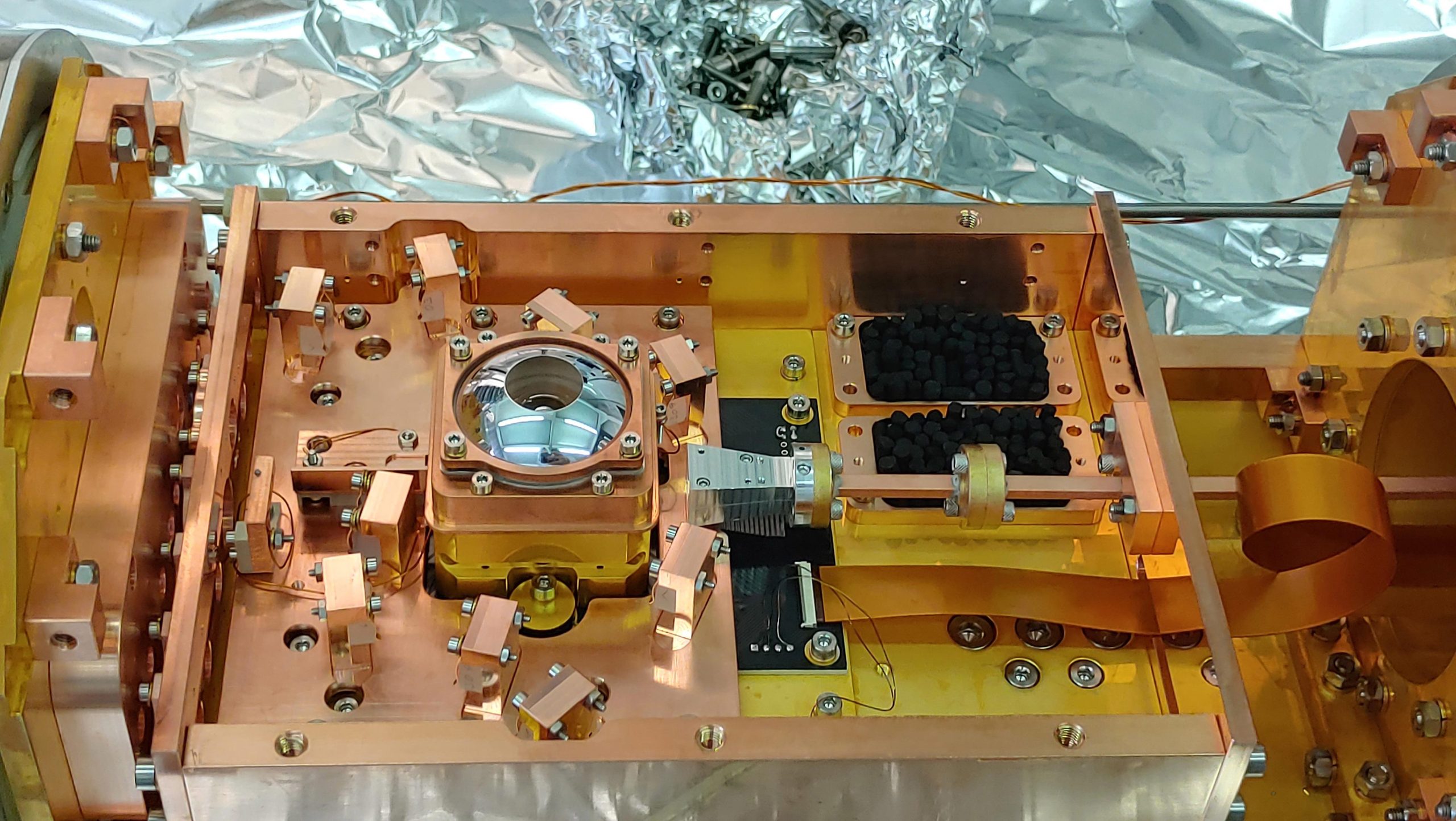
Researchers at ETH have managed to trap ions using static electric and magnetic fields and to perform quantum operations on them. In the future, such traps could be used to realize quantum computers with far more quantum bits than have been possible up to now.
- Using an oscillating electromagnetic field in ion traps limits the currently achievable number of qubits in quantum computers.
- Researchers at ETH have now created an ion trap on a microfabricated chip using only static fields – an electric field and a magnetic field – in which quantum operations can be performed.
- In this trap, the ions can be transported in arbitrary directions, and several such traps fit onto a single chip.
The energy states of electrons in an atom follow the laws of quantum mechanics: they are not continuously distributed but restricted to certain well-defined values – this is also called quantization. Such quantized states are the basis for quantum bits (qubits), with which scientists want to build extremely powerful quantum computers. To that end, the atoms have to be cooled down and trapped in one place.
Strong trapping can be achieved by ionizing the atoms, which means giving them an electric charge. However, a fundamental law of electromagnetism states that electric fields that are constant in time cannot trap a single charged particle. By adding an oscillating electromagnetic field, on the other hand, one obtains a stable ion trap, also known as a Paul trap.
In this way, it has been possible in recent years to build quantum computers with ion traps containing around 30 qubits. Much larger quantum computers, however, cannot straightforwardly be realized with this technique. The oscillating fields make it difficult to combine several such traps on a single chip, and using them heats up the trap – a more significant problem as systems get larger. Meanwhile, transport of ions is restricted to pass along linear sections connected by crosses.
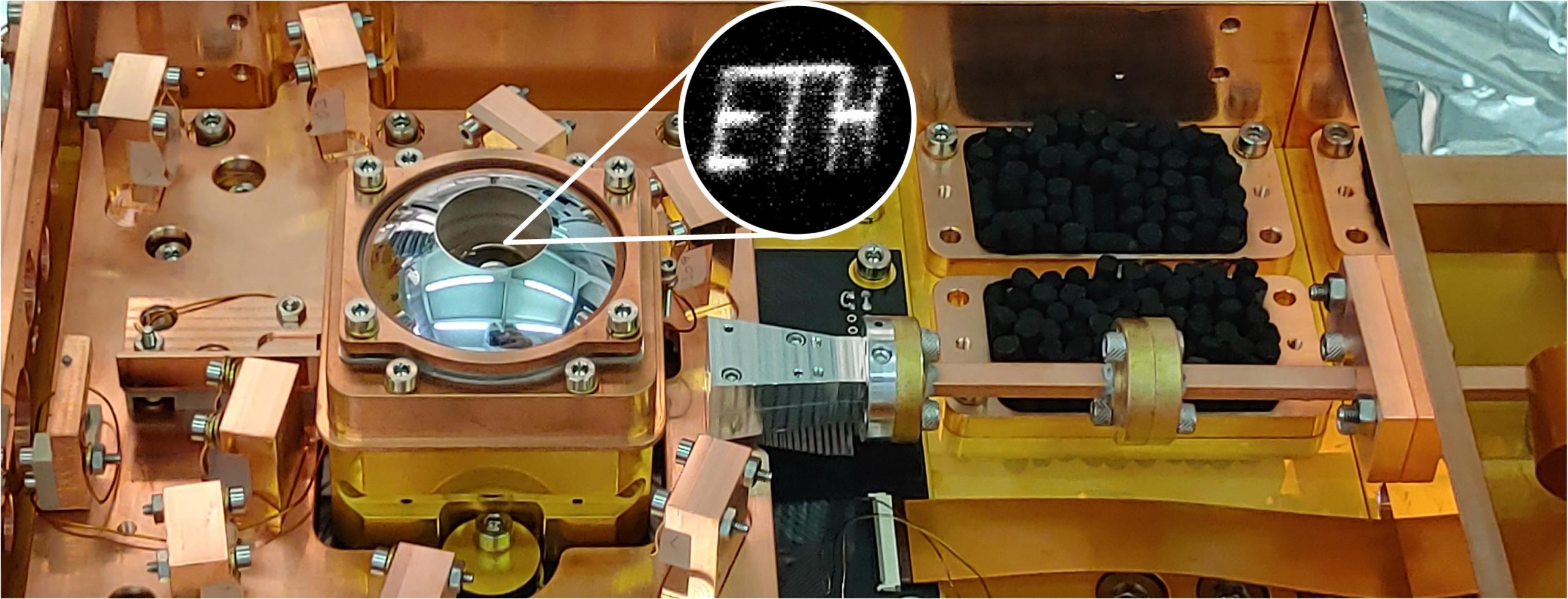
Ion Trap With a Magnetic Field
A team of researchers at ETH Zurich led by Jonathan Home has now demonstrated that ion traps suitable for use in quantum computers can also be built using static magnetic fields instead of oscillating fields. In those static traps with an additional magnetic field, called Penning traps, both arbitrary transport and the necessary operations for the future super-computers were realized. The researchers recently published their results in the scientific journal Nature.
“Traditionally, Penning traps are used when one wants to trap very many ions for precision experiments, but without having to control them individually,” says PhD student Shreyans Jain: “By contrast, in the smaller quantum computers based on ions, Paul traps are used.”
The idea of the ETH researchers to build future quantum computers also using Penning traps was initially met with skepticism by their colleagues. For various reasons: Penning traps require extremely strong magnets, which are very expensive and rather bulky. Also, all previous realizations of Penning traps had been very symmetric, something that the chip-scale structures used at ETH violate. Putting the experiment inside a large magnet makes it difficult to guide the laser beams necessary for controlling the qubits into the trap, while strong magnetic fields increase the spacing between the energy states of the qubits. This, in turn, makes the control laser systems much more complex: instead of a simple diode laser, several phase-locked lasers are needed.
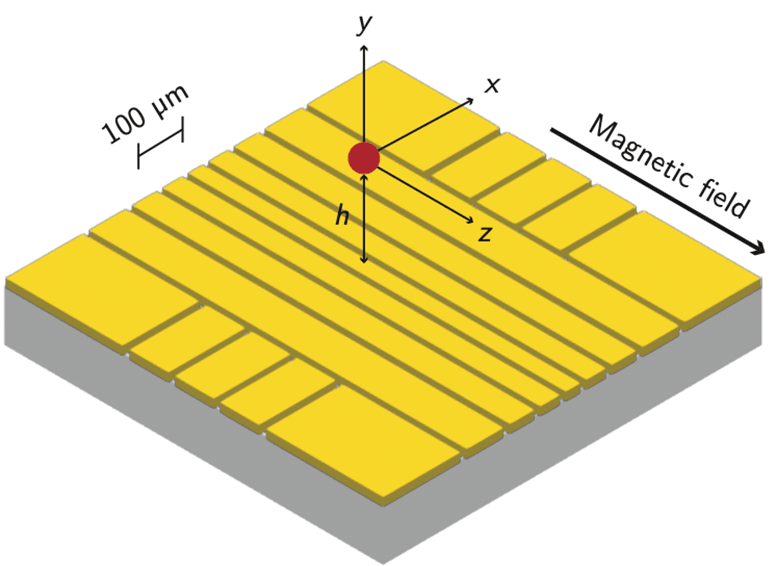
Transport in Arbitrary Directions
Home and his collaborators were not deterred by those difficulties, however, and constructed a Penning trap based on a superconducting magnet and a microfabricated chip with several electrodes, which was produced at the Physikalisch-Technische Bundesanstalt in Braunschweig. The magnet used delivers a field of 3 Tesla, almost 100’000 times stronger than Earth’s magnetic field. Using a system of cryogenically cooled mirrors, the Zurich researchers managed to channel the necessary laser light through the magnet to the ions.
The efforts paid off: a single trapped ion, which can stay in the trap for several days, could now be moved arbitrarily on the chip, connecting points “as the crow flies” by controlling the different electrodes – this is something not previously possible with the old approach based on oscillating fields. Since no oscillating fields are needed for trapping, many of those traps can be packed onto a single chip. “Once they are charged up, we can even completely isolate the electrodes from the outside world and thus investigate how strongly the ions are disturbed by external influences,” says Tobias Sägesser, who was involved in the experiment as a PhD student.
Coherent Control of the Qubit
The researchers also demonstrated that the qubit energy states of the trapped ion could also be controlled while maintaining quantum mechanical superpositions. Coherent control worked both with the electronic (internal) states of the ion and the (external) quantized oscillation states as well as for coupling the internal and external quantum states. This latter is a prerequisite for creating entangled states, which are important for quantum computers.
As a next step, Home wants to trap two ions in neighboring Penning traps on the same chip and thus demonstrate that quantum operations with several qubits can also be performed. This would be the definitive proof that quantum computers can be realized using ions in Penning traps. The professor also has other applications in mind. For instance, since the ions in the new trap can be moved flexibly, they can be used to probe electric, magnetic, or microwave fields near surfaces. This opens up the possibility to use these systems as atomic sensors of surface properties.
Reference: “Penning micro-trap for quantum computing” by Shreyans Jain, Tobias Sägesser, Pavel Hrmo, Celeste Torkzaban, Martin Stadler, Robin Oswald, Chris Axline, Amado Bautista-Salvador, Christian Ospelkaus, Daniel Kienzler and Jonathan Home, 13 March 2024, Nature.
DOI: 10.1038/s41586-024-07111-x
Never miss a breakthrough: Join the SciTechDaily newsletter.
Follow us on Google and Google News.
2 Comments
Thank you share this important topic and information…
Thank you share this important topic and information…https://tellthebell.fun/