
Close Menu
    Facebook X (Twitter) Instagram
    SciTechDaily
    • Biology
    • Chemistry
    • Earth
    • Health
    • Physics
    • Science
    • Space
    • Technology
    Facebook X (Twitter) Pinterest YouTube RSS
    SciTechDaily
    Home»Technology»Quantum Computing’s Dynamic Duo: Ion Trap Meets Single-Photon Detector
    Technology

    Quantum Computing’s Dynamic Duo: Ion Trap Meets Single-Photon Detector

    By National Institute of Standards and TechnologyMay 10, 2023No Comments3 Mins Read
    Facebook Twitter Pinterest Telegram LinkedIn WhatsApp Email Reddit
    Share
    Facebook Twitter LinkedIn Pinterest Telegram Email Reddit
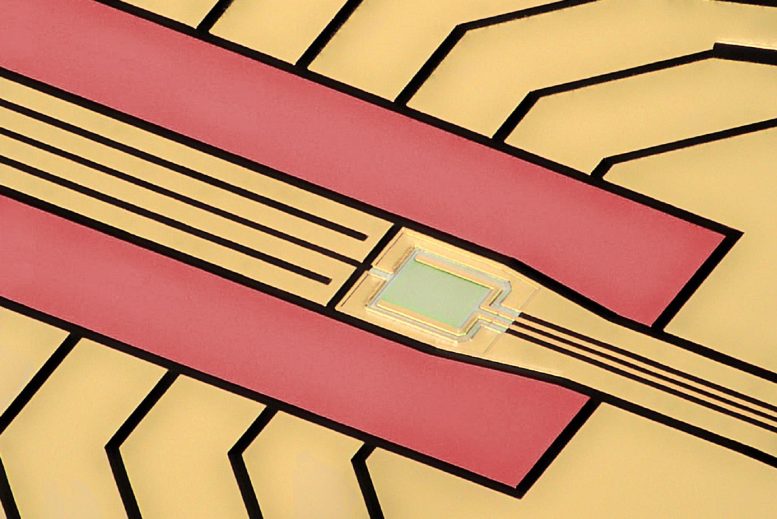
    Combined Trap for Ions and Detector for Individual Photons
    Researchers have developed a combined ion trap and single-photon detector device to improve quantum computing systems. The new device overcomes the issue of competing requirements between the ion trap and photon detector by incorporating an aluminum barrier at the bottom of the detector, allowing for large voltages to be used without disrupting the detector’s performance. This NIST innovation has been published in Applied Physics Letters. Credit: NIST

    A combined ion trap and single-photon detector device has been developed to improve quantum computing systems, overcoming previous challenges in tracking multiple ions for increased processing power. The device features an aluminum barrier to balance the needs of both the ion trap and photon detector.

    We’re building the tools to trap ions and watch them glow (or not).

    The art-deco-esque device shown here is a combined trap for ions (charged atoms) and detector for individual photons (particles of light). When you hold an ion in place and hit it with a laser, depending on its quantum state, the ion will either glow and emit photons … or it will do nothing and stay in the dark.

    But we aren’t going through this process for a 50/50 chance at a light show.

    The glow-or-no-glow odds for ions have a significant impact on the future of computing. Quantum computers can assign values to those two quantum states, similar to the 0s and 1s in the binary system that our classical computers use to operate.

    The best practice thus far has been to use a large, custom-built microscope lens and bulky single-photon detector to identify whether a trapped ion glows or not. That’s sufficient on a small scale, but technical problems arise when a quantum computing system needs to keep track of many ions at once (for added processing power). Ions can be out of view, or the image can get distorted.

    Not only do NIST researchers have a potential alternative, but they’ve just made it much more realistic.

    Our combined ion trap/single-photon detector takes away the need for bulky equipment and maintains the potential for a clear view of all the ions in the system.

    Previous iterations faced the challenge of competing personalities. The trap needed large voltages on its electrodes to hold ions in place, while the detector was much more delicate and preferred an environment without large electrical signals.

    Now, our team has crafted a version with an aluminum barrier around the bottom of the detector. The ion trap can use large voltages, and the detector can keep its peace. Get the specifics on this NIST innovation in the research paper, published in Applied Physics Letters.

    Reference: “Trap-integrated superconducting nanowire single-photon detectors with improved rf tolerance for trapped-ion qubit state readout” by Benedikt Hampel, Daniel H. Slichter, Dietrich Leibfried, Richard P. Mirin, Sae Woo Nam and Varun B. Verma, 24 April 2023, Applied Physics Letters.
    DOI: 10.1063/5.0145077

    Never miss a breakthrough: Join the SciTechDaily newsletter.
    Follow us on Google and Google News.

    National Institute of Standards and Technology Photonics Quantum Computing
    Share. Facebook Twitter Pinterest LinkedIn Email Reddit

    Related Articles

    Lighting Up the Ion Trap: Fiber Optics Built Into a Chip for Quantum Computing

    Super-Fast Quantum Light Detector Paves Way for Higher Performance Quantum Computers

    Generating Photons for Communication Between Processors in a Quantum Computing System

    Scaling Up the Quantum Chip: MIT Engineers Connect Photonics With “Artificial Atoms”

    Atomic ‘Swiss Army Knife’ Precisely Measures Advanced Materials for Quantum Computers

    Army Researchers Advance Toward Quantum Computing at Room Temperature

    New Recipe for Single-Atom Transistors May Enable Quantum Computers With Unparalleled Memory and Processing Power

    New Photon Detectors – A Crucial Step Toward Quantum Chips

    A New Model of a Quantum Computer

    Leave A Reply Cancel Reply

    • Facebook
    • Twitter
    • Pinterest
    • YouTube

    Don't Miss a Discovery

    Subscribe for the Latest in Science & Tech!

    Trending News

    Millions of People Have Osteopenia Without Realizing It – Here’s What You Need To Know

    Researchers Discover Boosting a Single Protein Helps the Brain Fight Alzheimer’s

    World-First Study Reveals Human Hearts Can Regenerate After a Heart Attack

    Why Your Dreams Feel So Real Sometimes and So Strange Other Times

    This Simple Home Device May Boost Brain Power in Adults Over 40

    Enormous Prehistoric Insects Puzzle Scientists

    Scientists Develop Bioengineered Chewing Gum That Could Help Fight Oral Cancer

    After 37 Years, the World’s Longest-Running Soil Warming Experiment Uncovers a Startling Climate Secret

    Follow SciTechDaily
    • Facebook
    • Twitter
    • YouTube
    • Pinterest
    • Newsletter
    • RSS
    SciTech News
    • Biology News
    • Chemistry News
    • Earth News
    • Health News
    • Physics News
    • Science News
    • Space News
    • Technology News
    Recent Posts
    • Scientists Discover Evolution’s 120-Million-Year-Old “Cheat Sheet”
    • This New “Sound Laser” Could Measure Gravity With Stunning Precision
    • Quantum Breakthrough: New Algorithm Solves “Impossible” Materials in Seconds
    • Could the Universe’s Hidden Shape Solve One of Physics’ Biggest Mysteries?
    • Rewriting Dinosaur Evolution: Scientists Unearth Remarkable 150-Million-Year-Old Stegosaur Skull
    Copyright © 1998 - 2026 SciTechDaily. All Rights Reserved.
    • Science News
    • About
    • Contact
    • Editorial Board
    • Privacy Policy
    • Terms of Use

    Type above and press Enter to search. Press Esc to cancel.