

Fraunhofer IAF achieves record output power with VECSEL for quantum frequency converters.
The expansion of fiber optics is progressing worldwide, which not only increases the bandwidth of conventional Internet connections, but also brings closer the realization of a global quantum Internet. The quantum internet can help to fully exploit the potential of certain technologies. These include much more powerful quantum computing through the linking of quantum processors and registers, more secure communication through quantum key distribution or more precise time measurements through the synchronization of atomic clocks.
However, the differences between the glass fiber standard of 1550 nm and the system wavelengths of the various quantum bits (qubits) realized to date represent a hurdle, because those qubits are mostly in the visible or near-infrared spectral range. Researchers want to overcome this obstacle with the help of quantum frequency conversion, which can specifically change the frequencies of photons while retaining all other quantum properties. This enables conversion to the 1550 nm telecom range for low-loss, long-range transmission of quantum states.
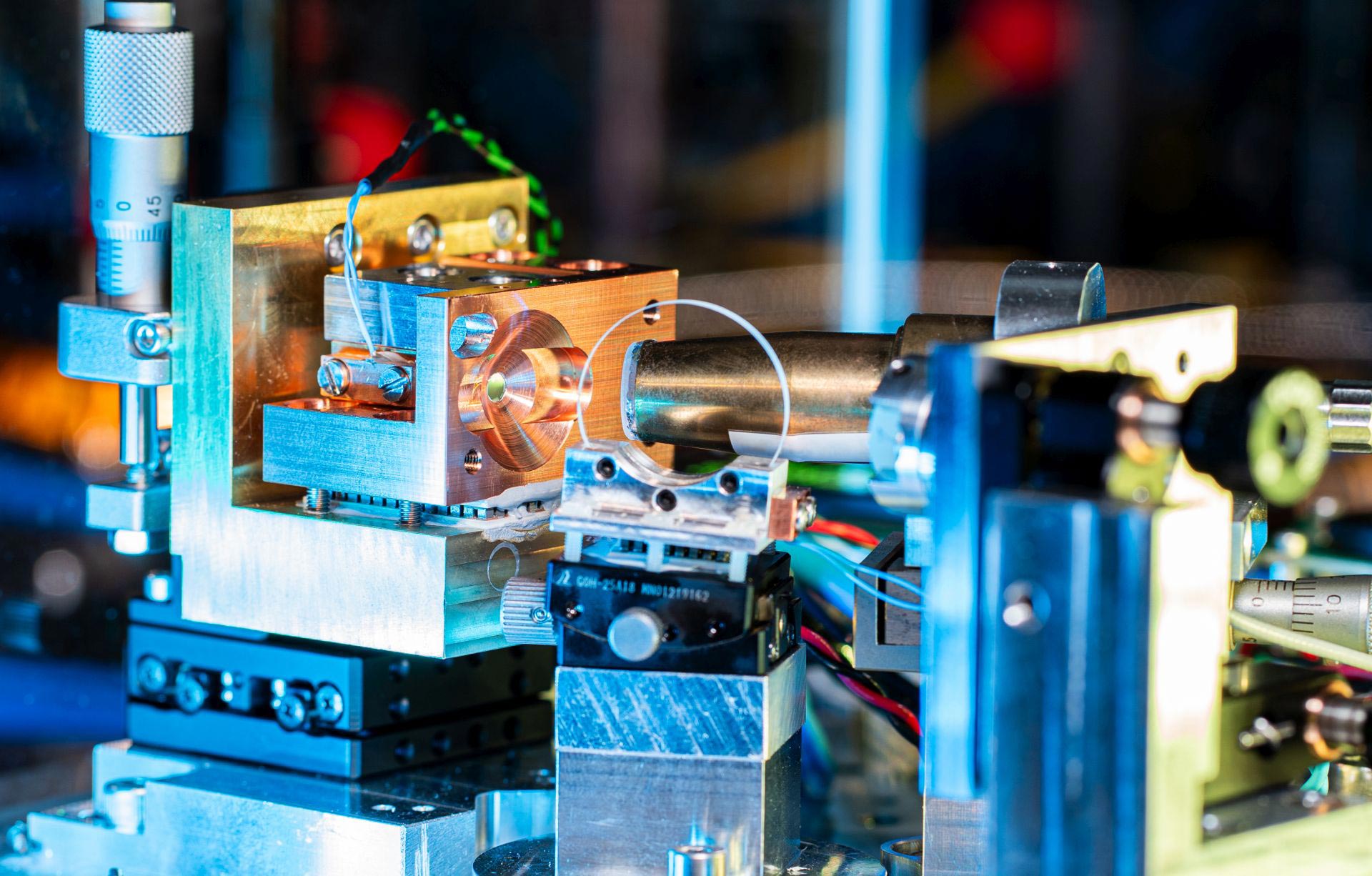
Project HiFi: Enabling technologies for quantum frequency conversion
In the joint project “HiFi — Highly integrated quantum frequency converter of highest fidelity based on innovative laser, fiber and production technology” funded by the German Federal Ministry of Education and Research (BMBF), researchers are working on the realization of all necessary technologies to provide quantum frequency converters (QFK) with high efficiency and low noise for initial test tracks. The Fraunhofer Institute for Applied Solid State Physics IAF has contributed to the project with the successful development of disk lasers (also known as vertical-external-cavity surface-emitting lasers, VECSELs) based on gallium antimonide (GaSb). These are optically pumped, surface-emitting semiconductor lasers with an external resonator and intracavity filter for wavelength selection.
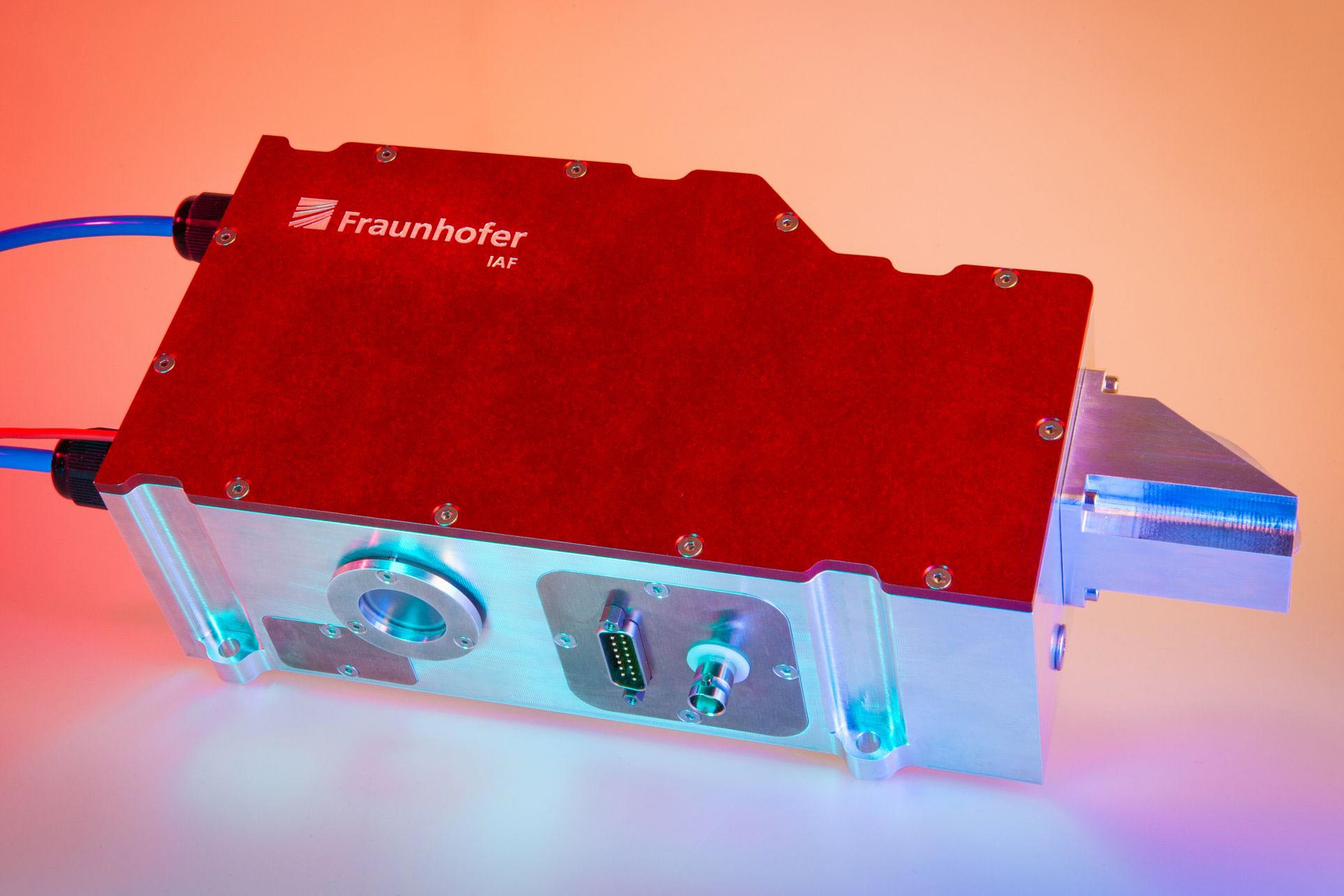
2.4 W output power with absolute frequency stability below 100 kHz
“The VECSELs we developed as part of HiFi are spectrally narrow-band pump sources which, depending on the output wavelength of the qubits used, specifically cover a wavelength between 1.9 and 2.5 µm and achieve an output power of up to 2.4 W with an absolute wavelength stability of less than 2 fm. This corresponds to a frequency stability of less than 100 kHz and clearly falls below the frequency stability class 1E-9. The result represents an international record for this type of laser,” explains Dr. Marcel Rattunde, HiFi sub-project coordinator and head of the optoelectronics department at Fraunhofer IAF.
“The result was made possible by the close cooperation with project partner MENLO Systems GmbH. Together, we locked the disk laser to a frequency comb, which in turn was coupled to a 10 MHz reference,” emphasizes Rattunde.
In their experiments, the researchers set the emission wavelength exactly to the target wavelength for demonstration experiments at the fiber link of Saarland University (2062.40 nm), to which Fraunhofer IAF has handed over the laser module. In addition to power scaling, the most important research tasks of Fraunhofer IAF in the HiFi project are the precise understanding of the mode behavior of the lasers and the identification and elimination of noise sources.
Quantum frequency conversion using pump lasers
In quantum frequency conversion, the energy of the pump photon is subtracted from the signal photon by a difference frequency process in a non-linear optical crystal. To ensure a low-noise process, the energy of the pump photons must be below the target wavelength (usually 1550 nm), otherwise the pump laser can generate photons in the output signal due to parasitic effects.
In combination with the MENLO frequency comb, the VECSELs developed at Fraunhofer IAF meet the high requirements of quantum frequency conversion, as their narrow bandwidth and wavelength stability prevent fluctuations in the pump wavelength and consequently changes in the target wavelength of the qubits. If there is a deviation above the natural linewidth, the qubits would no longer be indistinguishable, which would eliminate a basic requirement for subsequent quantum mechanical processing.
Never miss a breakthrough: Join the SciTechDaily newsletter.
Follow us on Google and Google News.