
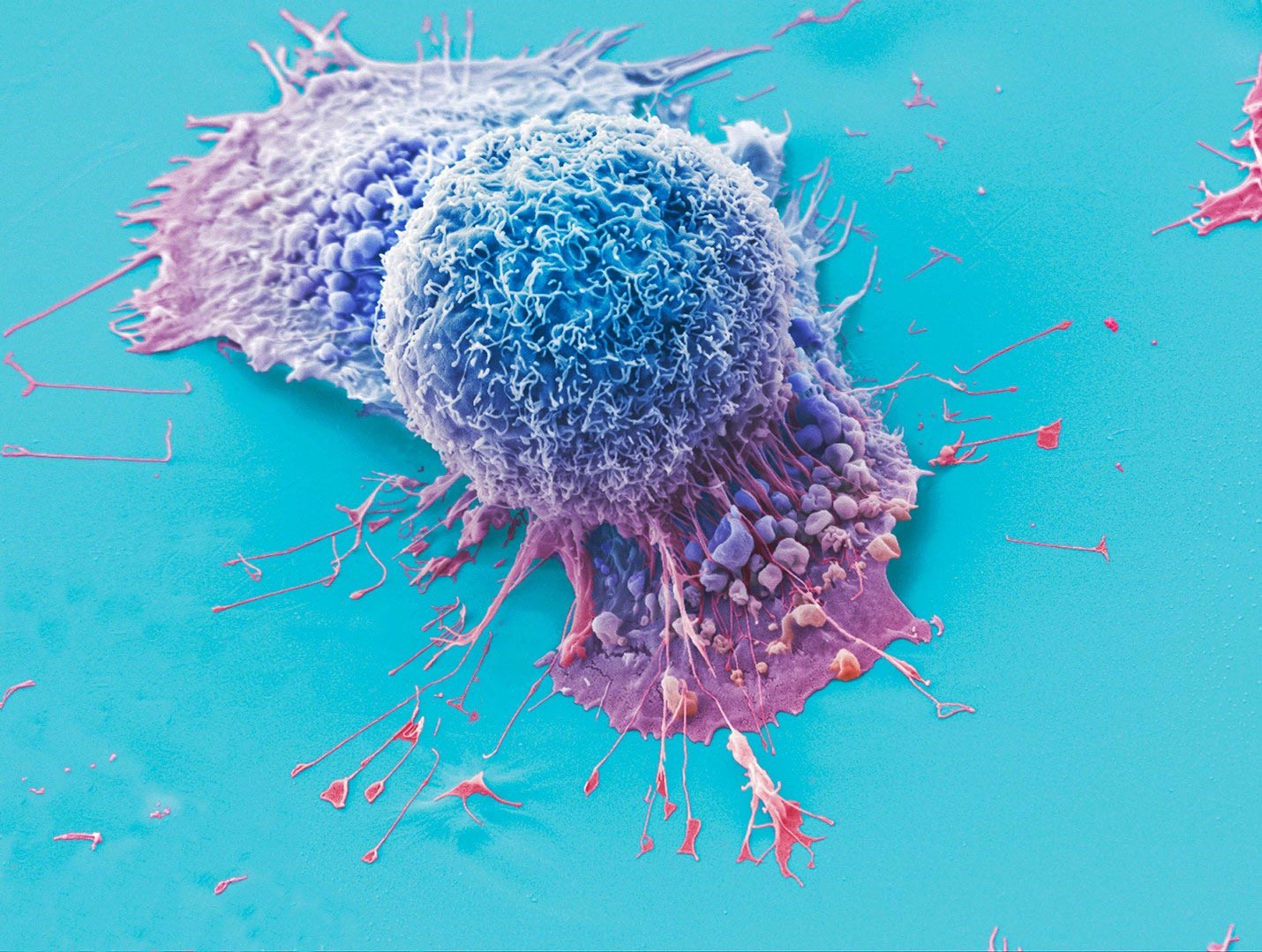
PERCEPTION, an AI-based approach predicts cancer treatment responses at single-cell resolution. The method, validated in clinical trials, analyzes tumor dynamics and drug resistance, aiming to refine future treatment strategies.
With more than 200 types of cancer and every cancer individually unique, ongoing efforts to develop precision oncology treatments remain daunting. Most of the focus has been on developing genetic sequencing assays or analyses to identify mutations in cancer driver genes, and then trying to match treatments that may work against those mutations.
Breakthrough in Predictive Cancer Treatment
But many, if not most, cancer patients do not benefit from these early targeted therapies. In a new study published today (April 18, 2024), in the journal Nature Cancer, first author Sanju Sinha, Ph.D., assistant professor in the Cancer Molecular Therapeutics Program at Sanford Burnham Prebys, with senior authors Eytan Ruppin, M.D., Ph.D., and Alejandro Schaffer, Ph.D., at the National Cancer Institute, part of the National Institutes of Health (NIH)—and colleagues—describe a first-of-its-kind computational pipeline to systematically predict patient response to cancer drugs at single-cell resolution.
Dubbed PERsonalized Single-Cell Expression-Based Planning for Treatments in Oncology, or PERCEPTION, the new artificial intelligence-based approach dives deeper into the utility of transcriptomics—the study of transcription factors, the messenger RNA molecules expressed by genes that carry and convert DNA information into action.

Advantages of Single-Cell Resolution
“A tumor is a complex and evolving beast. Using single-cell resolution can allow us to tackle both of these challenges,” says Sinha. “PERCEPTION allows for the use of rich information within single-cell omics to understand the clonal architecture of the tumor and monitor the emergence of resistance.” (In biology, omics refers to the sum of constituents within a cell.)
Sinha says, “The ability to monitor the emergence of resistance is the most exciting part for me. It has the potential to allow us to adapt to the evolution of cancer cells and even modify our treatment strategy.”
Development of PERCEPTION
Sinha and colleagues used transfer learning—a branch of AI—to build PERCEPTION.
“Limited single-cell data from clinics was our biggest challenge. An AI model needs large amounts of data to understand a disease, not unlike how ChatGPT needs huge amounts of text data scraped from the internet.”
PERCEPTION uses published bulk-gene expression from tumors to pre-train its models. Then, single-cell data from cell lines and patients, even though limited, was used to tune the models.
Validation and Potential of PERCEPTION
PERCEPTION was successfully validated by predicting the response to monotherapy and combination treatment in three independent, recently published clinical trials for multiple myeloma, breast, and lung cancer.
In each case, PERCEPTION correctly stratified patients into responder and non-responder categories. In lung cancer, it even captured the development of drug resistance as the disease progressed, a notable discovery with great potential.
Future Prospects for PERCEPTION
Sinha says that PERCEPTION is not ready for clinics, but the approach shows that single-cell information can be used to guide treatment. He hopes to encourage the adoption of this technology in clinics to generate more data, which can be used to further develop and refine the technology for clinical use.
“The quality of the prediction rises with the quality and quantity of the data serving as its foundation,” says Sinha. “Our goal is to create a clinical tool that can predict the treatment response of individual cancer patients in a systematic, data-driven manner. We hope these findings spur more data and more such studies, sooner rather than later.”
Reference: “PERCEPTION predicts patient response and resistance to treatment using single-cell transcriptomics of their tumors” by Sanju Sinha, Rahulsimham Vegesna, Sumit Mukherjee, Ashwin V. Kammula, Saugato Rahman Dhruba, Wei Wu, D. Lucas Kerr, Nishanth Ulhas Nair, Matthew G. Jones, Nir Yosef, Oleg V. Stroganov, Ivan Grishagin, Kenneth D. Aldape, Collin M. Blakely, Peng Jiang, Craig J. Thomas, Cyril H. Benes, Trever G. Bivona, Alejandro A. Schäffer and Eytan Ruppin, 18 April 2024, Nature Cancer.
DOI: 10.1038/s43018-024-00756-7
Additional authors on the study include Rahulsimham Vegesna, Sumit Mukherjee, Ashwin V. Kammula, Saugato Rahman Dhruba, Nishanth Ulhas Nair, Peng Jiang, Alejandro Schäffer, Kenneth D. Aldape and Eytan Ruppin, National Cancer Institute (NCI); Wei Wu, Lucas Kerr, Collin M. Blakely and Trever G. Biovona, University of California, San Francisco; Mathew G. Jones and Nir Yosef, University of California, Berkeley; Oleg Stroganov and Ivan Grishagin, Rancho BioSciences; Craig J. Thomas, National Institutes of Health; and Cyril H. Benes, Harvard University.
This research was supported in part by the Intramural Research Program of the NIH; NCI; and NIH grants R01CA231300, R01CA204302, R01CA211052, R01CA169338 and U54CA224081.
Never miss a breakthrough: Join the SciTechDaily newsletter.
Follow us on Google and Google News.