
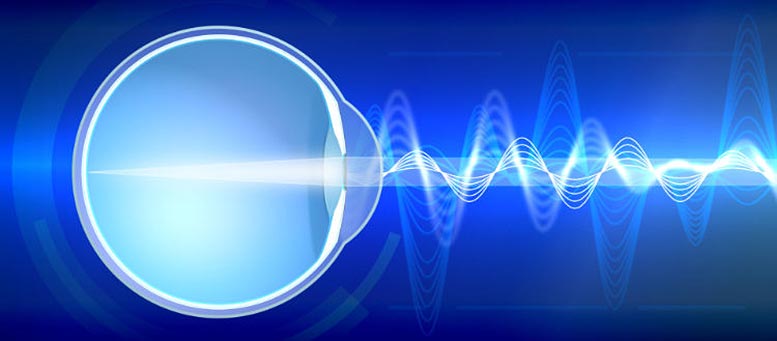
Scientists at the UNIGE have shown that the response of the retina to light depends not only on the intensity of the light perceived by the eye, but also on its temporal shape and the order in which the colors are organized.
Vision is a complex process that has been successfully deciphered by many disciplines – physics, biochemistry, physiology, neurology, etc. The retina captures light, the optic nerve transmits electrical impulses to the brain, which ultimately generates the perception of an image. Although this process takes some time, recent studies have shown that the first stage of vision, the perception of light itself, is extremely fast. But the analysis of this decisive step was carried out on molecules in solution in the laboratory.
Scientists from the University of Geneva (UNIGE), in collaboration with EPFL and the University Hospitals of Geneva (HUG), Switzerland, reproduced the experiment on mice, in order to observe the processing of light by a living organism in all its complexity. This non-invasive study shows that light energy alone does not define the response of the retina. Its shape –short or long– also has an impact on the signal sent to the brain to form an image. This discovery, published in the journal Science Advances, opens up a new field of research into vision, diagnostics, and possibly new curative possibilities.
The cellular mechanism of vision has been successfully studied thanks to the collaboration of several disciplines. “In the eye, the first stage of vision is based on a small molecule – the retinal – which, on contact with light, changes shape,” explains Geoffrey Gaulier, researcher at the Applied Physics Department of the UNIGE Faculty of Science and first author of the study. “When the retinal alters its geometric form, it triggers a complex mechanism that will result in a nerve impulse generated in the optic nerve.”
This process takes some time between the moment the eye perceives the light and the moment the brain decodes it. Physicists looked at the very first molecule in the chain, retinal, to see how long it took to switch its shape. They isolated this molecule in a cuvette and subjected it to laser pulses to test its reaction speed. To their great surprise, the molecule reacted in about 50 femtoseconds!
“By way of comparison, one femtosecond compared to one second is the equivalent of one second compared to the age of the Universe,” points out Jean-Pierre Wolf, professor at the UNIGE Physics Section and the last author of the research. “This is so fast that we wondered whether this speed could be achieved by the molecule only when it was isolated, or whether it possessed the same speed in a living organism in all its complexity.”
Light Intensity and Shape Define the Eye’s Sensitivity
To study this first stage of vision in detail, the scientists called on biologists, notably Ivan Rodriguez and Pedro Herrera, professors at the UNIGE Faculties of Science and Medicine, respectively, who placed a contact lens and performed an electroretinogram on mice. “This method, which is totally non-invasive, makes it possible to measure the intensity of the signal sent to the optic nerve,” continues Jean-Pierre Wolf. When the light hits the retina, they were able to observe an electrical voltage at the cornea, thanks to an electronic amplifier. And their results showed that this stage took place with the same extreme speed as when the molecule is isolated!
The team continued the study by varying the shape of the pulses over time. “We always send the same energy, the same number of photons, but we change the shape of the light pulse. Sometimes the pulse is short, sometimes long, sometimes sliced, etc,” explains Geoffrey Gaulier. Indeed, changing the shape should not induce any variation in the response of the retina, because until now it was thought that only the number of photons captured by the eye played a role. “But this is not the case!” says the Geneva-based researcher. This result could be explained with the help of computer simulations performed in the group of Ursula Röthlisberger from EPFL.
The scientists observed that the eye did not react in the same way depending on the shape of the light, even though the light energy was identical. “We also discovered that the eye’s reaction differed according to the order in which the colors were varied, for example as in a temporal rainbow, even though they follow each other extremely quickly,” continues Jean-Pierre Wolf. In short, the retina believes that there is more or less light depending on the shape of the light, while the energy is similar, and therefore sends a stronger or weaker current to the brain depending on its response.
This discovery, which was made in the context of a Swiss National Science Foundation (SNSF) Sinergia project, opens up a new field of research into vision. “Now that we know that the shape of light plays a role in perception, we can use this new knowledge to make the eye work differently,” proposes Jean-Pierre Wolf. Areas of investigation into new possibilities for diagnosing or possibly treating eye weaknesses can now be developed.
Reference: “Ultrafast pulse shaping modulates perceived visual brightness in living animals” by Geoffrey Gaulier, Quentin Dietschi, Swarnendu Bhattacharyya, Cédric Schmidt, Matteo Montagnese, Adrien Chauvet, Sylvain Hermelin, Florence Chiodini, Luigi Bonacina, Pedro L. Herrera, Ursula Rothlisberger, Ivan Rodriguez and Jean-Pierre Wolf, 28 April 2021, Science.
DOI: 10.1126/sciadv.abe1911
Never miss a breakthrough: Join the SciTechDaily newsletter.
Follow us on Google and Google News.