
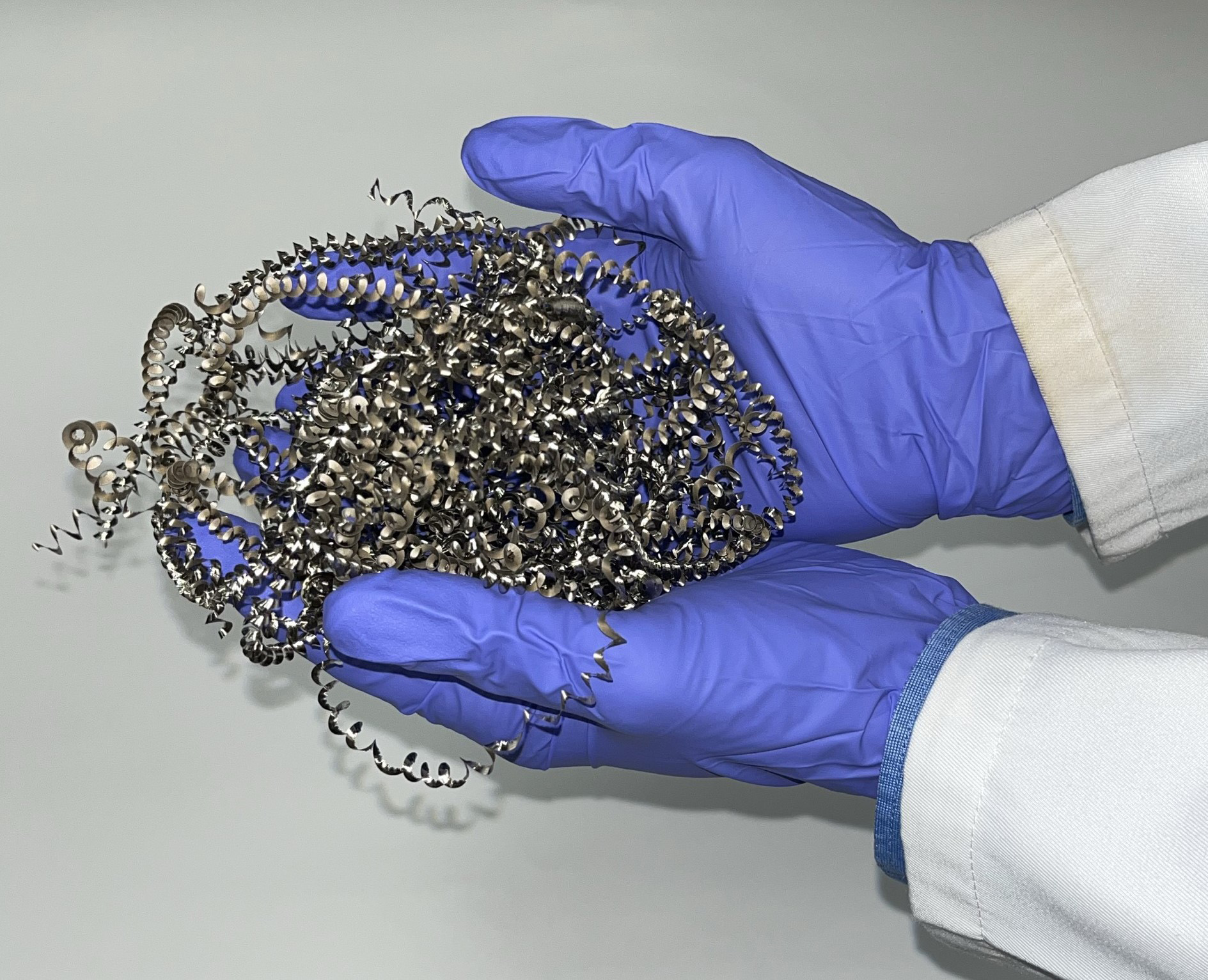
Researchers have developed a method to convert metal waste into an effective catalyst for producing hydrogen from water, a breakthrough that could enhance the sustainability of hydrogen production.
A team of researchers from the University of Nottingham’s School of Chemistry and Faculty of Engineering has found that the surface of swarf, a byproduct of the metal machining industry, is textured with tiny steps and grooves on a nanoscale level. These textures can anchor atoms of platinum or cobalt, leading to an efficient electrocatalyst that can split water into hydrogen and oxygen. The research has been published in the Journal of Material Chemistry A of the Royal Society of Chemistry.
Hydrogen is a clean fuel that can be used to generate heat or power vehicles, and the only byproduct of its combustion is water vapor. However, most hydrogen production methods rely on fossil fuel feedstock. Electrolysis of water is one of the most promising green pathways for hydrogen production, as it only requires water and electricity.
The industry is facing a challenge with water electrolysis, as this process requires rare and expensive elements like platinum to catalyze the water splitting. With the limited global supply and increasing prices of precious metals, there is an urgent need for alternative electrocatalyst materials to produce hydrogen from water.
Innovative Solutions from Industrial Waste
Dr Jesum Alves Fernandes, School of Chemistry, University of Nottingham, who led the research team, said: “Industries in the UK alone generate millions of tons of metal waste annually. By using a scanning electron microscope, we were able to inspect the seemingly smooth surfaces of the stainless steel, titanium, or nickel alloy swarf. To our astonishment, we discovered that the surfaces had grooves and ridges that were only tens of nanometres wide. We realized that this nanotextured surface could present a unique opportunity for the fabrication of electrocatalysts.”
The researchers used magnetron sputtering to create a platinum atom “rain” on the swarf’s surface. These platinum atoms then come together into nanoparticles that fit snugly into the nanoscale grooves.
Hydrogen production from water catalyzed by platinum atoms on metal swarf. Credit: University of Nottingham
Dr. Madasamy Thangamuthu, a Postdoctoral Researcher at the University of Nottingham who was responsible for the analysis of the structure and electrocatalytic activity of the new materials, says: “It is remarkable that we are able to produce hydrogen from water using only a tenth of the amount of platinum loading compared to state-of-the-art commercial catalysts. By spreading just 28 micrograms of the precious metal over 1 cm² of the swarf, we were able to create a laboratory-scale electrolyzer that operates with 100% efficiency and produces 0.5 liters of hydrogen gas per minute just from a single piece of swarf.”
The group is partnering with AqSorption Ltd, a Nottingham-based company specializing in electrolyzer design and fabrication to scale up their technology. Professor Andrei Khlobystov, School of Chemistry, University of Nottingham, said: “The electrocatalysts made from swarf have the potential to greatly impact the economy. Our unique technology developed at Nottingham, which involves atom-by-atom growth of platinum particles on nanotextured surfaces, has solved two major challenges. Firstly, it enables the production of green hydrogen using the least amount of precious metal possible, and secondly, it upcycles metal waste from the aerospace industry, all in a single process.”
The Zero Carbon Cluster has been set in the East Midlands to accelerate the development and deployment of innovation in green industries and advanced manufacturing.
Professor Tom Rodden, PVC for Research & Knowledge Exchange at the University of Nottingham says: “Developing hydrogen propulsion systems can be a significant step towards addressing some of the world’s most pressing zero-carbon challenges, especially for the transport and manufacturing industries. However, this strategy’s success depends on producing green hydrogen sustainably, such as through water splitting via electrolysis, and this, in turn, requires advancements in materials design.”
Reference: “From scrap metal to highly efficient electrodes: harnessing the nanotextured surface of swarf for effective utilisation of Pt and Co for hydrogen production” by Madasamy Thangamuthu, Emerson C. Kohlrausch, Ming Li, Alistair Speidel, Adam T. Clare, Richard Plummer, Paul Geary, James W. Murray, Andrei N. Khlobystov and Jesum Alves Fernandes, 16 April 2024, Journal of Materials Chemistry A.
DOI: 10.1039/D4TA00711E
This work, funded by the EPSRC Programme Grant ‘Metal atoms on surfaces and interfaces (MASI) for sustainable future’, represents a significant step towards reducing reliance on expensive metals for hydrogen production, thus contributing significantly to the circular and low-carbon economy.
Never miss a breakthrough: Join the SciTechDaily newsletter.
Follow us on Google and Google News.
4 Comments
“… we were able to create a laboratory-scale electrolyzer that operates with 100% efficiency …”
Just what does that claim mean?
It means they can finally now efficiently electrolyze laboratory scales. Also, they’ve solved the second law of thermodynamics! Worst law ever, and repealing it is a real win for science here.
You make about as much sense as they do. Although, I realize your comment is in jest.
Information You shared was really helpful. keep posting such blogs.