

Close Menu
    Facebook X (Twitter) Instagram
    SciTechDaily
    • Biology
    • Chemistry
    • Earth
    • Health
    • Physics
    • Science
    • Space
    • Technology
    Facebook X (Twitter) Pinterest YouTube RSS
    SciTechDaily
    Home»Technology»Quantum Leap: Redefining Complex Problem-Solving
    Technology

    Quantum Leap: Redefining Complex Problem-Solving

    By Helmholtz-Zentrum Berlin für Materialien und EnergieApril 1, 2024No Comments4 Mins Read
    Facebook Twitter Pinterest Telegram LinkedIn WhatsApp Email Reddit
    Share
    Facebook Twitter LinkedIn Pinterest Telegram Email Reddit
    Abstract Futuristic Quantum Computing
    Quantum computers, utilizing versatile qubits, are at the forefront of solving complex optimization problems like the traveling salesman dilemma, traditionally plagued by computational inefficiency. Through rigorous mathematical analysis, researchers have demonstrated that quantum computing can fundamentally transform problem-solving, offering a more efficient polynomial increase in computation time compared to classical methods and yielding superior solutions.

    The traveling salesman problem is considered a prime example of a combinatorial optimization problem. Now a Berlin team led by theoretical physicist Prof. Dr. Jens Eisert of Freie Universität Berlin and HZB has shown that a certain class of such problems can actually be solved better and much faster with quantum computers than with conventional methods.

    Quantum computers use so-called qubits, which are not either zero or one as in conventional logic circuits, but can take on any value in between. These qubits are realized by highly cooled atoms, ions, or superconducting circuits, and it is still physically very complex to build a quantum computer with many qubits. However, mathematical methods can already be used to explore what fault-tolerant quantum computers could achieve in the future.

    “There are a lot of myths about it, and sometimes a certain amount of hot air and hype. But we have approached the issue rigorously, using mathematical methods, and delivered solid results on the subject. Above all, we have clarified in what sense there can be any advantages at all,” says Prof. Dr. Jens Eisert, who heads a joint research group at Freie Universität Berlin and Helmholtz-Zentrum Berlin.

    Classic Traveling Salesman’s Problem Mathematics
    The traveling salesman’s problem is a classic in mathematics. A traveller is to visit N cities by the shortest route and return to the starting point. As the number N increases, the number of possible routes explodes. This problem can then be solved using approximation methods. Quantum computers could provide significantly better solutions more quickly. Credit: HZB

    Addressing Complex Problems

    The well-known problem of the traveling salesman serves as a prime example: A traveler has to visit a number of cities and then return to his hometown. Which is the shortest route? Although this problem is easy to understand, it becomes increasingly complex as the number of cities increases and computation time explodes.

    The traveling salesman problem stands for a group of optimization problems that are of enormous economic importance, whether they involve railway networks, logistics, or resource optimization. Good enough solutions can be found using approximation methods.
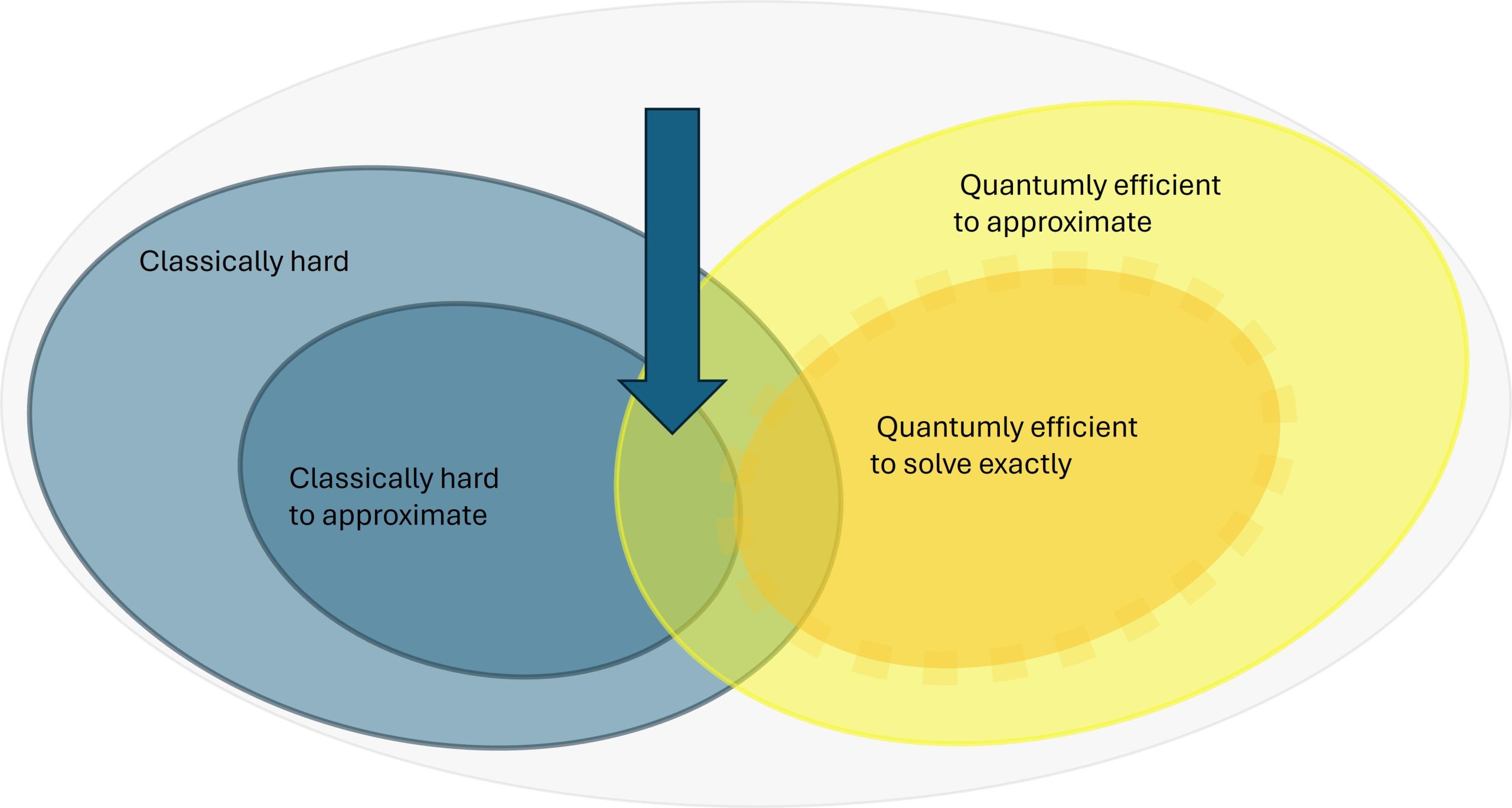
    Combinatorial Problems Can Be Solved Much Better With Quantum Computers
    The present work (arrow) shows that a certain part of the combinatorial problems can be solved much better with quantum computers, possibly even exactly. Credit: HZB/Eisert

    Quantum Solutions and Advancements

    The team led by Jens Eisert and his colleague Jean-Pierre Seifert has now used purely analytical methods to evaluate how a quantum computer with qubits could solve this class of problems. A classic thought experiment with pen and paper and a lot of expertise.

    “We simply assume, regardless of the physical realization, that there are enough qubits and look at the possibilities of performing computing operations with them,” explains Vincent Ulitzsch, a PhD student at the Technical University of Berlin. In doing so, they unveiled similarities to a well-known problem in cryptography, i.e. the encryption of data. “We realized that we could use the Shor algorithm to solve a subclass of these optimization problems,” says Ulitzsch.

    This means that the computing time no longer “explodes” with the number of cities (exponential, 2N), but only increases polynomially, i.e. with Nx, where x is a constant. The solution obtained in this way is also qualitatively much better than the approximate solution using the conventional algorithm.

    “We have shown that for a specific but very important and practically relevant class of combinatorial optimization problems, quantum computers have a fundamental advantage over classical computers for certain instances of the problem,” says Eisert.

    Reference: “An in-principle super-polynomial quantum advantage for approximating combinatorial optimization problems via computational learning theory” by Niklas Pirnay, Vincent Ulitzsch, Frederik Wilde, Jens Eisert and Jean-Pierre Seifert, 15 March 2024, Science Advances.
    DOI: 10.1126/sciadv.adj5170

    Never miss a breakthrough: Join the SciTechDaily newsletter.
    Follow us on Google and Google News.

    Helmholtz-Zentrum Berlin Popular Quantum Computing
    Share. Facebook Twitter Pinterest LinkedIn Email Reddit

    Related Articles

    New Breakthrough for Connecting Future Quantum Computers Into a Global Network

    New Superconducting Material Discovered That Could Power Quantum Computers of the Future

    New Tunable Optical Chips Can Be Used As Building-Blocks for Next Generation Quantum Computers

    Scientists Pave the Way for Quantum Computing by Coupling Magnetization to Superconductivity

    Scientists Achieve Solar Hydrogen Production Breakthrough

    A New Model of a Quantum Computer

    Engineers Show Feasibility of Organic Topological Insulators

    Yale Physicists Observe Quantum Information While Preserving Its Integrity

    Electronic Read-Out of the Quantum State of an Atom

    Leave A Reply Cancel Reply

    • Facebook
    • Twitter
    • Pinterest
    • YouTube

    Don't Miss a Discovery

    Subscribe for the Latest in Science & Tech!

    Trending News

    289-Million-Year-Old Reptile Mummy Reveals Origin of Human Breathing System

    New Brain Discovery Challenges Long-Held Theory of Teenage Brain Development

    Scientists Discover Plants “Scream” – We Just Couldn’t Hear Them Until Now

    Scientists Discover a Surprising Reason Intermittent Fasting Extends Life

    This Simple Fruit Wash Could Make Produce Safer and Last Days Longer

    Scientists Say Adding This Unusual Seafood to Your Diet Could Reverse Signs of Aging

    Scientists Say a Hidden Structure May Exist Inside Earth’s Core

    Doctors Surprised by the Power of a Simple Drug Against Colon Cancer

    Follow SciTechDaily
    • Facebook
    • Twitter
    • YouTube
    • Pinterest
    • Newsletter
    • RSS
    SciTech News
    • Biology News
    • Chemistry News
    • Earth News
    • Health News
    • Physics News
    • Science News
    • Space News
    • Technology News
    Recent Posts
    • Nearly 1 in 5 Gray Whales That Enter San Francisco Bay Die There
    • The Ozone Layer Is Healing, But There’s a Hidden Catch
    • Earth’s Crust Is Tearing Open in Africa, and It Could Form a New Ocean
    • Breakthrough Bowel Cancer Trial Leaves Patients Cancer-Free for Nearly 3 Years
    • New Immune Pathway Could Supercharge mRNA Cancer Vaccines
    Copyright © 1998 - 2026 SciTechDaily. All Rights Reserved.
    • Science News
    • About
    • Contact
    • Editorial Board
    • Privacy Policy
    • Terms of Use

    Type above and press Enter to search. Press Esc to cancel.