

Quantum scientists have cracked a longstanding problem by devising a method to speed up measurements without losing accuracy, a key hurdle for quantum technology.
By cleverly adding extra qubits, they traded “space” for time, gathering more information faster without destabilizing the fragile quantum systems. This innovative approach, involving top researchers from several major universities, could soon become a standard tool as the race to quantum supremacy heats up.
New Breakthrough in Quantum Measurements
Researchers have discovered a new method to speed up quantum measurements — a key step toward advancing the next generation of quantum technologies.
Fast and accurate quantum measurements are essential for future quantum devices. However, quantum systems are extremely fragile; even small disturbances during measurement can cause significant errors. Until now, scientists faced a fundamental trade-off: they could either improve the accuracy of quantum measurements or make them faster, but not both at once.
Now, a team of quantum physicists, led by the University of Bristol and published in Physical Review Letters, has found a way to break this trade-off.
How Extra Qubits Make a Difference
The team’s approach involves using additional qubits, the fundamental units of information in quantum computing, to “trade space for time.” Unlike the simple binary bits in classical computers, qubits can exist in multiple states simultaneously, a phenomenon known as superposition.
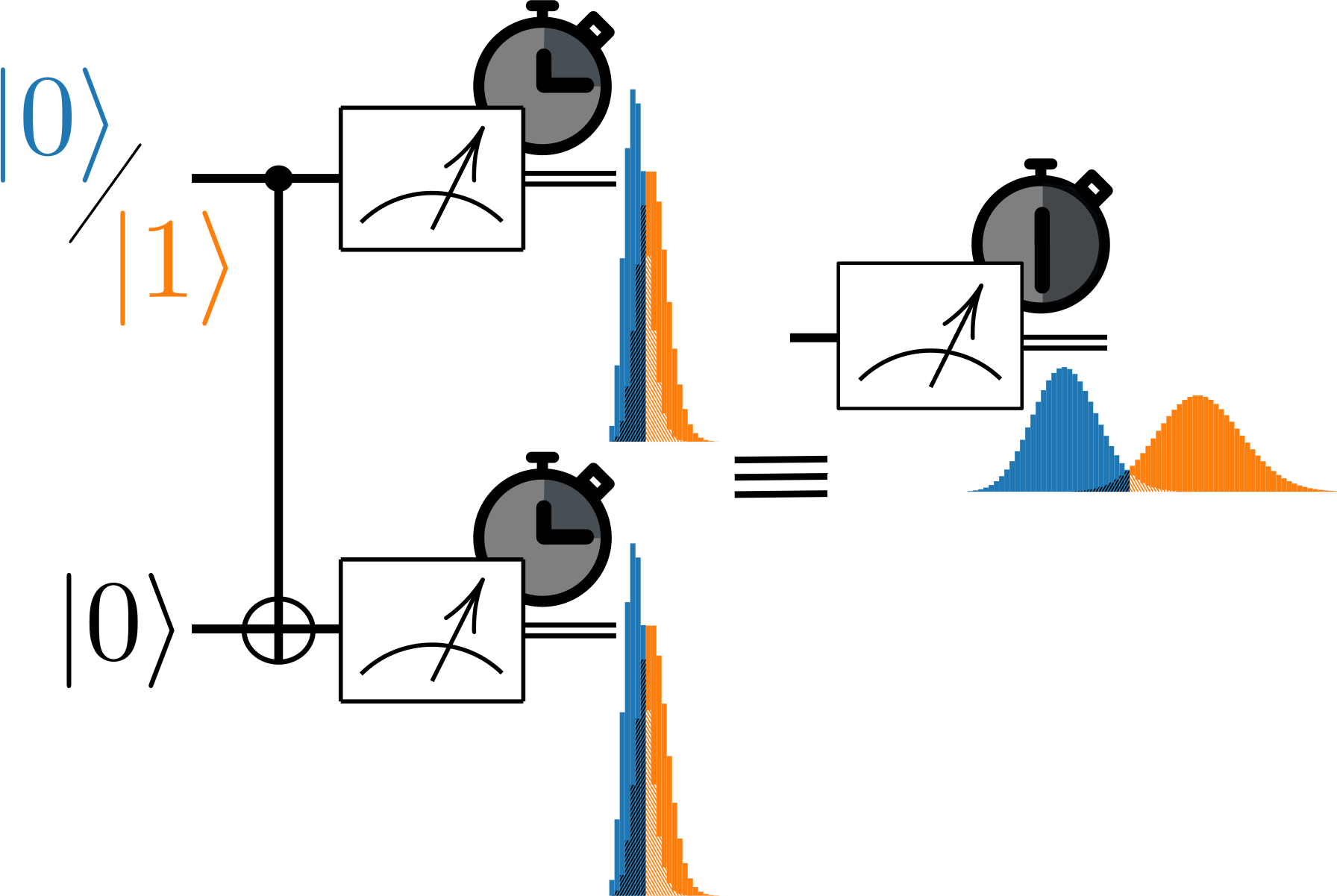
In quantum computing, measuring a qubit typically requires probing it for a relatively long time to achieve a high level of certainty. However, by introducing extra qubits into the measurement process, researchers can gather more information in less time, significantly accelerating the measurement without losing accuracy.
Explaining the Concept Through an Everyday Analogy
Chris Corlett, a PhD student at the University’s School of Physics, and first author on the paper, explained: “Imagine you are shown a picture of two glasses of water – one with 25ml and the other with 20ml, and you have to determine by sight which glass has more water in it. If you’re only shown the picture for one second, you might struggle to tell which glass is more full, but if you’re shown the picture for two seconds, then you can be more confident that you chose the glass with more water in it.
“In our scheme, by including an additional qubit, you increase the amount of information the probe can gather in a fixed amount of time, so we can be more confident about our answer. Adding the qubit is like doubling the volume of each glass to 50ml and 40ml, making it easier to distinguish which is more full in a shorter amount of time due to the greater difference between the two volumes.
“A significant benefit of our approach is that this relationship continues with additional qubits – so for example if you added a third qubit and, by analogy, the volume of the glasses now appears as 75ml and 60ml, you would be able to tell which was greater, with confidence, in just 0.66 seconds – this is the intuition behind our solution.”
Collaborative Discovery Across Leading Universities
Chris made the breakthrough working with his supervisors, Professor Noah Linden, Professor of Theoretical Physics, and Dr Paul Skrzypczyk, Associate Professor of Physics, along with collaborators from the University of Oxford, Strathclyde University, and Sorbonne Université in Paris.
Remarkably, the team’s process allows the quality of a measurement to be maintained, or even enhanced, even as it is sped up. The method could be applicable to a broad range of leading quantum hardware platforms. As the global race to build the highest-performance quantum technologies continues, the scheme has the potential to become a standard part of the quantum read-out process.
Reference: “Speeding Up Quantum Measurement Using Space-Time Trade-Off” by Christopher Corlett, Ieva Čepaitė, Andrew J. Daley, Cica Gustiani, Gerard Pelegrí, Jonathan D. Pritchard, Noah Linden and Paul Skrzypczyk, 27 February 2025, Physical Review Letters.
DOI: 10.1103/PhysRevLett.134.080801
Never miss a breakthrough: Join the SciTechDaily newsletter.
Follow us on Google and Google News.
8 Comments
Until now, scientists faced a fundamental trade-off: they could either improve the accuracy of quantum measurements or make them faster, but not both at once.
WHY?
Ask researchers:
1. How do you understand the traded of “space” for time?
2. How do you understand time and space?
If anyone is interested, please browse https://zhuanlan.zhihu.com/p/1905658918916589273.
We should underscore the necessity of distinguishing experimental artifacts from fundamental physics. Only through disciplined multiscale validation and error-aware modeling can analog experiments meaningfully inform our understanding of chirality and symmetry-breaking mechanisms.
Death
@Brice pena
What era is it? You still don’t know about knowledge updates. It makes people sympathize with you, but also makes it difficult for them to understand you.
Done died forever
Today’s physics and so-called peer-reviewed publications (including Physical Review Letters, Science, Nature, etc.) have been immersed in the world of God, Devil, and Cat. They build their own high walls and stay away from the original intention of scientific research. They use self righteous mirrors as a criterion to construct a more shameless pseudo scientific theoretical framework and system in the history of science than the “geocentric model”. They indiscriminately strike, reject dissent and innovation. They will be proud and honored to have you, a ‘medieval defender’, speaking up for them.
If anyone is interested, please browse https://zhuanlan.zhihu.com/p/1906678707730506847 and https://zhuanlan.zhihu.com/p/1908596980432761028.
Note 2505181329_Source1. Analyzing【
What is more accelerated in an accelerated material is not a mass with general relativistic gravity that distorts space-time. It becomes internet data and qpeoms.qbit. Of course it is sms.oms.vix.ain qbit chiral qbit which implements a stable system, not a normal qubit. Hmm.
_[3-1] If the speed increases and the acceleration of the mass increases, Einstein’s general relativity gravity appears. What will appear if the msbase information is accompanied by a measurement confirmation speed loss? Intuitive dark information (*) with deep data appears. Huh. If you add imagination to reasoning and deduce and imagine again, you will have a circular area of intuitive pie data with a diameter that reaches the correct answer. Huh.
_[2,2-1] The data can be faster if you work on the Internet or make an e-mail or call on the plane. This is similar to adding qubits to the measurement process. It is similar to finding the cause of the accident in simulation like a local survey before reaching the destination. The time space was shortened by attaching qpeoms data. Uh-huh.
1-1.
They replaced the qpeoms “space” with msbase time by cleverly adding qubits,
It gathered more information faster without destabilizing fragile quantum systems. This innovative approach, involving top researchers from several major universities, could soon become the standard tool as competition for quantum dominance intensifies.
≈≈≈=========
Source 1.
https://scitechdaily.com/quantum-speed-hack-extra-qubits-slash-measurement-time-without-losing-precision/
1.
Quantum speed hack: Additional qubits reduce measurement time without compromising precision
The researchers found a way to measure faster without degrading the quality of quantum measurements by adding qubits. This method could revolutionize the way quantum devices work.
Quantum scientists have solved a long-standing problem by devising a method to speed up measurements without compromising accuracy. This has been a major obstacle to quantum technology.
2. New innovations in quantum measurement
Researchers have discovered a new way to speed up quantum measurements. This is an important step in advancing the next generation of quantum technologies.
[Quick and accurate quantum measurements] are essential for future quantum devices. However, quantum systems are so vulnerable that even small disturbances during measurements can lead to serious errors. So far, scientists have faced fundamental trade-offs. We could only choose between increasing the accuracy of quantum measurements or speeding up measurements, but we could not achieve both at the same time.
A team of quantum physicists led by the University of Bristol have found a way to break this trade-off and have published it in Physical Review Letters.
2-1.
How additional qubits make a difference
The team’s approach is to “exchange space into time” using qubits, the basic units of information in quantum computing. Unlike simple binary bits on traditional computers, qubits can exist simultaneously in multiple states, called superposition.
2-2.
Measuring qubits in quantum computing typically requires [probing for a relatively long time to ensure a high level of certainty].
2-3.
However, adding qubits to the measurement process allows researchers to gather more information in a shorter time, and significantly speed up the measurement without compromising accuracy.
Quantum circuits showing fast measurement results for two qubits are equivalent to slow measurement results for one qubit.
3.Explain the concept with everyday parables
Imagine that you showed a picture of two glasses of water. One is 25ml, the other is 20ml. And you have to match with your eyes which glass has more water. Showing the picture for just one second can make it difficult to tell which glass has more water, but showing the picture for two seconds is more likely to have chosen a glass with more water.
In our method, by adding another qubit, we can increase the amount of information the probe can collect in a certain amount of time, increasing the confidence in the answer. Adding qubits is equivalent to doubling the volume of each glass to 50ml and 40ml. Because the difference between the two volumes is larger, it is easier to tell which one is fuller in a shorter time.
An important benefit of our approach is that this relationship persists for additional qubits. For example, if we add a third qubit and the volume of the glass now appears to be 75ml and 60ml, we can tell for sure which is larger in just 0.66 seconds. This is the intuition of our solution.
3-1.
Surprisingly, the team’s process [ensures measurement speed while maintaining or improving measurement quality.]
The method can be applied to a variety of leading quantum hardware platforms. As the global competition to develop the best-performing quantum technologies continues, this scheme has the potential to become the standard for quantum reading processes.
thank you