
An endangered Australian frog has been hiding a remarkable visual trick in plain sight.
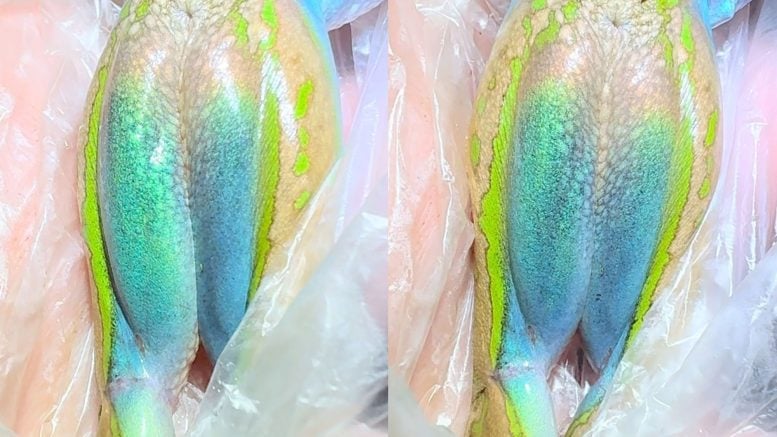
Researchers at the University of Newcastle discovered that the green and golden bell frog (Ranoidea aurea) has iridescent skin on its inner thighs. As the frog or observer moves, the normally blue area can appear green, creating one of the clearest examples of color shifting ever documented in an amphibian.
The finding, published in Austral Ecology, reveals that frog skin can manipulate light in a far more precise and complex way than scientists previously recognized. It may also explain how the species turns a concealed patch of skin into a sudden visual distraction when danger approaches.
The Science Behind Color-Shifting Skin
Unlike a permanent color produced by pigment, iridescence changes with the viewing angle. The effect is familiar from butterfly wings, beetle shells, and bird feathers, but it has rarely been confirmed in frogs.
“Iridescence occurs when color changes according to the angle from which it is viewed,” said lead author Dr. John Gould, a conservation biologist at the University of Newcastle.
“Two people standing in different locations can look at the same patch of tissue at the same time and see different colors. It’s a remarkable optical effect, but it’s very rarely documented in amphibians. Given the green and golden bell frog is such a well-known Australian species, our finding highlights how much remains to be discovered in the animal kingdom.”
How Color-Shifting Skin Could Confuse Predators
Photographs captured by the researchers show the frog’s inner thigh changing from blue to green as the viewing angle shifts. The transition confirms that the skin is genuinely iridescent rather than simply appearing different under changing levels of light.
Most of the time, the colorful area remains hidden beneath the frog’s body. It becomes visible when the animal stretches its legs, jumps, or quickly changes position.
Iridescence in the inner blue thigh skin of an adult green and golden bell frog. Credit: Newcastle University
That sudden burst of color may help the frog survive. Scientists think the blue thighs act as flash coloration, briefly startling a predator or drawing its attention away from the frog’s body as it escapes.
“The blue inner thigh is already thought to play an important role in anti-predator defense,” Dr. Gould said.
“Our findings suggest that iridescence may enhance that visual signal, making it even more conspicuous and attention-grabbing when the frog moves.”
Rethinking How Frogs Create Blue
The discovery also offers new clues about the microscopic architecture of frog skin.
Blue is an unusual color in nature because animals rarely make it with blue pigment. Instead, microscopic structures inside the tissue reflect and interfere with light, allowing certain wavelengths to reach the observer’s eyes. This is known as structural coloration.
Frogs produce green and blue shades using reflective platelets inside specialized skin cells. Until now, scientists had proposed that blue frog skin could be created largely through light scattering from structures arranged without a consistent pattern.
The Hidden Structure Behind the Color
True iridescence requires greater organization. The structures must be positioned in a way that changes how light is reflected at different angles, much like the microscopic features responsible for the shifting colors of butterfly wings.
“True iridescence only occurs when these microscopic structures are ordered as opposed to completely random, similar to what we see in butterfly wings,” Dr. Gould said.
“The presence of iridescence in this frog shows the blue color isn’t being produced through random scattering alone. Instead, it indicates that ordered reflective platelets are responsible for creating the structural blue color.”
What This Means for Amphibian Evolution
The results suggest that amphibian skin contains optical systems that researchers are only beginning to understand. Similar effects may have gone unnoticed because they appear only from certain angles or during brief movements.
“People are often surprised to learn that frogs produce structural colors at all,” Dr. Gould said.
“This study demonstrates that amphibian skin can be far more complex than we previously appreciated and suggests there may be other examples of iridescence waiting to be discovered.”
Reference: “Shifty Frogs: Evidence of Iridescence Among Amphibians” by John Gould, 6 July 2026, Austral Ecology.
DOI: 10.1111/aec.70259
Never miss a breakthrough: Join the SciTechDaily newsletter.
Follow us on Google and Google News.
1 Comment
That thumbnail caught me extremely off guard.