
Close Menu
    Facebook X (Twitter) Instagram
    SciTechDaily
    • Biology
    • Chemistry
    • Earth
    • Health
    • Physics
    • Science
    • Space
    • Technology
    Facebook X (Twitter) Pinterest YouTube RSS
    SciTechDaily
    Home»Space»Rate of Nuclear Reaction in Exploding Stars Identified by Mimicking Excited Quantum States With Exotic Nuclei
    Space

    Rate of Nuclear Reaction in Exploding Stars Identified by Mimicking Excited Quantum States With Exotic Nuclei

    By University of SurreyAugust 30, 2021No Comments2 Mins Read
    Facebook Twitter Pinterest Telegram LinkedIn WhatsApp Email Reddit
    Share
    Facebook Twitter LinkedIn Pinterest Telegram Email Reddit
    Aluminum-26 Nucleus
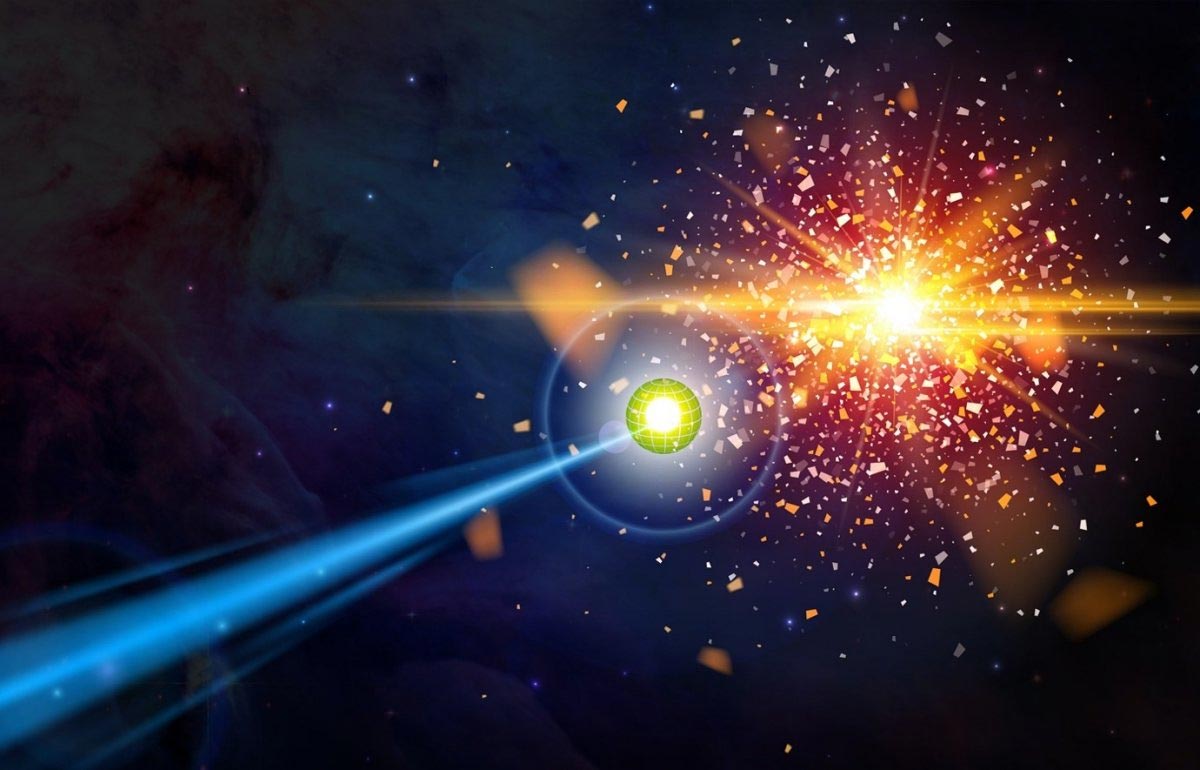
    The illustration shows an aluminum-26 nucleus (green) escaping a supernova explosion. It will subsequently decay via gamma-ray emission that can be observed by satellites. Credit: Erin O’Donnell, FRIB

    New research by Surrey’s Nuclear Physics Group has shown that it’s possible to mimic excited quantum states with exotic nuclei, opening up a host of opportunities for next generation radioactive beam facilities, such as the Facility for Rare Isotope Beams (FRIB).

    The results of the project – which was a collaboration between the University of Surrey and Michigan State University, USA – were published in Physical Review Letters in January 2021. The lead author was Surrey PhD student Samuel Hallam, who also studied for his undergraduate physics degree at Surrey.

    One of the biggest challenges in nuclear physics is measuring reactions that occur in excited quantum states, such as those found in exploding stars, due to their extreme temperature and density. Until now, physicists have had to determine the rates at which nuclear reactions occur in these conditions through theoretical estimates.

    This pioneering study has shown, for the first time, that it is possible to mimic an excited quantum state by using a completely separate nucleus.

    Dr. Gavin Lotay explains: “Our results now indicate that proton capture on the first, excited state of Aluminium-26 (found in stars) is likely to be ten times slower than was previously expected from theoretical estimates. This provides crucial insight into the analysis of meteoritic material and impacts on future theoretical studies of nucleosynthesis in exploding stars.”

    The research has already received significant attention around the world, with the US Department of Energy recently selecting it as one of its key Science Highlights.

    For more on this research, see Exploring Nuclear Reactions in Exploding Stars and the Origin of Aluminum-26.

    Reference: “Exploiting Isospin Symmetry to Study the Role of Isomers in Stellar Environments” by S. Hallam, G. Lotay, A. Gade, D. T. Doherty, J. Belarge, P. C. Bender, B. A. Brown, J. Browne, W. N. Catford, B. Elman, A. Estradé, M. R. Hall, B. Longfellow, E. Lunderberg, F. Montes, M. Moukaddam, P. O’Malley, W.-J. Ong, H. Schatz, D. Seweryniak, K. Schmidt, N. K. Timofeyuk, D. Weisshaar and R. G. T. Zegers, 29 January 2021, Physical Review Letters.
    DOI: 10.1103/PhysRevLett.126.042701

    Never miss a breakthrough: Join the SciTechDaily newsletter.
    Follow us on Google and Google News.

    Astronomy Astrophysics University of Surrey
    Share. Facebook Twitter Pinterest LinkedIn Email Reddit

    Related Articles

    400-Year-Old Cosmic Mystery Solved: New Class of Ancient Star System Discovered Hiding in Our Galaxy

    Mystery Solved? Hidden Black Hole Cluster Found in Omega Centauri

    Euclid Space Telescope Reveals How the Milky Way Tears Apart Star Clusters

    Galactic Archeologists Discover “Fossil” of One of the First Ever Galaxies

    Astrophysicists Create New Method to Measure Dark Matter in Dwarf Galaxies

    Baryon Oscillation Spectroscopic Survey Measures the Universe’s Expansion and Dark Energy

    SN Primo Is Farthest Type Ia Supernova Discovered

    Scientists Convene to Take a Picture of the Supermassive Black Hole at the Center of the Milky Way

    Hubble Observes Rare Blue Stars in Andromeda’s Core

    Leave A Reply Cancel Reply

    • Facebook
    • Twitter
    • Pinterest
    • YouTube

    Don't Miss a Discovery

    Subscribe for the Latest in Science & Tech!

    Trending News

    First-of-Its-Kind Discovery: Homer’s Iliad Found Embedded in a 1,600-Year-Old Egyptian Mummy

    Beyond Inflammation: Scientists Uncover New Cause of Persistent Rheumatoid Arthritis

    A Simple Molecule Could Unlock Safer, Easier Weight Loss

    Scientists Just Built a Quantum Battery That Charges Almost Instantly

    Researchers Unveil Groundbreaking Sustainable Solution to Vitamin B12 Deficiency

    Millions of People Have Osteopenia Without Realizing It – Here’s What You Need To Know

    Researchers Discover Boosting a Single Protein Helps the Brain Fight Alzheimer’s

    World-First Study Reveals Human Hearts Can Regenerate After a Heart Attack

    Follow SciTechDaily
    • Facebook
    • Twitter
    • YouTube
    • Pinterest
    • Newsletter
    • RSS
    SciTech News
    • Biology News
    • Chemistry News
    • Earth News
    • Health News
    • Physics News
    • Science News
    • Space News
    • Technology News
    Recent Posts
    • After Decades, MIT Researchers Capture the First 3D Atomic View of a Mysterious Material
    • Your Favorite Fishing Spot Is Turning Brown – and the Fish Are Changing
    • 380-Million-Year-Old Fish Fossil Reveals Secrets of Life’s First Steps Onto Land
    • Mezcal “Worm” in a Bottle Mystery: DNA Testing Reveals a Surprise
    • Scientists Turn Red Lettuce Green, Unlocking Hidden Nutrients
    Copyright © 1998 - 2026 SciTechDaily. All Rights Reserved.
    • Science News
    • About
    • Contact
    • Editorial Board
    • Privacy Policy
    • Terms of Use

    Type above and press Enter to search. Press Esc to cancel.