
Close Menu
    Facebook X (Twitter) Instagram
    SciTechDaily
    • Biology
    • Chemistry
    • Earth
    • Health
    • Physics
    • Science
    • Space
    • Technology
    Facebook X (Twitter) Pinterest YouTube RSS
    SciTechDaily
    Home»Chemistry»Reactor System Allows Visualizing Chemical Reactions in Real-Time [Video]
    Chemistry

    Reactor System Allows Visualizing Chemical Reactions in Real-Time [Video]

    By EPFLJanuary 9, 2020No Comments3 Mins Read
    Facebook Twitter Pinterest Telegram LinkedIn WhatsApp Email Reddit
    Share
    Facebook Twitter LinkedIn Pinterest Telegram Email Reddit
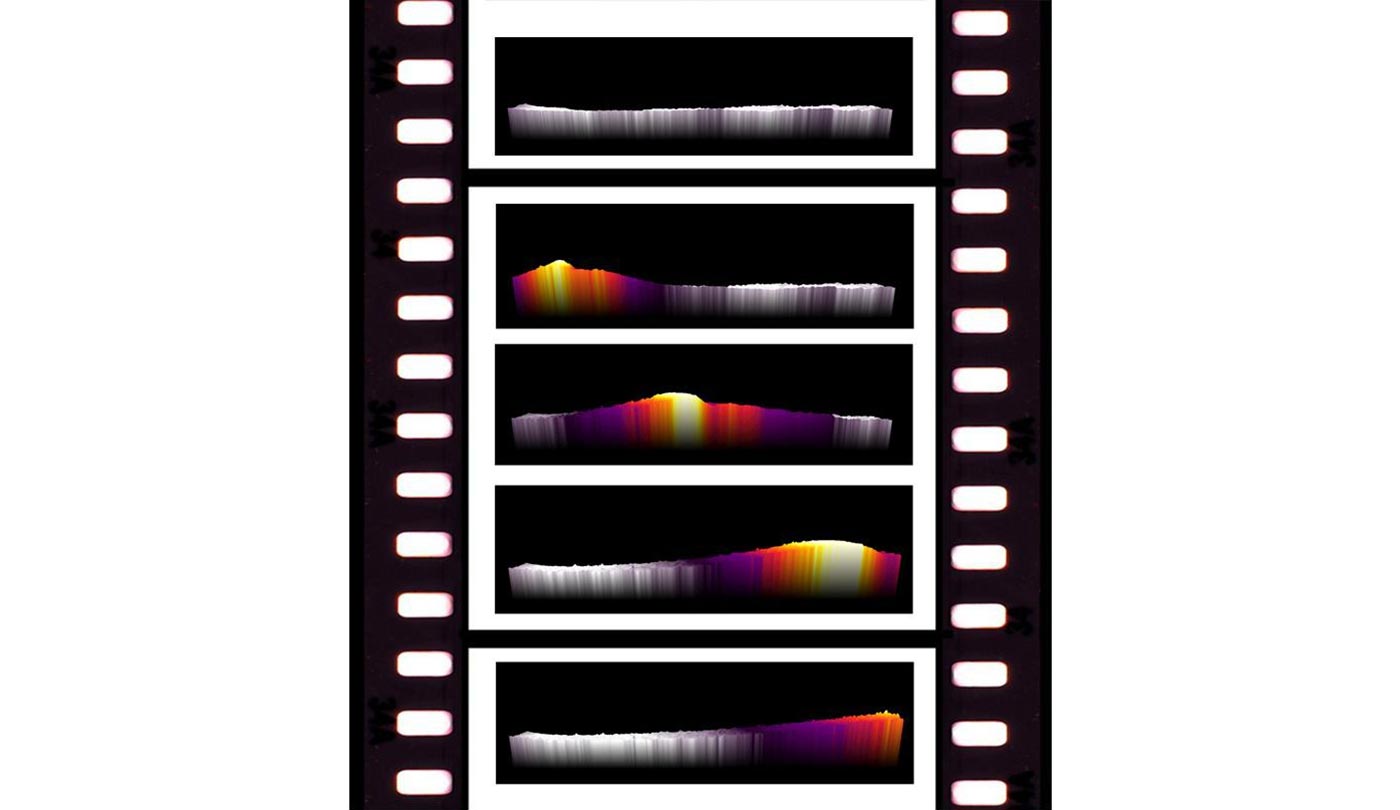
    Exothermic Surface Reaction Front Moving Over the Catalyst
    Thermal image sequence showing the exothermic surface reaction front moving over the catalyst. Credit: ACS Catalysis; DOI: 10.1021/acscatal.9b04475

    Researchers at EPFL have developed a reactor system and an analysis method that has allowed them to observe the real-time production of synthetic natural gas from CO2 and H2 for the first time.

    Infrared (IR) thermography is used to determine the temperature of humans and objects with high precision and without interfering with the system. A single image taken with an IR camera can capture the same amount of information as hundreds to millions of thermocouples (temperature sensors) at once. Furthermore, modern IR cameras can achieve fast acquisition frequencies of over 50 Hz, which allows the investigation of dynamic phenomena with high resolution.

    Now, scientists at EPFL have designed a reactor that can use IR thermography to visualize dynamic surface reactions and correlate it with other rapid gas analysis methods to obtain a holistic understanding of the reaction in rapidly changing conditions. The research was led by Robin Mutschler and Emanuele Moioli at the lab of Andreas Züttel (EPFL and Empa) and they collaborated with researchers at the Polytechnic University of Milan.

    The scientists applied their method to catalytic surface reactions between carbon dioxide and hydrogen, including the Sabatier reaction, which can be used to produce synthetic methane from renewable energy by combining CO2 from the atmosphere and H2 from water splitting, thus enabling the synthesis of renewable synthetic fuels with similar properties to their fossil counterparts which is why the Sabatier reaction has attracted a lot of attention recently. A catalyst is required in the Sabatier reaction to activate the relatively inert CO2 as a reactant.

    In particular the EPFL researchers focused on the investigation of dynamic reaction phenomena occurring during the reaction activation from different initial catalyst states.

    “The reaction on the catalyst is favored by a hydrogenated surface while an exposure to CO2 poisons the catalyst and inhibits a fast reaction activation,” says Mutschler.

    “Thanks to this new approach, we could visualize new dynamic reaction phenomena never observed before,” says Moioli.

    In their work they showed the catalyst working and responding to the changes in the feed gas composition and during its activation from different initial states in real time for the first time. By means of their results, the reaction startup and activation behavior are now better understood and it can lead to optimized reactor and catalyst designs to improve the performance of these reactor systems working in dynamic conditions.

    This is crucial since renewable energy typically provides energy and reactants stochastically and therefore the reactors converting renewable energy to fuels have to be adapted to work in dynamic conditions under certain circumstances.

    Reference: “Imaging catalysis: Operando investigation of the CO2 hydrogenation reaction dynamics by means of infrared thermography” by Robin Mutschler, Emanuele Moioli, Kun Zhao, Loris Lombardo, Emad Oveisi, Alessandro Porta, Leonardo Falbo, Carlo Giorgio Visconti, Luca Lietti and Andreas Züttel, 11 December 2019, ACS Catalysis.
    DOI: 10.1021/acscatal.9b04475

    Other contributors: Empa Materials Science & Technology

    Funding: Swiss National Science Foundation (SNSF)

    Never miss a breakthrough: Join the SciTechDaily newsletter.
    Follow us on Google and Google News.

    EPFL Molecular Physics Particle Physics
    Share. Facebook Twitter Pinterest LinkedIn Email Reddit

    Related Articles

    Banana Split: Extracting Hydrogen Fuel From Banana Peels

    A New Approach for Recycling Plastics

    New Inorganic Material Discovered With Lowest Thermal Conductivity Ever Reported

    Machine Learning Using Collective Knowledge to Crack the Oxidation States of Crystal Structures

    Quantization of Electric Charge: Absorption of an Individual Electron Captured on Film

    Breakthrough in Stabilization of Bio-Inspired Solar Energy Harvesting Materials

    Quark-Gluon Plasma – Which Filled the Universe Shortly After the Big Bang – Flows Like Water

    Uncovering Exotic Molecules of Astrochemical Interest

    New Molecule Developed to Store Solar Energy in Chemical Bonds

    Leave A Reply Cancel Reply

    • Facebook
    • Twitter
    • Pinterest
    • YouTube

    Don't Miss a Discovery

    Subscribe for the Latest in Science & Tech!

    Trending News

    Hair Loss May Be an Overlooked Side Effect of Ozempic and Mounjaro

    Scientists Develop a Groundbreaking Chip That Operates at Brain-Like Speed

    Viagra May Block a Hidden Pathway Cancer Cells Need To Spread

    How Brown Tree Snakes Became an Unstoppable Invasive Species

    Earth’s First Complex Organisms May Hold Clues to Life Beyond Our Planet

    A 25,000-Year-Old Ritual Tradition Was Hidden Beneath This Cave Floor

    Plant Compounds in Berries, Tea, and Cocoa May Support Healthy Brain Aging

    Scientists Turn an Old Antibiotic Back Into a Superbug Killer

    Follow SciTechDaily
    • Facebook
    • Twitter
    • YouTube
    • Pinterest
    • Newsletter
    • RSS
    SciTech News
    • Biology News
    • Chemistry News
    • Earth News
    • Health News
    • Physics News
    • Science News
    • Space News
    • Technology News
    Recent Posts
    • Quantum Computing’s “Dark Horse” Just Cleared a Major Hurdle
    • CERN Experiments Detect Signs of the Universe’s Primordial Matter
    • Ancient Immune Protein Could Hold the Key to Better Cancer Immunotherapy
    • Study Finds a Surprising Link Between Gut Microbes and Aging
    • Frequent Cannabis Users Wake Up With More “Stress Hormone”
    Copyright © 1998 - 2026 SciTechDaily. All Rights Reserved.
    • Science News
    • About
    • Contact
    • Editorial Board
    • Privacy Policy
    • Terms of Use

    Type above and press Enter to search. Press Esc to cancel.