
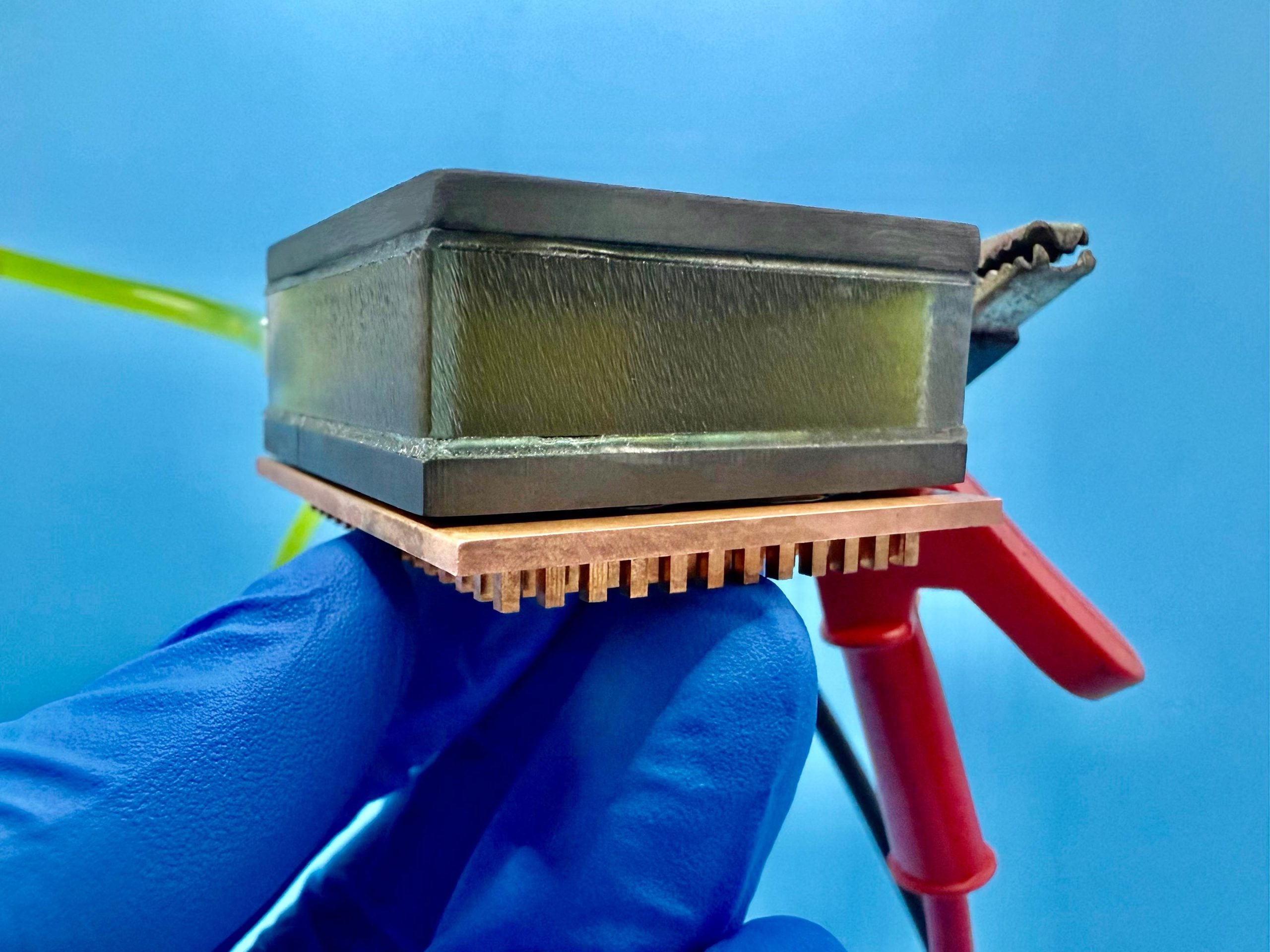
Scientists have enhanced thermogalvanic refrigeration, a cooling method that leverages electrochemical reactions.
By refining the electrolyte composition, they improved efficiency dramatically, making it a promising, low-energy alternative for cooling applications, from wearable tech to industrial systems.
A Breakthrough in Cooling Technology
Scientists have introduced a promising new cooling technology that could be more efficient and environmentally friendly than traditional refrigeration. Published on January 30 in the Cell Press journal Joule, the study explores thermogalvanic refrigeration, which harnesses reversible electrochemical reactions to generate a cooling effect. This method requires significantly less energy than conventional cooling systems, making it both cost-effective and scalable for applications ranging from personal cooling devices to large-scale industrial use.
“Thermogalvanic technology is on its way to our lives, either in the form of clean electricity or low-power cooling, and both research and commercial communities should be paying attention,” says senior author Jiangjiang Duan of Huazhong University of Science and Technology in Wuhan, China.
The Science Behind Thermogalvanic Cooling
Thermogalvanic cells typically convert heat into electrical power through reversible electrochemical reactions. By reversing this process—applying an external electrical current to drive these reactions—scientists can generate cooling. While previous research suggested limited cooling potential, Duan’s team significantly improved performance by refining the chemical composition of the system, unlocking new possibilities for practical applications.
“While previous studies mostly focus on original system design and numerical simulation, we report a rational and universal design strategy of thermogalvanic electrolytes, enabling a record-high cooling performance that is potentially available for practical application,” says Duan.
How Iron Ions Power the Cooling Effect
The cooling thermodynamic cells are based on electrochemical redox reactions involving dissolved iron ions. In one phase of the reaction, iron ions lose an electron and absorb heat (Fe3+ → Fe2+), and in the other phase, they gain an electron and release heat (Fe2+ → Fe3+). The power produced by the first reaction cools the surrounding electrolyte solution, and the heat produced by the first reaction is removed by a heat sink.
By tweaking the solutes and solvents used in the electrolyte solution, the researchers were able to improve the hydrogalvanic cell’s cooling power. They used a hydrated iron salt containing perchlorate, which helped the iron ions dissolve and dissociate more freely compared to other previously tested iron-containing salts such as ferricyanide. By dissolving the iron salts in a solvent containing nitriles rather than pure water, the researchers were able to improve the hydrogalvanic cell’s cooling power by 70%.
A Major Leap in Performance
The optimized system was able to cool the surrounding electrolyte by 1.42 K, which is a big improvement compared to the 0.1 K cooling capacity reported by previously published thermogalvanic systems.
Looking ahead, the team plans to continue optimizing their system’s design and is also investigating potential commercial applications.
“Though our advanced electrolyte is commercially viable, further efforts in the system-level design, scalability, and stability are required to promote the practical application of this technology,” says Duan. “In the future, we aim to continuously improve the thermogalvanic cooling performance by exploring novel mechanisms and advanced materials. We are also attempting to develop diverse refrigerator prototypes towards potential application scenarios and are seeking to collaborate with innovation companies to promote commercialization of thermogalvanic technologies.”
Reference: “Solvation entropy engineering of thermogalvanic electrolytes for efficient electrochemical refrigeration” by Yilin Zeng, Boyang Yu, Ming Chen, Jinkai Zhang, Pei Liu, Jinhua Guo, Jun Wang, Guang Feng, Jun Zhou and Jiangjiang Duan, 30 January 2025, Joule.
DOI: 10.1016/j.joule.2025.101822
This research was supported by the National Natural Science Foundation of China and the China National Postdoctoral Program for Innovative Talents.
Never miss a breakthrough: Join the SciTechDaily newsletter.
Follow us on Google and Google News.
4 Comments
How does this thermogalvanic response compare in efficiency to the thermoelectric effect of existing Peltier Junction coolers? Is it necessary to expend energy to reverse the thermogalvanic process to recharge the device?
Sorry, but I think you made a mistake in the writing. Electrons have negative charge. If an atom or ion loses an electron, then that atom becomes more positively charged, not less, as was written: (Fe3+ → Fe2+).
Fe3 has three negative charges associated with electrons. Loss of an electronic yields Fe2 which is more positively charged. I have no idea what the + signs are for.
I seriously question the environmental impacts of these electrolytes and technology, e.g. battery electrolytes are what are most harmful to the environment in terms of the mining of different compounds and the chemical processes and products necessary for synthesis. The synthesis consumes large volumes of different acids, and the processes are very harmful on water consumption, air pollution and soil contamination
Have comprehensive life cycle analyses been conducted on these kinds of technologies?