
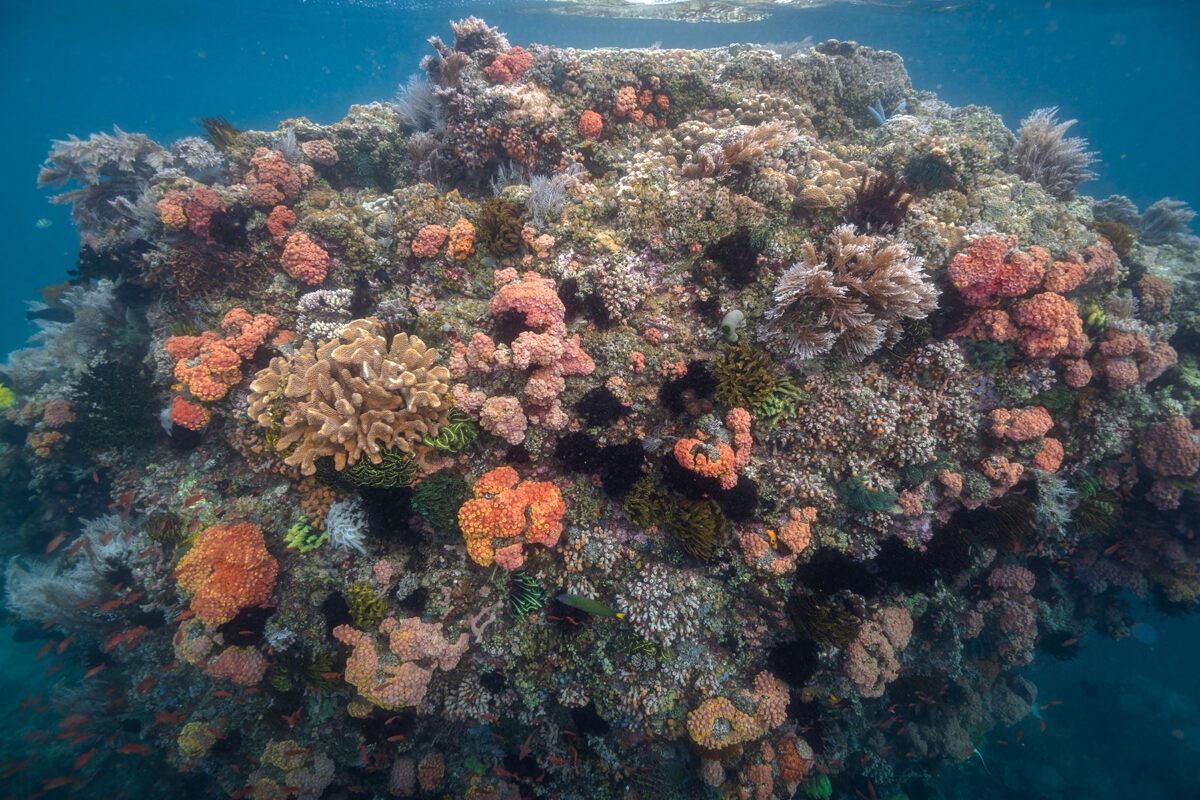
Researchers uncovered a coral reef thriving under high CO₂ stress from groundwater in the Philippines.
In 2019, a hydrology professor at The University of Texas at Austin set out on a research project to see if he could identify harmful nutrients flowing through groundwater into a delicate coral reef sanctuary in the Philippines. He achieved this goal, but following the long history of accidental scientific discoveries, he instead stumbled upon something completely unexpected: a region of possible “super corals” that are thriving despite high levels of carbon dioxide.
The findings based on the 2019 field work were published in August in the journal ACS ES&T Water.
Groundwater’s Hidden Influence on Reefs
For the first time, the UT Austin professor, Bayani Cardenas, and a team of international researchers were able to attribute the source of CO2 and other gases and nutrients in seawater at this location to groundwater, a finding that the researchers believe shows how the undersea reef environment can be vulnerable to the way communities discharge wastewater, agricultural runoff and other byproducts into the sea.
“This is an unseen vulnerability,” said Cardenas, a professor in the Department of Geological Sciences at the UT Jackson School of Geosciences. “We’ve been able to show with this site that groundwater is part of these delicate coral reef environments. There is a connection, and that’s still not as accepted in science and in many parts of the world.”
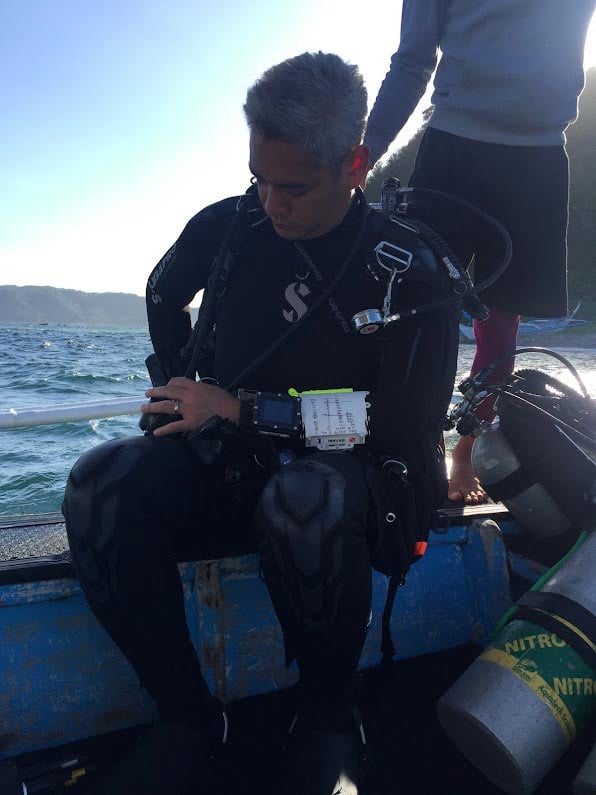
More than that, Cardenas said the research has led to new questions — and new research proposals — about the super corals they found that could be replicated elsewhere in the coming years as global CO2 levels are expected to rise.
Coral reefs have long been suffering due to climate change, most notably during a global coral bleaching event from 2014 to 2017 that caused heat stress to 75% of the world’s reefs, according to the American Meteorological Society. Yet the coral-filled area Cardenas studied in the Verde Island Passage in the Philippines, a region so vibrant and diverse that he refers to it as the “Amazon of the ocean,” is thriving despite the vast amounts of CO2 being pumped in from groundwater.
Lead author Rogger E. Correa, a researcher at Southern Cross University in Australia, estimated that groundwater is pumping about 989 grams of CO2 per square meter per year into the area they studied, which is known as “Twin Rocks” and borders a chain of volcanoes. That’s the equivalent of parking two cars on the seabed and letting them emit carbon dioxide for a full year on every hectare of reef.
Radon Tracers Reveal Carbon Sources
To distinguish groundwater from seawater, the scientists submerged devices that measure the levels of CO2 and radon 222, a naturally occurring radioactive isotope that is found in local groundwater but not in open ocean water. The measurement technique was developed by co-author Isaac Santos, a professor at the University of Gothenburg in Sweden.
This work follows a 2020 study conducted by Cardenas where he discovered CO2 bubbling up from the seafloor off an area of the Philippine coast so dramatically that he dubbed it “Soda Springs.”
The end result from the latest investigation is an entire region of coral reefs that must be studied more closely, said Cardenas, who is a geoscientist and not a coral researcher.
Adina Paytan, a research scientist at the Institute of Marine Sciences at the University of California, Santa Cruz, who was not associated with the study, warned that other human-made stressors, including sedimentation, overfishing and pollution, can still doom coral reefs. But she was heartened that Cardenas’ team showed corals can grow in high-carbon environments, a finding that “provides some hope for the future of corals.”
Reference: “Submarine Groundwater Discharge Releases CO2 to a Coral Reef” by Rogger E. Correa, M. Bayani Cardenas, Raymond S. Rodolfo, Mark R. Lapus, Kay L. Davis, Anna B. Giles, Jose C. Fullon, Mithra-Christin Hajati, Nils Moosdorf, Christian J. Sanders and Isaac R. Santos, 4 August 2021, ACS ES&T Water.
DOI: 10.1021/acsestwater.1c00104
Study co-authors included researchers from the Leibniz Centre for Tropical Marine Research (ZMT) in Germany; the State Office for Mining, Energy and Geology in Germany; and the following institutions in the Philippines: Ateneo de Manila University, Agricultural Sustainability Initiatives for Nature Inc., and Planet Dive Resort.
Never miss a breakthrough: Join the SciTechDaily newsletter.
Follow us on Google and Google News.
3 Comments
We have a problem here. We have the tools and knowledge at hand to eliminate Covid but we are incapable. If we cannot save ourselves how in the heck do we expect to save the planet or coral. Our future does not look too bright. reefreliefarchive.org
“Our future does not look too bright.”
The problem is, humans are not inherently rational creatures. We are only capable of rational behavior for short periods of time, in order to achieve our irrational goals. The difference between an average person, and someone who qualifies for Mensa, is that the bright person is better able to articulate their rationalizations for their irrational behavior. To compound the problem, the more personal the problem is, the more likely the response will be irrational. Thus, we have people denying what professional medical researchers are finding, and relying on what some high school dropout writes on a social media blog.
The solution is rigorous adherence to the Scientific Method whenever the ‘problem’ is more complex than “What is your favorite color,” or “Would you like fries with that?” Lest you leap to the conclusion that the answer to the claimed anthropogenic global warming is simply to “trust the science,” consider that the emotional involvement is far different for determining the mass of a neutrino than it is for ‘saving the world.’ That is exactly why the standard for scientific research has (until recently) been that of a detached observer. Once someone is convinced that they are doing the work of God, they are no longer abiding by the Scientific Method.
Uh-oh this flies in the face of AOC and all them cow farts.