
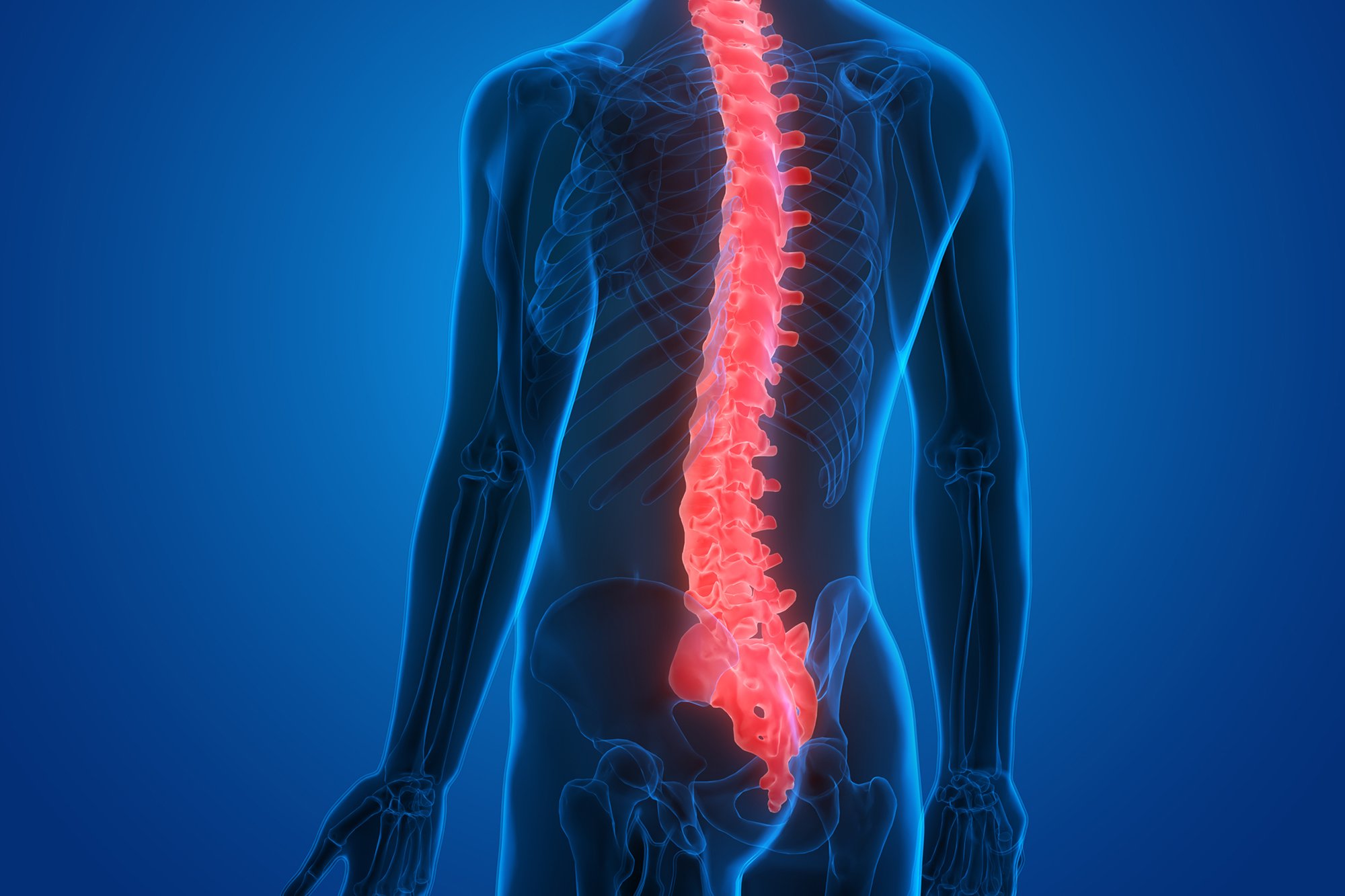
New research reveals that spinal cord neurons possess the capability to learn and retain information independently of the brain.
The spinal cord is often described as merely a conduit for transmitting signals between the brain and the body. However, the spinal cord can actually learn and remember movements on its own.
A team of researchers at the Leuven-based Neuro-Electronics Research Flanders (NERF) details how two different neuronal populations enable the spinal cord to adapt and recall learned behavior in a way that is completely independent of the brain. These remarkable findings, published in the journal Science, shed new light on how spinal circuits might contribute to mastering and automating movement. The insights could prove relevant in the rehabilitation of people with spinal injuries.
The spinal cord’s puzzling plasticity
The spinal cord modulates and finetunes our actions and movements by integrating different sources of sensory information, and it can do so without input from the brain. What’s more, nerve cells in the spinal cord can learn to adjust various tasks autonomously, given sufficient repetitive practice. How the spinal cord achieves this remarkable plasticity, however, has puzzled neuroscientists for decades.
One such neuroscientist is Professor Aya Takeoka. Her team at Neuro-Electronics Research Flanders (NERF, a research institute backed by imec, KU Leuven, and VIB) studies how the spinal cord recovers from injuries by exploring how the nerve connections are wired, and how they function and change when we learn new movements.
“Although we have evidence of ‘learning’ within the spinal cord from experiments dating back as early as the beginning of the 20th century, the question of which neurons are involved and how they encode this learning experience has remained unanswered,” says Prof. Takeoka.
Part of the problem is the difficulty in directly measuring the activity of individual neurons in the spinal cord in animals that are not sedated but awake and moving. Takeoka’s team took advantage of a model in which animals train specific movements within minutes. In doing so, the team uncovered a cell type-specific mechanism of spinal cord learning.
Two specific neuronal cell types
To check how the spinal cord learns, doctoral researcher Simon Lavaud and his colleagues at the Takeoka lab built an experimental setup to measure changes in movement in mice, inspired by methods used in insect studies. “We evaluated the contribution of six different neuronal populations and identified two groups of neurons, one dorsal and one ventral, that mediate motor learning.”
“These two sets of neurons take turns,” explains Lavaud. “The dorsal neurons help the spinal cord learn a new movement, while the ventral neurons help it remember and perform the movement later.”
“You can compare it to a relay race within the spinal cord. The dorsal neurons act like the first runner, passing on the critical sensory information for learning. Then, the ventral cells take the baton, ensuring the learned movement is remembered and executed smoothly.”
Learning and memory outside the brain
The detailed results, published in Science, illustrate that neuronal activity in the spinal cord resembles various classical types of learning and memory. Further unraveling these learning mechanisms will be crucial, as they likely contribute to different ways in which we learn and automate movement, and may also be relevant in the context of rehabilitation, says Prof. Aya Takeoka: “The circuits we described could provide the means for the spinal cord to contribute to movement learning and long-term motor memory, which both help us to move, not only in normal health but especially during recovery from brain or spinal cord injuries.”
Reference: “Two inhibitory neuronal classes govern acquisition and recall of spinal sensorimotor adaptation” by Simon Lavaud, Charlotte Bichara, Mattia D’Andola, Shu-Hao Yeh and Aya Takeoka, 11 April 2024, Science.
DOI: 10.1126/science.adf6801
The research (team) was supported by the Research Foundation Flanders (FWO), Marie Skłodowska-Curie Actions (MSCA), a Taiwan-KU Leuven PhD fellowship (P1040), and the Wings for Life Spinal Cord Research Foundation.
Never miss a breakthrough: Join the SciTechDaily newsletter.
Follow us on Google and Google News.
2 Comments
I’m glad they uncover the biological template to the earlier “motion pattern generators” that have been hypothesized to be positioned along the spinal column. Evolving local, independent control and keeping it makes sense even for fused segment tetrapods vs segmented lifeforms, and anyone that have danced more complicated dances appreciate the principle. You can “decouple” the various body parts in separate rhythmic schemes, and eventually also keep free creative style control on top if it suits the dance context.
This is so relevant to me at this point in my life, I’m waiting on surgery on my Brain Tumour whick sit on the base of my brain stem where my brain stem meets my spinal cord. Benine squogmous tumour which is 3cm in circumference. My rehabilitation depends on how surgery goes.