
Close Menu
    Facebook X (Twitter) Instagram
    SciTechDaily
    • Biology
    • Chemistry
    • Earth
    • Health
    • Physics
    • Science
    • Space
    • Technology
    Facebook X (Twitter) Pinterest YouTube RSS
    SciTechDaily
    Home»Health»Researchers Crack COVID-19 Genetic Signature Using AI, Identify Origin
    Health

    Researchers Crack COVID-19 Genetic Signature Using AI, Identify Origin

    By Western UniversityApril 29, 2020No Comments3 Mins Read
    Facebook Twitter Pinterest Telegram LinkedIn WhatsApp Email Reddit
    Share
    Facebook Twitter LinkedIn Pinterest Telegram Email Reddit
    Researchers Crack COVID 19 Genome Signature
    Researchers have identified an underlying genomic signature for 29 different COVID-19 DNA sequences using machine learning. This new tool will enable researchers to rapidly classify the virus and aid in strategic planning during a pandemic.

    Using machine learning, a team of Western computer scientists and biologists have identified an underlying genomic signature for 29 different COVID-19 DNA sequences.

    This new data discovery tool will allow researchers to quickly and easily classify a deadly virus like COVID-19 in just minutes – a process and pace of high importance for strategic planning and mobilizing medical needs during a pandemic.

    The study also supports the scientific hypothesis that COVID-19 (SARS-CoV-2) has its origin in bats as Sarbecovirus, a subgroup of Betacoronavirus.

    The findings, Machine learning using intrinsic genomic signatures for rapid classification of novel pathogens: COVID-19 case study, were published recently in PLOS ONE.

    The “ultra-fast, scalable, and highly accurate” classification system uses a new graphic-based, specialized software and decision-tree approach to illustrate the classification and arrive at the best choice out of all possible outcomes.
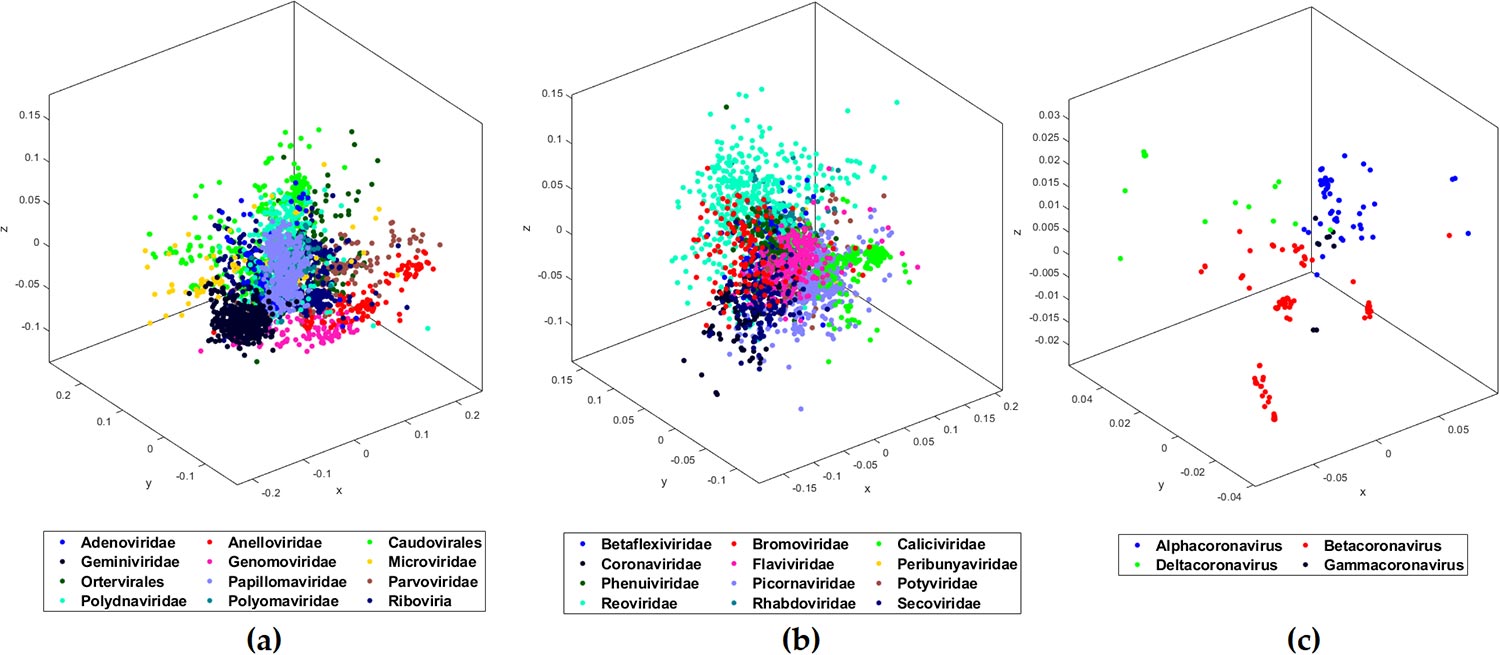
    MoDMap3D COVID-19 DNA
    MoDMap3D of (a) 3273 viral sequences from Test-1 representing 11 viral families and realm Riboviria, (b) 2779 viral sequences from Test-2 classifying 12 viral families of realm Riboviria, (c) 208 Coronaviridae sequences from Test-3a classified into genera. Credit: Randhawa, et. al., PLOS ONE, doi: 10.1371/journal.pone.0232391

    Biology professor Kathleen Hill co-led the study with Western collaborators in Computer Science and Statistical and Actuarial Sciences, along with others in the University of Waterloo’s Department of Computer Science.

    The machine-learning method achieves 100 percent accurate classification of the COVID-19 sequences and more importantly, discovers the most relevant relationships among more than 5,000 viral genomes again within minutes.

    “All we needed was the COVID-19 DNA sequence to discover its own intrinsic sequence pattern. We used that signature pattern and a logical approach to match that pattern as close as possible to other viruses and achieved a fine level of classification in minutes – not days, not hours but minutes,” Hill said.

    This classification tool has already been used to analyze more than 5,000 unique viral genomic sequences, including the 29 COVID-19 sequences available on January 27.

    Hill believes the tool, which is able to classify any newly discovered virus sequence COVID-19 or otherwise, will be an essential component in the toolkit for vaccine and drug developers, front-line health-care workers, researchers and scientists during this global pandemic and beyond.

    Reference: “Machine learning using intrinsic genomic signatures for rapid classification of novel pathogens: COVID-19 case study” by Gurjit S. Randhawa, Maximillian P. M. Soltysiak, Hadi El Roz, Camila P. E. de Souza, Kathleen A. Hill and Lila Kari, 24 April 2020, PLOS ONE.
    DOI: 10.1371/journal.pone.0232391

    Never miss a breakthrough: Join the SciTechDaily newsletter.
    Follow us on Google and Google News.

    COVID-19 DNA Genetics Machine Learning Popular Virology Western University
    Share. Facebook Twitter Pinterest LinkedIn Email Reddit

    Related Articles

    It’s Evolving: Coronavirus Genetic Mutation May Have Made COVID-19 More Contagious

    Researchers Identify Possible New Entry Points for SARS-CoV-2 / COVID-19 Into the Human Body

    Global COVID-19 Cases Now Dominated by New, More Infectious Strain of Virus

    Bats, Pangolins and Humans: COVID-19 Virus Likely Emerged From Recombination of Viral Genes Across Different Species

    Close Genetic Relative of SARS-CoV-2 Found in Bats Offers More Evidence It Evolved Naturally

    New COVID-19 Test Accurately Detects Viral DNA in Minutes

    Clues to COVID-19 Treatment From DNA of Patients With Severe Forms of Coronavirus Disease

    No Evidence COVID-19 Coronavirus Was Genetically Engineered in a Lab – Epidemic Has a Natural Origin

    “Snake Pneumonia” – Coronavirus Outbreak in China Traced to Snakes by Genetic Analysis

    Leave A Reply Cancel Reply

    • Facebook
    • Twitter
    • Pinterest
    • YouTube

    Don't Miss a Discovery

    Subscribe for the Latest in Science & Tech!

    Trending News

    Millions Take These IBS Drugs, But a New Study Finds Serious Risks

    Scientists Unlock Hidden Secrets of 2,300-Year-Old Mummies Using Cutting-Edge CT Scanner

    Bread Might Be Making You Gain Weight Even Without Eating More Calories

    Scientists Discover Massive Magma Reservoir Beneath Tuscany

    Europe’s Most Active Volcano Just Got Stranger – Here’s Why Scientists Are Rethinking It

    Alzheimer’s Symptoms May Start Outside the Brain, Study Finds

    Millions Take This Popular Supplement – Scientists Discover a Concerning Link to Heart Failure

    The Universe Is Expanding Too Fast and Scientists Can’t Explain Why

    Follow SciTechDaily
    • Facebook
    • Twitter
    • YouTube
    • Pinterest
    • Newsletter
    • RSS
    SciTech News
    • Biology News
    • Chemistry News
    • Earth News
    • Health News
    • Physics News
    • Science News
    • Space News
    • Technology News
    Recent Posts
    • Scientists Say a Hidden Structure May Exist Inside Earth’s Core
    • Doctors Surprised by the Power of a Simple Drug Against Colon Cancer
    • Why Popular Diabetes Drugs Like Ozempic Don’t Work for Everyone: The “Genetic Glitch”
    • Scientists Create Improved Insulin Cells That Reverse Diabetes in Mice
    • Scientists Stunned After Finding Plant Thought Extinct for 60 Years
    Copyright © 1998 - 2026 SciTechDaily. All Rights Reserved.
    • Science News
    • About
    • Contact
    • Editorial Board
    • Privacy Policy
    • Terms of Use

    Type above and press Enter to search. Press Esc to cancel.