
Close Menu
    Facebook X (Twitter) Instagram
    SciTechDaily
    • Biology
    • Chemistry
    • Earth
    • Health
    • Physics
    • Science
    • Space
    • Technology
    Facebook X (Twitter) Pinterest YouTube RSS
    SciTechDaily
    Home»Physics»CERN Searches for Matter–Antimatter Asymmetry in the Higgs Boson–Top Quark Interaction
    Physics

    CERN Searches for Matter–Antimatter Asymmetry in the Higgs Boson–Top Quark Interaction

    By CERNApril 29, 2020No Comments3 Mins Read
    Facebook Twitter Pinterest Telegram LinkedIn WhatsApp Email Reddit
    Share
    Facebook Twitter LinkedIn Pinterest Telegram Email Reddit
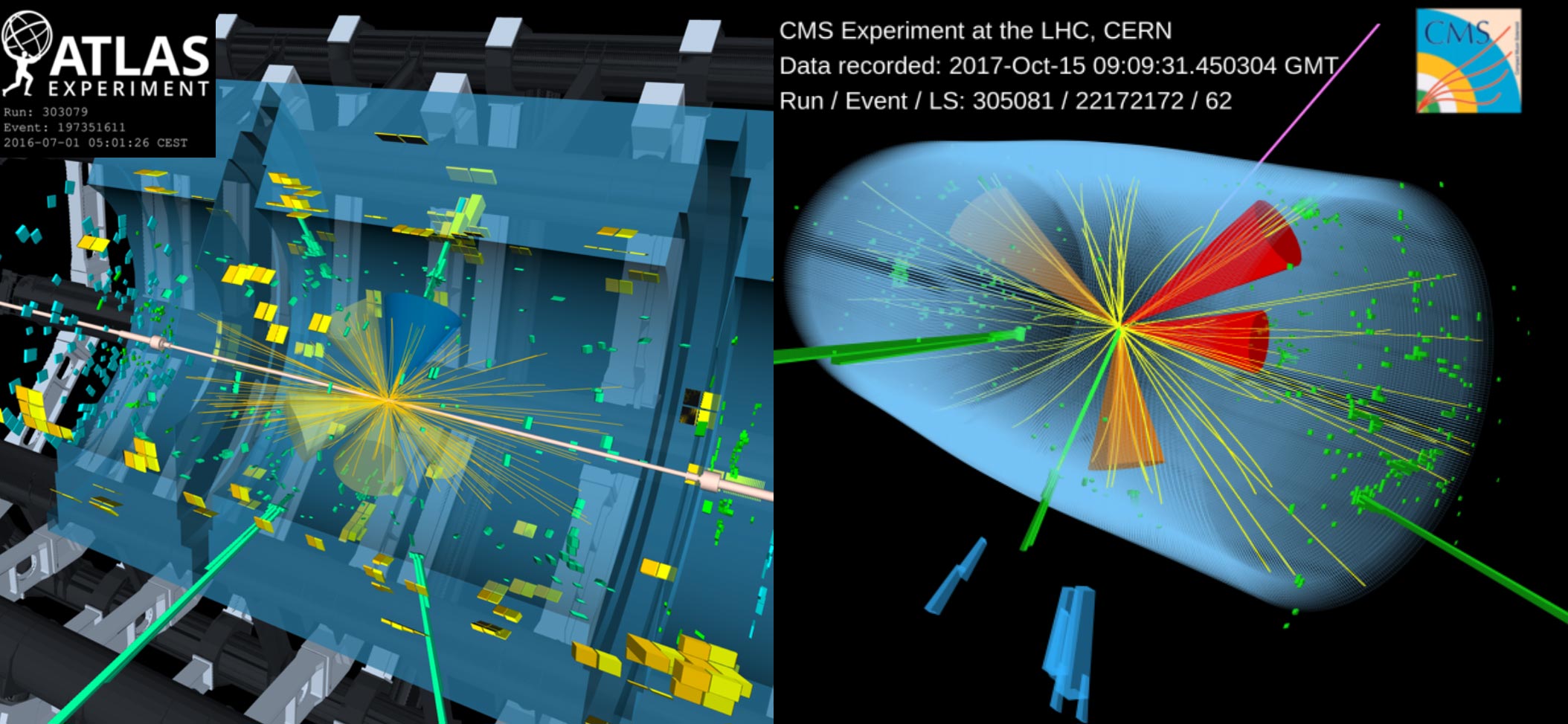
    ATLAS CMS Higgs Top Quark Event Displays
    CMS and ATLAS teams used LHC’s Run 2 dataset to study the top-Higgs interaction and found no CP violation. Credit: ATLAS Collaboration / CERN

    The ATLAS and CMS collaborations used the full LHC Run 2 dataset to obtain new insights into the interaction.

    Recent years have seen the study of the Higgs boson progress from the discovery age to the measurement age. Among the latest studies of the properties of this unique particle by the ATLAS and CMS collaborations are measurements that shed further light on its interaction with top quarks – which, as the heaviest elementary particle, have the strongest interactions with the Higgs boson. In addition to allowing a determination of the strength of the top-Higgs interaction, the analyses open a new window on charge-parity (CP) violation.

    Discovered unexpectedly more than 50 years ago, CP violation reveals a fundamental asymmetry in nature that causes rare differences in the rates of processes involving matter particles and their antimatter counterparts, and is therefore thought to be an essential ingredient to explaining the observed abundance of matter over antimatter in the universe. While the Standard Model of particle physics can explain CP violation, the amount of CP violation observed so far in experiments – recently in the behavior of charm quarks by the LHCb collaboration – is too small to account for the cosmological matter–antimatter imbalance. Searching for new sources of CP violation is thus of great interest to physicists.

    In their recent studies, the CMS and ATLAS teams independently performed a direct test of the properties of the top–Higgs interaction. The studies are based on the full dataset of Run 2 of the LHC, which allowed for more precise measurements and analyses of the collision events where the Higgs boson is produced in association with one or two top quarks before decaying into two photons. The detection of this extremely rare association, which was first observed by the two collaborations in 2018, required the full capacities of the detectors and analysis techniques.

    As predicted by the Standard Model, no signs of CP violation were found in the top–Higgs interaction by either experiment. The top–Higgs production rate, a measure of the strength of the interaction between the particles, was also found by both experiments to be in line with previous results and consistent with the Standard Model predictions.

    Following these first investigations of CP violation in the top–Higgs interaction, ATLAS and CMS physicists plan to study other Higgs-boson decay channels as part of the decades-long search for the origin of the universe’s missing antimatter.

    Never miss a breakthrough: Join the SciTechDaily newsletter.
    Follow us on Google and Google News.

    CERN Higgs Boson Particle Physics
    Share. Facebook Twitter Pinterest LinkedIn Email Reddit

    Related Articles

    Large Hadron Collider Detects Evidence of a Rare Higgs Boson Process: God Particle Decaying Into a Pair of Muons

    ATLAS Experiment Observes the Decay Signature of the Higgs Boson

    New CERN Research Details Evidence of the Direct Decay of the Higgs Boson to Fermions

    New Results Indicate That Particle Discovered at LHC Is a Higgs Boson

    Higgs Duality: Contradictory Results At LHC

    CERN to Announce the Latest Results from ATLAS and CMS

    Discussing the Search for the Higgs Particle

    More Data of Elusive Higgs Boson from Defunct US Tevatron Collider

    Higgs Boson Signals Gain Strength at Large Hadron Collider

    Leave A Reply Cancel Reply

    • Facebook
    • Twitter
    • Pinterest
    • YouTube

    Don't Miss a Discovery

    Subscribe for the Latest in Science & Tech!

    Trending News

    Sitting Up Straight Could Actually Help You Make Better Decisions

    Never-Before-Seen Vortices Are Swirling Across the Sun

    This Common Amino Acid May Help the Body Fight Cancer and Viruses

    Low-Protein “Longevity Diet” Linked to Fat Loss, Muscle Preservation, and Healthy Aging

    How Prehistoric Poop Changed Earth’s Ecosystems Forever

    This Fossil Upends a Decades-Old Debate About Snake Evolution

    A Blood Test Years Before Cancer May Reveal a Hidden Warning Sign

    Starlink Satellites Reveal a Hidden Atmosphere 300 Miles Above Earth

    Follow SciTechDaily
    • Facebook
    • Twitter
    • YouTube
    • Pinterest
    • Newsletter
    • RSS
    SciTech News
    • Biology News
    • Chemistry News
    • Earth News
    • Health News
    • Physics News
    • Science News
    • Space News
    • Technology News
    Recent Posts
    • Astronomers Caught a Star Exploding Almost the Instant It Began
    • Empty Space May Not Be Empty After All: Magnetar Reveals a Bizarre Quantum Effect
    • Humanity May Soon Have the Technology To Reach Other Star Systems
    • A “Double Punch” Nanoparticle Could Reveal and Destroy Brain Cancer Cells
    • Popular GLP-1 Weight-Loss Drugs Linked to 30% Lower Breast Cancer Risk
    Copyright © 1998 - 2026 SciTechDaily. All Rights Reserved.
    • Science News
    • About
    • Contact
    • Editorial Board
    • Privacy Policy
    • Terms of Use

    Type above and press Enter to search. Press Esc to cancel.