
A one-week mind-body retreat led to consistent changes in the brain and at the molecular level that were associated with greater resilience, reduced pain, and improved recovery from stress.
Researchers at the University of California, San Diego report that a short, intensive retreat combining several mind-body practices, including meditation and healing exercises, led to fast and widespread changes in brain activity and blood biology.
The team found that the program activated natural physiological systems linked to brain plasticity, metabolism, immune function, and pain regulation. Published in Communications Biology, the study offers new evidence that mental and psychological practices can produce measurable effects on physical health.
A long history, little biology
Meditation and other mind-body approaches have been used across cultures for thousands of years to support health and well-being, yet the biological mechanisms behind these practices have remained largely unclear.
This new research, part of a multi-million-dollar initiative funded by the InnerScience Research Fund, is the first to systematically measure the biological impact of combining multiple mind-body techniques over a brief, concentrated period.

“We’ve known for years that practices like meditation can influence health, but what’s striking is that combining multiple mind-body practices into a single retreat produced changes across so many biological systems that we could measure directly in the brain and blood,” said senior study author Hemal H. Patel, Ph.D., professor of anesthesiology at UC San Diego School of Medicine and research career scientist at the Veterans Affairs San Diego Healthcare System. “This isn’t about just stress relief or relaxation; this is about fundamentally changing how the brain engages with reality and quantifying these changes biologically.”
Inside an intensive retreat experiment
The study involved 20 healthy adults who took part in a seven-day residential program led by neuroscience educator and author Joe Dispenza, D.C. The retreat included daily lectures, about 33 hours of guided meditation, and group healing sessions. These activities followed an “open-label placebo” model, meaning participants were aware that the healing practices were presented as placebos, defined as procedures or treatments without an active medical ingredient that can still produce real effects through expectation, social connection, and shared experience.
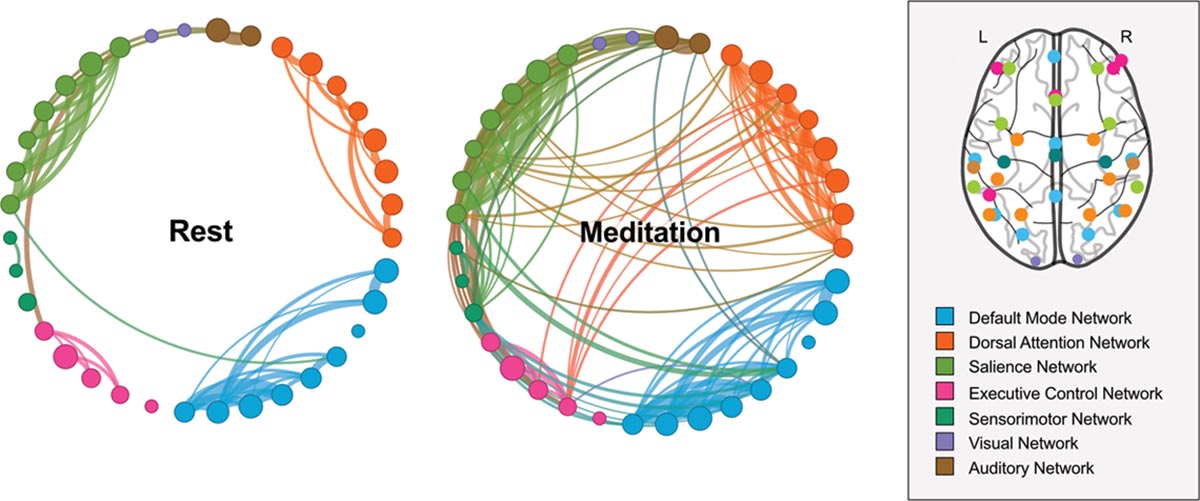
Before and after the retreat, participants had their brains scanned using functional magnetic resonance imaging (fMRI), an approach that measures brain activity in real time. The researchers also used blood testing to measure changes in metabolic activity, immune activation, and other biological functions.
The researchers observed several major changes after the retreat:
- Brain network changes: Meditation practiced during the retreat lowered activity in brain regions linked to constant internal thought, resulting in more streamlined and efficient brain function overall.
- Enhanced neuroplasticity: When researchers exposed laboratory-grown neurons to blood plasma collected after the retreat, the brain cells developed longer extensions and formed additional connections, indicating increased capacity for neural growth.
- Metabolic shifts: Cells treated with post-retract plasma showed higher levels of glycolytic (sugar-burning) metabolism, reflecting a metabolic state that is more flexible and better able to adapt to changing demands.
- Natural pain relief: After the retreat, participants had higher blood levels of endogenous opioids, the body’s own pain-relieving compounds, suggesting activation of natural pain control systems.
- Immune activation: Meditation led to simultaneous increases in both inflammatory and anti-inflammatory immune signals, pointing to a balanced and adaptive immune response rather than simple immune suppression or stimulation.
- Gene and molecular signaling changes: Analysis of blood samples revealed shifts in small RNA and gene activity following the retreat, especially in biological pathways connected to brain function.
Participants also completed the Mystical Experience Questionnaire (MEQ-30) to assess whether they had a “mystical” experience during meditation—characterized by profound feelings of unity, transcendence, and altered states of consciousness. Average MEQ scores increased significantly after the retreat, rising from 2.37 before the retreat to 3.02 afterwards. Higher scores on these surveys were also correlated with greater biological changes after the retreat, including greater integration of brain activity across different regions. In other words, the more connected the brain is, the greater the likelihood of a mystical experience.
Parallels with psychedelic brain states
The findings suggest that intensive meditation can trigger very similar brain activity to that which has been previously documented with psychedelic substances.
“We’re seeing the same mystical experiences and neural connectivity patterns that typically require psilocybin, now achieved through meditation practice alone,” added Patel. “Seeing both central nervous system changes in brain scans and systemic changes in blood chemistry underscores that these mind-body practices are acting on a whole-body scale.”
Toward clinical and therapeutic use
The study results provide a biological framework for understanding how non-drug mind-body interventions can support health and well-being. By enhancing neuroplasticity and activating the immune system, these practices could help promote mental health, emotional regulation, and stress resilience. Additionally, the activation of endogenous opioid pathways suggests that this combination of mind-body practices may also be useful for chronic pain management.
While the retreat’s effects were measured in healthy adults, the researchers emphasize that controlled trials in patient populations are still needed to determine specific clinical benefits and applications. They are particularly interested in whether mind-body retreats can benefit people with chronic pain, mood disorders or immune-related conditions.
Looking ahead, the research team plans to investigate how each individual component of the retreat — meditation, reconceptualization, and open-label placebo healing — works alone and in combination. Additionally, future studies will investigate the duration of these biological changes and whether repeated interventions can enhance or sustain their effects.
“This study shows that our minds and bodies are deeply interconnected — what we believe, how we focus our attention, and the practices we participate in can leave measurable fingerprints on our biology,” said first author Alex Jinich-Diamant, a doctoral student in the Departments of Cognitive Science and Anesthesiology at UC San Diego. “It’s an exciting step toward understanding how conscious experience and physical health are intertwined, and how we might harness that connection to promote well-being in new ways.”
Reference: “Neural and molecular changes during a mind-body reconceptualization, meditation, and open label placebo healing intervention” by Alex Jinich-Diamant, Sierra Simpson, Juan P. Zuniga-Hertz, Ramamurthy Chitteti, Jan M. Schilling, Jacqueline A. Bonds, Laura Case, Andrei V. Chernov, Joe Dispenza, Jacqueline Maree, Natalia Esther Amkie Stahl, Michael Licamele, Narin Fazlalipour, Swetha Devulapalli, Leonardo Christov-Moore, Nicco Reggente, Michelle A. Poirier, Tobias Moeller-Bertram and Hemal H. Patel, 6 November 2025, Communications Biology.
DOI: 10.1038/s42003-025-09088-3
This work was supported by the InnerScience Research Fund and a Veterans Administration Research Career Scientist Award (BX005229).
Disclosure: One co-author (Joe Dispenza) is employed by Encephalon, Inc., the company offering the retreat; all other authors declare no competing interests.
Never miss a breakthrough: Join the SciTechDaily newsletter.
Follow us on Google and Google News.
19 Comments
Sheer chicanium for this proto-centenarian.
Yes, chicanery is often sponsored by the VA: This work was supported by the InnerScience Research Fund and a Veterans Administration Research Career Scientist Award (BX005229). Pretty well known tie in between the VA medical system and Buddhists too.
Sounds like just California dreaming to me.
“A one-week mind-body retreat led to …”
Or so they claim! It reads like an advertisement for Esalen in Big Sur (Calif.) or Erhard Seminars Training (EST), also of California fame.
“The placebo effect is a phenomenon where a person experiences a real improvement in their symptoms after receiving a treatment that has no therapeutic value, such as a sugar pill. This effect is often linked to the individual’s expectations and beliefs about the treatment, demonstrating the powerful connection between the mind and body.”
What I find interesting about this line of research is that it’s measuring physiological and neurological changes, not belief systems. Whether someone connects meditation to spirituality or just stress reduction, it’s fascinating to see the body respond so measurably.
“This work was supported by the InnerScience Research Fund and a Veterans Administration Research Career Scientist Award (BX005229).”
Yes, that certainly backs up your theory.
Comparing a mind-body retreat to Erhard (mispelled) is a new level of gross mis-understanding of the human body
California,
Just medical science attempting to verify what Buddhists have known for millenia.
Namaste.
The findings are interesting, but what’s largely missing from coverage like this is a serious discussion of risk, limits, and long-term effects.
Rapid changes in brain connectivity, neuroplasticity markers, immune signaling, and endogenous opioid activity are not inherently “good” or “bad” — they’re powerful. Any intervention capable of shifting multiple biological systems in a short time frame deserves the same scrutiny we apply to drugs or other intensive interventions.
Questions that seem worth asking:
How durable are these changes weeks or months later?
Are there subgroups for whom such rapid shifts are destabilizing rather than beneficial?
Were adverse experiences, psychological distress, or negative after-effects systematically tracked?
How do we distinguish adaptive plasticity from maladaptive or dysregulating changes?
Historically, many practices with real effects were embraced early for benefits and only later examined for unintended consequences. Caution isn’t opposition — it’s part of responsible science.
I’d be genuinely interested to see follow-up work that looks not just at short-term biological markers, but at long-term stability, variability between individuals, and potential risks, not only benefits.
Look up the qork of Dr. Willoughby Britton. She has cataloged 57 adverse events with these kinds of retreats, and 56 are also sometimes seen as positive. The only one that no one thinks is positive is suicide after these retreats.
She has been in some good YouTube interviews describing the dangers.
She says a lot of the leaders of these retreats kept ending up in the psych ward where she worked, leading her to study deeper.
She found out widely known among practitioners, but seldom mentioned is that the people who meditate the most are also known to be the ones who sleep way less than normal.
It seemed the threshold for bad events occuring was sessions exceeding about 20 minutes per day. It is very easy for people to exceed that as they try to amplify the benefits.
Studies have shown that people reporting so-called ‘adverse effects’ are glad to have practiced meditation and believe that meditation positively contributes to their mental health. Other studies indicate that a lack of understanding of the theoretical foundations of meditation is the reason why some people struggle with it (and call it ‘adverse effects’). Remember that even exercise has many adverse effects like muscle pains, but we know that it is good for us. Further, lots of studies indicate that meditation is beneficial for sleep.
Lots of other research has demonstrated that brain structural changes are positively linked to psychological changes like reductions in stress.
Please google: research on long term effects of meditation. The AI answer is accurate as to what I have read. I am a Buddhist and very interested in the topic of this. Studies have been done on Buddhist monks and Catholuc nuns (on the grounds that repeating the rosary, etc. has the same effects). Yes, the positive effects of meditation seem to be powerful and longterm.
Noticed I put the disclaimer at the bottom of the article. Joe dispenza, who was involved in a cult since the age of 27 with the Ramtha School of Enlightenment and it’s cult leader J.Z. Knight. Joe Dispenza spent 17 years under her tutelage. She then made him a master teacher at her cult. He taught there for 7 years, then realized he could make millions of dollars like his cult teacher. So he went out on his own and started these retreats. Joe Dispenza, works for encephalon, who just happens to be the company conducting the retreat.
As someone who has been to two of these week long retreats.. .it’s real. It’s all REAL!
All of these comments remind me of Plato’s allegory of the Cave. Unless you have experienced it all, you can do is judge it from a not knowing state. I agree with Jackie. Its absolutley real.
Hi, nicely done job.
Meditation is the power to overwhelm the old ways, like the jedi trainings.