
A Universal Nanoparticle Response Links Immunity Across Species
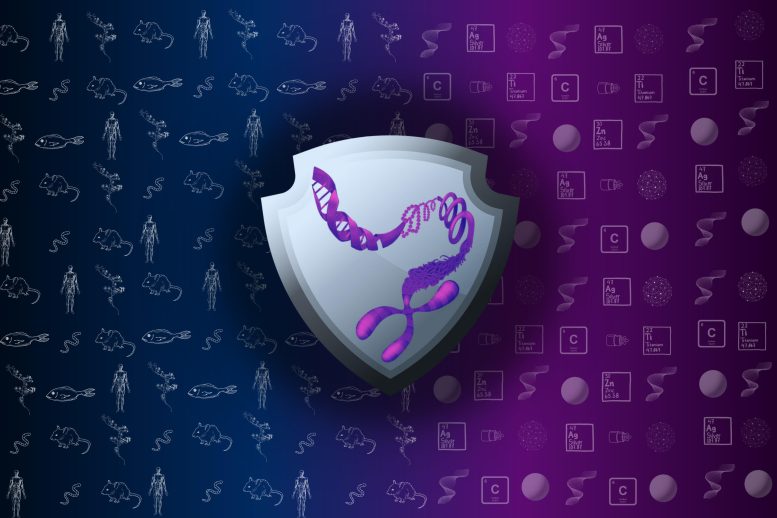
Scientists from the Finnish Hub for Development and Validation of Integrated Approaches (FHAIVE FHAIVE) and Tampere University have uncovered a novel response mechanism related to nanoparticle exposure that’s shared across various species.
Dr. Giusy del Giudice, a doctoral researcher, through extensive data analysis concerning the molecular response to nanomaterials, has shed light on an ancestral epigenetic defense mechanism. This discovery elucidates the adaptation process of diverse species, from humans to more basic organisms, over time to such exposures.
The results of the research coordinated by Professor Dario Greco of the Faculty of Medicine and Health Technologies were recently published in the prestigious journal Nature Nanotechnology.
“We have demonstrated for the first time that there is a specific response to nanoparticles, and it is interlinked to their nano-properties. This study sheds light on how various species respond to particulate matter in a similar manner. It proposes a solution to the one-chemical-one-signature problem, currently limiting the use of toxicogenomic in chemical safety assessment,” Director of the FHAIVE, Professor of Bioinformatics at Tampere University Dario Greco says.
Linking Nanoparticles and Immunity
The implications of this study go beyond the field of toxicology. The COVID-19 pandemic highlighted the importance of immune activation in predicting the clinical outcome of a viral infection. In more polluted areas, COVID-19 had a more severe impact on the human population.
“Our results uncover an important link between understanding the basic defense mechanisms in living organisms and their immune functions”, Greco points out.
“When it comes to drugs or viruses, we have understood that any exposure or infection leaves a trace on our immune system and that this trace will affect the way we respond to future agents. Now, we have evidence that even particulate matter primes our immunity,” says Giusy del Giudice, the first author of the scientific publication.
The detrimental effects of air pollution on respiratory functions have been long known, but only recently scientists from The Francis Crick Institute proved it to be among the driving causes of lung cancer in non-smokers. In both cases, COVID-19 and lung cancer, the impact of particulate on the immune system contributed to these effects.
“The association between particulate matter and immune activation is of utmost importance and may lead to crucial epidemiological implications,” del Giudice says.
A Step Closer to Planetary Health
Another important lesson learned from the COVID-19 pandemic concerns the concept of planetary health: all living organisms on the Earth are interconnected, and the effects on one specie will eventually propagate to others. In this regard, the results of this study open also new avenues to formulate integrated models that predict the effects of chemical exposures on many species at a time.
“Our results move in this direction by describing fundamental defense mechanisms common to many species throughout the tree of life”, del Giudice says.
Nanotechnology plays an important part in many fields, from biomedicine to energy and climate. Engineered nanomaterials are chemical substances or materials with particle sizes just between 1 to 100 nanometres, one-third of a human hair.
Currently, thousands of consumer products contain nanomaterials, which requires testing their possible health and environmental effects. Because traditional toxicology relies on animal or in vitro tests to monitor phenotypic changes in response to exposures, it cannot keep in pace with this technological development.
“We cannot test every new nanomaterial on every possible species on Earth. We need innovative ways to reliably assess possible dangerous products as quickly as possible. Scientific evidence such as the one generated in this study can help to develop new models that do not require large amounts of animal experiments,” Grego says.
Reference: “An ancestral molecular response to nanomaterial particulates” by G. del Giudice, A. Serra, L. A. Saarimäki, K. Kotsis, I. Rouse, S. A. Colibaba, K. Jagiello, A. Mikolajczyk, M. Fratello, A. G. Papadiamantis, N. Sanabria, M. E. Annala, J. Morikka, P. A. S. Kinaret, E. Voyiatzis, G. Melagraki, A. Afantitis, K. Tämm, T. Puzyn, M. Gulumian, V. Lobaskin, I. Lynch, A. Federico and D. Greco, 8 May 2023, Nature Nanotechnology.
DOI: 10.1038/s41565-023-01393-4
This research was carried out within the EU project NanoSolveIT that establishes computational models to test environmental health and safety of engineered nanomaterials. The study was led by FHAIVE, and it involved researchers from universities across Europe, as well as in the United States, Australia, South Africa, Japan, and South Korea. Moreover, FHAIVE also develops alternatives to animal testing at a national level.
Never miss a breakthrough: Join the SciTechDaily newsletter.
Follow us on Google and Google News.