
Close Menu
    Facebook X (Twitter) Instagram
    SciTechDaily
    • Biology
    • Chemistry
    • Earth
    • Health
    • Physics
    • Science
    • Space
    • Technology
    Facebook X (Twitter) Pinterest YouTube RSS
    SciTechDaily
    Home»Space»Researchers Discover Oxygen Molecules in Dione’s Exosphere
    Space

    Researchers Discover Oxygen Molecules in Dione’s Exosphere

    By University College LondonMarch 2, 2012No Comments3 Mins Read
    Facebook Twitter Pinterest Telegram LinkedIn WhatsApp Email Reddit
    Share
    Facebook Twitter LinkedIn Pinterest Telegram Email Reddit
    Dione
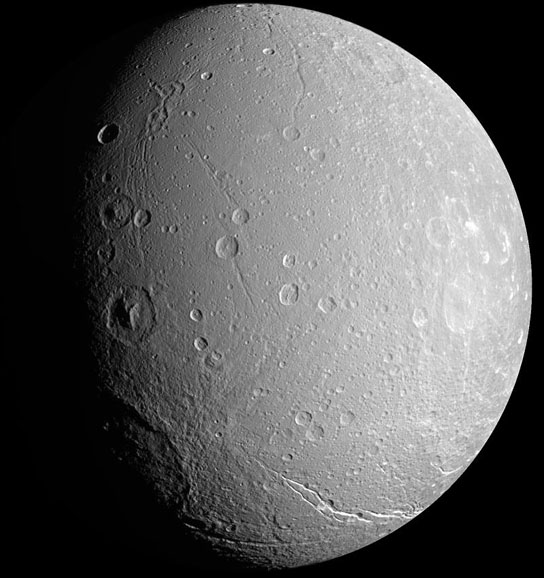
    The Cassini spacecraft investigates the craters and deep valleys on Dione during a close approach in April 2007. Significant variations in the density of impact craters on the surface of Dione can be seen here, with more craters seen on the right side of this mosaic (on Dione’s sub-Saturn hemisphere) than on the left (on Dione’s anti-Saturn hemisphere). The southern end of the bright Palatine Linea fracture system can be seen near the bottom of the mosaic. Along the terminator, at lower left, part of a large impact basin can be seen. Credit: NASA/JPL/Space Science Institute

    By combining data from one of Cassini’s instruments, called CAPS (Cassini Plasma Spectrometer), researchers discovered that Dione’s exosphere contains molecules of oxygen. The researchers estimate the density of the molecular oxygen ions to be in the range of 0.01 to 0.09 ions per cubic centimeter and are produced when neutral molecules are ionized.

    Dione, one of Saturn’s icy moons, has a weak exosphere that includes molecules of oxygen, according to new findings from the Cassini-Huygens mission.

    The international mission made the discovery using combined data from one of Cassini’s instruments, called CAPS (Cassini Plasma Spectrometer), which includes a sensor designed and built at the University College London’s Mullard Space Science Laboratory.

    Dione joins Rhea and the main rings in Saturn’s system in having an oxygen-rich exosphere, as well as Jupiter’s moons Ganymede, Europa, and Callisto — the target for ESA’s proposed JUICE (JUpiter ICy moons Explorer) mission for launch in 2022.

    Professor Andrew Coates (UCL Mullard Space Science Laboratory), one of the authors of the study said: “It now looks like oxygen production is a universal process wherever an icy moon is bathed in a strong trapped radiation and plasma environment.

    “Energetic particles hit the icy surface, the hydrogen is lost and molecular oxygen remains as an exosphere. We now know that this happens at Saturn’s moons as well as Jupiter’s — and it may well occur in extrasolar planetary systems too.”

    Cassini flew by Dione on April 7, 2010. During that flyby, CAPS detected molecular oxygen ions near the moon’s icy surface, due to bombardment by particles trapped in Saturn’s strong magnetic field. The research is published online in the journal Geophysical Research Letters.

    A team of scientists, led by Robert Tokar at the Los Alamos National Laboratory in the US, used the measurements to estimate the density of the molecular oxygen ions to be in the range of 0.01 to 0.09 ions per cubic centimeter. These molecular oxygen ions are produced when neutral molecules are ionized; the measurements confirm that a neutral exosphere surrounds Dione.

    Electron measurements from UCL’s electron spectrometer (ELS), part of CAPS, played a key role in reaching the conclusion of an exosphere, data from ELS showed the plasma wake due to Dione and characterized the changes in Saturn’s magnetosphere during the flyby.

    Dr. Geraint Jones (UCL Mullard Space Science Laboratory), also an author of the paper, said: “Dione’s exosphere is very thin — compared to Earth’s atmosphere the density is about a million billionth. The exciting thing is that there is oxygen — and the oxygen may be being recycled via the surface.”

    Never miss a breakthrough: Join the SciTechDaily newsletter.
    Follow us on Google and Google News.

    Cassini-Huygens Mission Dione Moon Oxygen University College London
    Share. Facebook Twitter Pinterest LinkedIn Email Reddit

    Related Articles

    New Cassini Images of Saturn’s Moon Dione

    Cassini Reveals Titan’s Atmosphere Even More Earth-like Than Previously Thought

    Cassini Images Captures Dione Dwarfing Rhea

    Cassini Views the Wisps of Dione

    Evidence of Activity at Saturn Moon Dione

    Saturn’s Moon Phoebe Has Planet-Like Qualities

    Cassini Explores Titan’s Lake, Similarities to Etosha Salt Pan

    Cassini Views Saturn’s Moons Enceladus and Tethys

    Research Papers Explore Titan’s Atmosphere

    Leave A Reply Cancel Reply

    • Facebook
    • Twitter
    • Pinterest
    • YouTube

    Don't Miss a Discovery

    Subscribe for the Latest in Science & Tech!

    Trending News

    A Long-Held Idea About Alzheimer’s Tau May Be Wrong

    Your Favorite Scented Cleaner Could Be Filling the Air With Invisible Pollution

    New Study Reveals a Major Shift Behind Rising ADHD and Autism Diagnoses

    New Treatment Cuts “Bad” Cholesterol in Half for a Full Year

    Astronomers Expected More Tiny Worlds Beyond Neptune – Webb Found Something Else

    Scientists Discover New Compound That Burns Fat Without Killing Your Appetite

    Mount Vesuvius Buried These Scrolls for 2,000 Years – Now Scientists May Read Them

    The Asteroid That Killed the Dinosaurs Was Stranger Than We Thought

    Follow SciTechDaily
    • Facebook
    • Twitter
    • YouTube
    • Pinterest
    • Newsletter
    • RSS
    SciTech News
    • Biology News
    • Chemistry News
    • Earth News
    • Health News
    • Physics News
    • Science News
    • Space News
    • Technology News
    Recent Posts
    • Astronomers Just Caught a Giant Planet in the Act of Forming
    • NASA Planned for 10 Years. The Roman Space Telescope May Keep Going for 22
    • Two Dead Stars Are Racing Around Each Other Every 6.2 Minutes
    • Scientists Reassess a Major Risk of Breast Cancer Screening
    • Every Breath Leaves a Unique Signature in Your Brain, Study Finds
    Copyright © 1998 - 2026 SciTechDaily. All Rights Reserved.
    • Science News
    • About
    • Contact
    • Editorial Board
    • Privacy Policy
    • Terms of Use

    Type above and press Enter to search. Press Esc to cancel.