
Close Menu
    Facebook X (Twitter) Instagram
    SciTechDaily
    • Biology
    • Chemistry
    • Earth
    • Health
    • Physics
    • Science
    • Space
    • Technology
    Facebook X (Twitter) Pinterest YouTube RSS
    SciTechDaily
    Home»Health»Researchers in China Use Radiomics To Predict Heart Attacks
    Health

    Researchers in China Use Radiomics To Predict Heart Attacks

    By SciTechDailyFebruary 14, 2023No Comments4 Mins Read
    Facebook Twitter Pinterest Telegram LinkedIn WhatsApp Email Reddit
    Share
    Facebook Twitter LinkedIn Pinterest Telegram Email Reddit
    Heart Attack Illustration
    A study in Radiology, a journal of the Radiological Society of North America, reveals that researchers are utilizing radiomics to predict future heart attacks. Radiomics is an approach that helps extract quantitative information from CT images, allowing researchers to uncover disease characteristics that aren’t evident from the images alone.

    Radiomics, which uses CT image data to detect vulnerable coronary plaques, offers a more accurate prediction of cardiac events like heart attacks.

    Researchers are using an approach called radiomics to predict future cardiac events like heart attacks, according to a study published today (February 14, 2023) in Radiology, a journal of the Radiological Society of North America (RSNA). Radiomics allows researchers to extract quantitative, or measurable, data from CT images that can reveal disease characteristics not visible in the images alone.

    Coronary artery disease is linked with fatty deposits of plaque that build up inside the artery walls. Large, lipid-rich plaques are vulnerable to rupture. The rupture of these plaques causes most heart attacks. However, predicting which plaques will rupture is challenging.

    Researchers in China developed a radiomics model that uses information from coronary CT angiography images to assess plaque vulnerability. They developed the model in 299 patients. They then studied the approach in 708 patients with suspected coronary artery disease.

    The model enabled the detection of vulnerable plaques associated with an increased risk for major adverse cardiac events like heart attacks. A high radiomic signature was independently associated with these events over a median three-year follow-up.
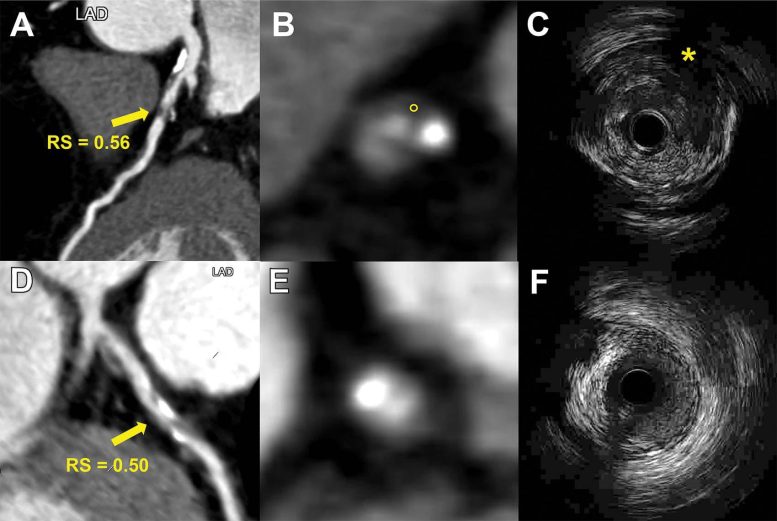
    Radiomics to Predict Heart Attacks
    Representative images from two patients demonstrate the use of a radiomic signature (RS) to discriminate vulnerable plaques defined with intravascular US. (A–C) Images depict a vulnerable plaque with a high RS. (A) Image from coronary CT angiography (CCTA) shows a partially calcified plaque (arrow) with RS value of 0.56 in the proximal left anterior descending artery (LAD). (B) Corresponding axial CCTA image shows the plaque with low-attenuation area (circle, 25 HU). (C) Corresponding intravascular US scan confirms the plaque as an attenuated plaque (*). (D–F) Images show a nonvulnerable plaque with low RS. (D, E) CCTA images show a partially calcified plaque (arrow in D) with RS value of 0.50 in the proximal left anterior descending artery. (F) Corresponding intravascular US scan confirms the plaque as a partially calcified plaque without echo attenuation and echolucent zone. High versus low RS lesion was defined using an optimal cut-off value of 0.53 (range, 0.46–0.58). Credit: Radiological Society of North America

    “The results of this study are encouraging and exciting,” said study co-lead author Long Jiang Zhang, M.D., Ph.D., from the Department of Radiology at Jinling Hospital, Medical School of Nanjing University in Nanjing, China. “Radiomics provided a more accurate approach to detect vulnerable plaques compared to conventional coronary CT angiography anatomical parameters.”

    The radiomic signature would be easy to add into clinical practice, Dr. Zhang said. In the clinic, it could assess potentially vulnerable plaques and help stratify high-risk patients.

    “If the radiomics analysis is embedded into the routine CT angiography workstation, it can automatically identify vulnerable plaques for clinician review,” Dr. Zhang said. “Thus, radiomics may significantly improve the accuracy and precision of high-risk plaque detection in routine clinical practice.”

    The researchers intend to build a radiomics model from different scanner types and vendors. They also are planning a larger, multicenter study of 10,000 patients.

    “With the support of large observational studies and randomized controlled trials, the radiomics approach may help guide clinical decision-making and improve patient care in the future,” Dr. Zhang said.

    Reference: “A Coronary CT Angiography Radiomics Model to Identify Vulnerable Plaque and Predict Cardiovascular Events” by Qian Chen, Tao Pan, Yi Ning Wang, U. Joseph Schoepf, Samuel L. Bidwell, Hongyan Qiao, Yun Feng, Cheng Xu, Hui Xu, Guanghui Xie, Xiaofei Gao, Xin-Wei Tao, Mengjie Lu, Peng Peng Xu, Jian Zhong, Yongyue Wei, Xindao Yin, Junjie Zhang and Long Jiang Zhang, 14 February 2023, Radiology.
    DOI: 10.1148/radiol.221693

    Collaborating with Dr. Zhang were Qian Chen, M.D., Tao Pan, M.B.B.S., Yi Ning Wang, M.D., Ph.D., U. Joseph Schoepf, M.D., Samuel L. Bidwell, B.S., Hongyan Qiao, M.D., Yun Feng, M.D., Cheng Xu, M.D., Hui Xu, M.Sc., Guanghui Xie, M.B.B.S., Xiaofei Gao, M.D., Xin-Wei Tao, M.Sc., Mengjie Lu, Ph.D., Peng Peng Xu, M.D., Jian Zhong, M.B.B.S., Yongyue Wei, Ph.D., Xindao Yin, M.D., Ph.D., and Junjie Zhang, Ph.D.

    Never miss a breakthrough: Join the SciTechDaily newsletter.
    Follow us on Google and Google News.

    Heart Attack Radiological Society of North America
    Share. Facebook Twitter Pinterest LinkedIn Email Reddit

    Related Articles

    Stress Slows Women’s Recovery from Acute Myocardial Infarction

    Noninvasive Arterial Spin Labeling MRI Detects Evidence of Cognitive Decline Before Symptoms Appear

    Mediterranean Diet Significantly Reduces the Risk of Suffering a Cardiovascular Death

    Study Links Levels of Air Pollution and Ozone to Cardiac Arrest

    Chelation-Therapy Heart Trial Criticized

    Immune Response to Heart Attack Can Worsen Atherosclerosis

    Flavonoid Compound Shown to Prevent Blood Clots

    Inexpensive Strategies Linked to Lowering Heart Attack Mortality Rates

    Researchers Find Possible Link Between Diet Soda and Vascular Risks

    Leave A Reply Cancel Reply

    • Facebook
    • Twitter
    • Pinterest
    • YouTube

    Don't Miss a Discovery

    Subscribe for the Latest in Science & Tech!

    Trending News

    Millions Take These IBS Drugs, But a New Study Finds Serious Risks

    Scientists Unlock Hidden Secrets of 2,300-Year-Old Mummies Using Cutting-Edge CT Scanner

    Bread Might Be Making You Gain Weight Even Without Eating More Calories

    Scientists Discover Massive Magma Reservoir Beneath Tuscany

    Europe’s Most Active Volcano Just Got Stranger – Here’s Why Scientists Are Rethinking It

    Alzheimer’s Symptoms May Start Outside the Brain, Study Finds

    Millions Take This Popular Supplement – Scientists Discover a Concerning Link to Heart Failure

    The Universe Is Expanding Too Fast and Scientists Can’t Explain Why

    Follow SciTechDaily
    • Facebook
    • Twitter
    • YouTube
    • Pinterest
    • Newsletter
    • RSS
    SciTech News
    • Biology News
    • Chemistry News
    • Earth News
    • Health News
    • Physics News
    • Science News
    • Space News
    • Technology News
    Recent Posts
    • U.S. Waste Holds $5.7 Billion Worth of Crop Nutrients
    • Scientists Say a Hidden Structure May Exist Inside Earth’s Core
    • Doctors Surprised by the Power of a Simple Drug Against Colon Cancer
    • Why Popular Diabetes Drugs Like Ozempic Don’t Work for Everyone: The “Genetic Glitch”
    • Scientists Create Improved Insulin Cells That Reverse Diabetes in Mice
    Copyright © 1998 - 2026 SciTechDaily. All Rights Reserved.
    • Science News
    • About
    • Contact
    • Editorial Board
    • Privacy Policy
    • Terms of Use

    Type above and press Enter to search. Press Esc to cancel.