
Close Menu
    Facebook X (Twitter) Instagram
    SciTechDaily
    • Biology
    • Chemistry
    • Earth
    • Health
    • Physics
    • Science
    • Space
    • Technology
    Facebook X (Twitter) Pinterest YouTube RSS
    SciTechDaily
    Home»Space»Researchers Predicted Blue, Red and Green Aurorae at Mars
    Space

    Researchers Predicted Blue, Red and Green Aurorae at Mars

    By Denise Lineberry​, NASA Langley Research CenterMay 29, 2015No Comments3 Mins Read
    Facebook Twitter Pinterest Telegram LinkedIn WhatsApp Email Reddit
    Share
    Facebook Twitter LinkedIn Pinterest Telegram Email Reddit
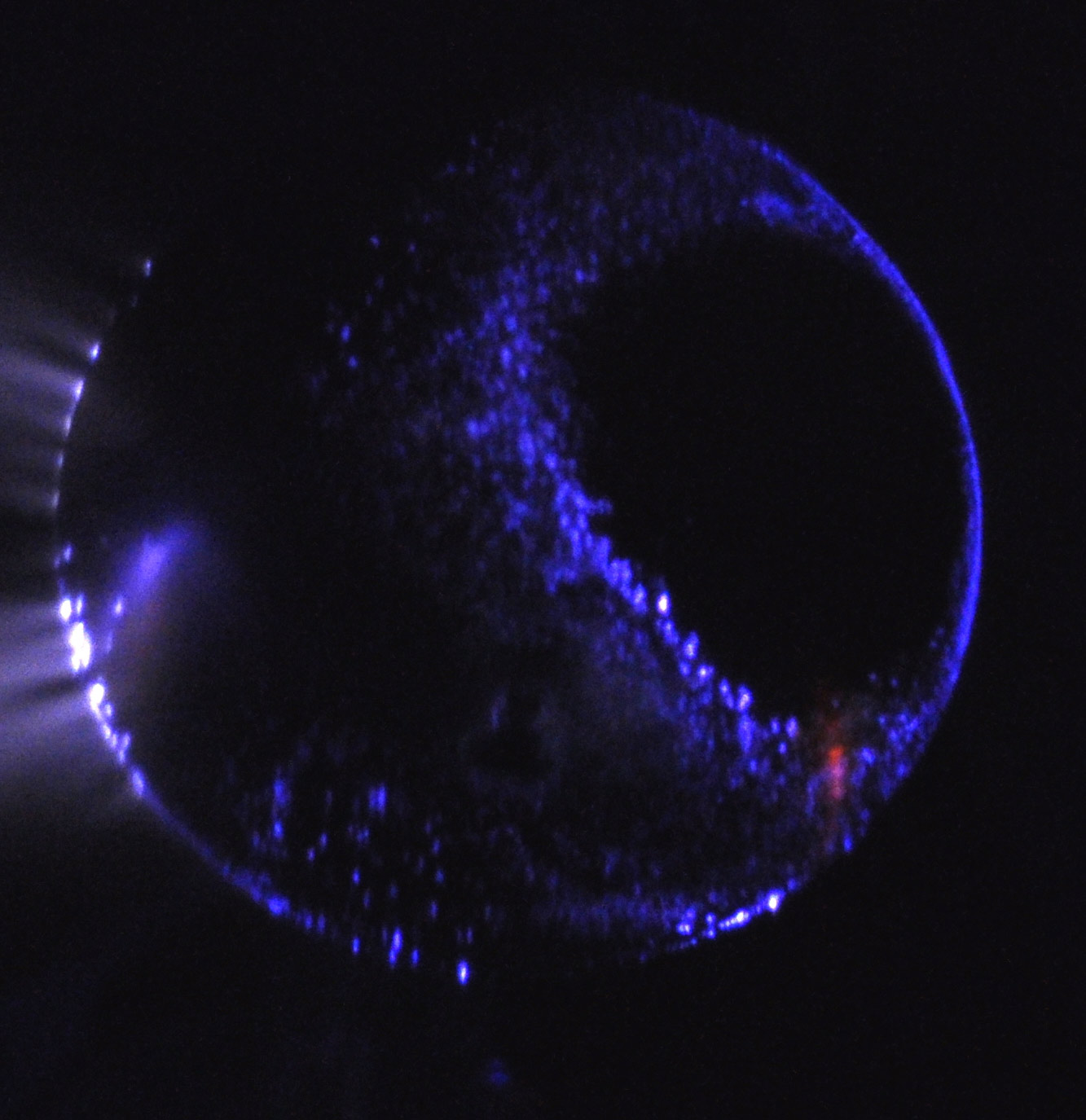
    Prediction of Blue, Red and Green Aurorae at Mars
    The Planeterella sphere simulates a magnetized planet with an atmosphere of CO2 and bombarded by the solar wind. Blue aurorae develop according to its magnetic field configuration. Credit: D. Bernard/IPAG — CNRS

    Astronomers believe glowing aurorae of blue, with red and green hues, would be visible to astronauts walking on Mars.

    For the first time, an international team of scientists from NASA, the Institute of Planetology and Astrophysics of Grenoble (IPAG), the European Space Agency, and Aalto University in Finland have predicted that colorful, glowing aurorae can be seen by the naked eye on a terrestrial planet other than Earth — Mars.

    Visible Martian aurorae seemed possible after the SPICAM imaging instrument on-board the ESA satellite Mars Express spotted aurorae from space in 2005. Those observations were confirmed in March 2015 by the NASA-led MAVEN mission, which completed 1,000 orbits around the red planet on April 6, 2015.

    Through laboratory experiments and a physical numerical model developed at NASA and IPAG, the study shows that, on Mars, aurorae also occur in the visible range. The most intense color is deep blue. As on Earth, green and red colors are also present. Several times during a solar cycle, after intense solar eruptions, these lights are bright enough to be seen with the naked eye.

    Aurorae occur when charged solar particles reach local magnetic field lines, where they enter the planetary atmosphere and excite its atoms and molecules. As they deactivate, the particles produce light emission. On Earth, aurorae are essentially green or red (excitation of atomic oxygen), but even blue-purple (excitation of ionized molecular nitrogen) can be seen.

    At the beginning of Mars’ existence and up until 3.5 billion years ago, the red planet hosted a global magnetic field. Although this global field somehow shut down, local spots of increased magnetic fields, called crustal magnetic anomalies, still remain on Mars’ surface. These anomalies are concentrated in the southern hemisphere, where aurorae are predicted to occur.

    It is predicted that an astronaut walking on the red soil of the planet could look up to see the southern night sky glow blue, with red and green hues.

    Perhaps NASA astronauts who plan to make their way toward Mars’ surface by the 2030s aboard Orion will be the first to provide first-hand confirmation of the prediction. And to think, Mars’ southern lights could eventually become as much of a draw to aurorae admirers as Earth’s northern lights.

    “Our planetary research gives us good insight on physics in the Martian atmosphere — how it evolved, why Mars’ mass is different than Earth’s,” said Guillaume Gronoff, a research scientist at NASA’s Langley Research Center who helped to lead the study. “It helps us to better understand planetary atmosphere emissions, ultimately helping us to discover habitable planets.”

    The Planeterella:

    The Planeterella simulates aurorae using a magnetic field, charged particles, and a sphere. For this study, they replaced the terrestrial atmospheric gas with CO2, the major component of the Martian atmosphere, and then created a discharge in a vacuum similar to Mars’ upper atmosphere. There are seventeen Planeterellas worldwide. One is located at NASA Langley’s official Visitors Center — the Virginia Air and Space Center in Hampton, Va. — where Guillaume occasionally exhibits the simulation.

    Reference: “Prediction of blue, red and green aurorae at Mars” by J. Lilensten, D. Bernard, M. Barthélémy, G. Gronoff, C. Simon Wedlund and A. Opitz, 1 May 2015, Planetary and Space Science.
    DOI: 10.1016/j.pss.2015.04.015


    Never miss a breakthrough: Join the SciTechDaily newsletter.
    Follow us on Google and Google News.

    Astronomy Astrophysics Aurora Mars Planetary Science
    Share. Facebook Twitter Pinterest LinkedIn Email Reddit

    Related Articles

    An Unexpected Planetary Neighbor May Play a Surprising Role in Earth’s Climate Cycles

    Perseverance Rover Captures Elusive Martian Aurora for a Second Time

    Mars’ Growth Stunted by Planetary Instability, Could Have Become Habitable

    MAVEN Reveals That Solar Wind Has Transformed Martian Atmosphere

    NASA’s MAVEN Spacecraft to Study Martian Atmosphere

    Color HiRISE Image of Curiosity Rover on Mars

    First 360-Degree Color Panorama From NASA’s Curiosity Mars Rover

    Vaporization Simulation of Earth Helps Explain the Atmospheres of Super-Earths

    A Connection Between Volatiles in the Subsurface of Mars and the Impact Process

    Leave A Reply Cancel Reply

    • Facebook
    • Twitter
    • Pinterest
    • YouTube

    Don't Miss a Discovery

    Subscribe for the Latest in Science & Tech!

    Trending News

    Scientists Uncover Potential Brain Risks of Popular Fish Oil Supplements

    Scientists Discover a Surprising Way To Make Bread Healthier and More Nutritious

    After 60 Years, Scientists Uncover Unexpected Brain Effects of Popular Diabetes Drug Metformin

    New Research Uncovers Hidden Side Effects of Popular Weight-Loss Drugs

    Scientists Rethink Extreme Warming After Surprising Ocean Discovery

    Landmark Study Links Never Marrying to Significantly Higher Cancer Risk

    Researchers Discover Unknown Beetle Species Just Steps From Their Lab

    Largest-Ever Study Finds Medicinal Cannabis Ineffective for Anxiety, Depression, PTSD

    Follow SciTechDaily
    • Facebook
    • Twitter
    • YouTube
    • Pinterest
    • Newsletter
    • RSS
    SciTech News
    • Biology News
    • Chemistry News
    • Earth News
    • Health News
    • Physics News
    • Science News
    • Space News
    • Technology News
    Recent Posts
    • Not Just Alzheimer’s: Scientists Uncover Clues to a Second, Overlooked Disorder
    • Scientists Uncover Dangerous Connection Between Serotonin and Heart Valve Disease
    • Scientists Discover a “Protector” Protein That Could Help Reverse Hair Loss
    • Powerful Lasers Reveal How Matter Becomes Plasma in Trillionths of a Second
    • A Simpler Path to Super-Resolution: Scientists Reinvent Microscopy
    Copyright © 1998 - 2026 SciTechDaily. All Rights Reserved.
    • Science News
    • About
    • Contact
    • Editorial Board
    • Privacy Policy
    • Terms of Use

    Type above and press Enter to search. Press Esc to cancel.