
Close Menu
    Facebook X (Twitter) Instagram
    SciTechDaily
    • Biology
    • Chemistry
    • Earth
    • Health
    • Physics
    • Science
    • Space
    • Technology
    Facebook X (Twitter) Pinterest YouTube RSS
    SciTechDaily
    Home»Biology»Researchers Regenerate Axons in Nerve Cells Severed by Spinal Cord Injury
    Biology

    Researchers Regenerate Axons in Nerve Cells Severed by Spinal Cord Injury

    By Yale UniversityApril 11, 2018No Comments2 Mins Read
    Facebook Twitter Pinterest Telegram LinkedIn WhatsApp Email Reddit
    Share
    Facebook Twitter LinkedIn Pinterest Telegram Email Reddit
    Gene Spurs Regeneration of Damaged Nerve Cells
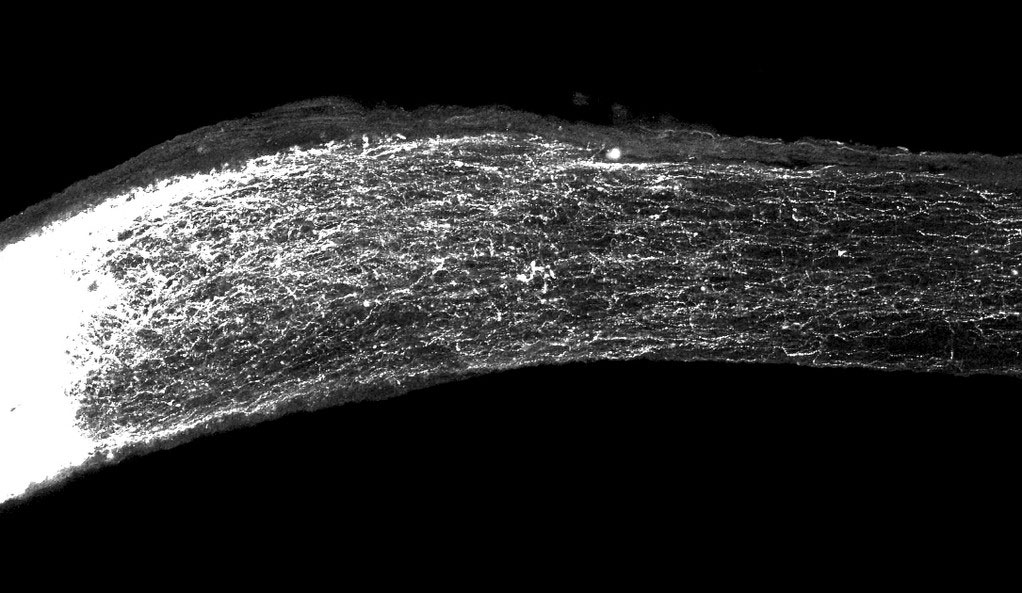
    Regeneration of axons can be seen in this image from the study, depicting a mouse’s optic nerve. Credit: Yale University

    Searching the entire genome, a Yale research team has identified a gene that when eliminated can spur regeneration of axons in nerve cells severed by spinal cord injury.

    “For the first time, the limits on nerve fiber regeneration were studied in an unbiased way across nearly all genes,” said Stephen Strittmatter, the Vincent Coates Professor of Neurology and senior author of the study appearing April 10 in the journal Cell Reports. “We had no idea whether we knew a lot or a little about the mechanics of nerve cell regeneration.”

    The Yale team found more than 580 different genes that may play a role in regeneration of axons in nerve cells, something that rarely occurs in adult mammals but is of vital interest to scientists hoping to repair injuries to the central nervous system. Intriguingly, said the researchers, about one in 10 of those came from a family of genes involved in transport of information within cells. The researchers also reported that eliminating one of those genes, Rab27, led to regeneration of axons in the optic nerve or spinal cord of mice.

    “We only looked at this one gene, and we have hundreds more to investigate,” Strittmatter said. “It is not hard to envision an approach where you can knock down two or three of these pathways and help spur regeneration further than achieved previously.”

    Reference: “Functional Genome-wide Screen Identifies Pathways Restricting Central Nervous System Axonal Regeneration” by Yuichi Sekine, Alexander Lin-Moore, Devon M. Chenette, Xingxing Wang, Zhaoxin Jiang, William B. Cafferty, Marc Hammarlund and Stephen M. Strittmatter, 10 April 2018, Cell Reports.
    DOI: 10.1016/j.celrep.2018.03.058

    The work was primarily funded by the National Institutes of Health. Yale’s Yuichi Sekine is lead author of the paper.

    Never miss a breakthrough: Join the SciTechDaily newsletter.
    Follow us on Google and Google News.

    Axons Medicine Neurology Spinal Cord Yale University
    Share. Facebook Twitter Pinterest LinkedIn Email Reddit

    Related Articles

    Scientists Restore Partial Brain Function Hours After Death

    New Test for Alzheimer’s Disease Directly Measures Synaptic Loss

    New Genetic Study Links Stem Cell Mutations to Hydrocephalus

    New Technique Fine-Tunes Treatment for Epilepsy Patients

    Mesenchymal Stem Cell-Derived Exosomes Aid Spinal Cord Recovery

    Researchers Pinpoint Fetal Cells ‘Vulnerable’ to Later Life Stress

    Yale Neurologists Discover the Source of Diabetic Neuropathy Pain

    ML-SA1 Increases Trafficking and Reduces Lysosome Storage

    Researchers Use Window on Live Mouse to View Spinal Cord Trauma

    Leave A Reply Cancel Reply

    • Facebook
    • Twitter
    • Pinterest
    • YouTube

    Don't Miss a Discovery

    Subscribe for the Latest in Science & Tech!

    Trending News

    Millions Take These IBS Drugs, But a New Study Finds Serious Risks

    Scientists Unlock Hidden Secrets of 2,300-Year-Old Mummies Using Cutting-Edge CT Scanner

    Bread Might Be Making You Gain Weight Even Without Eating More Calories

    Scientists Discover Massive Magma Reservoir Beneath Tuscany

    Europe’s Most Active Volcano Just Got Stranger – Here’s Why Scientists Are Rethinking It

    Alzheimer’s Symptoms May Start Outside the Brain, Study Finds

    Millions Take This Popular Supplement – Scientists Discover a Concerning Link to Heart Failure

    The Universe Is Expanding Too Fast and Scientists Can’t Explain Why

    Follow SciTechDaily
    • Facebook
    • Twitter
    • YouTube
    • Pinterest
    • Newsletter
    • RSS
    SciTech News
    • Biology News
    • Chemistry News
    • Earth News
    • Health News
    • Physics News
    • Science News
    • Space News
    • Technology News
    Recent Posts
    • Doctors Surprised by the Power of a Simple Drug Against Colon Cancer
    • Why Popular Diabetes Drugs Like Ozempic Don’t Work for Everyone: The “Genetic Glitch”
    • Scientists Create Improved Insulin Cells That Reverse Diabetes in Mice
    • Scientists Stunned After Finding Plant Thought Extinct for 60 Years
    • A Common Diabetes Drug May Hold the Key to Stopping HIV From Coming Back
    Copyright © 1998 - 2026 SciTechDaily. All Rights Reserved.
    • Science News
    • About
    • Contact
    • Editorial Board
    • Privacy Policy
    • Terms of Use

    Type above and press Enter to search. Press Esc to cancel.