

Close Menu
    Facebook X (Twitter) Instagram
    SciTechDaily
    • Biology
    • Chemistry
    • Earth
    • Health
    • Physics
    • Science
    • Space
    • Technology
    Facebook X (Twitter) Pinterest YouTube RSS
    SciTechDaily
    Home»Health»Researchers Solve 25-Year Crohn’s Disease Mystery
    Health

    Researchers Solve 25-Year Crohn’s Disease Mystery

    By University of California - San DiegoOctober 28, 2025No Comments4 Mins Read
    Facebook Twitter Pinterest Telegram LinkedIn WhatsApp Email Reddit
    Share
    Facebook Twitter LinkedIn Pinterest Telegram Email Reddit
    Senior Woman Stomachache Digestive Problems IBS
    A team at UC San Diego used artificial intelligence and molecular biology to unravel how the immune system’s gut macrophages decide whether to fight infection or heal tissue. Credit: Shutterstock

    UC San Diego researchers have resolved a decades-long debate about the role of the first Crohn’s disease gene linked to an increased risk of developing the autoimmune condition.

    The human digestive system relies on two main kinds of macrophages, a type of specialized white blood cell that helps keep the gut healthy. One group, known as inflammatory macrophages, protects the body by fighting off harmful microbes.

    The other group, called non-inflammatory macrophages, helps heal and restore damaged tissues. When this balance is disrupted, as in Crohn’s disease (a form of inflammatory bowel disease, or IBD), the result can be persistent inflammation in the intestines, leading to pain, tissue damage, and other symptoms.

    Scientists at the University of California San Diego School of Medicine have created an innovative method that combines artificial intelligence (AI) with advanced molecular biology to uncover what causes a macrophage to act as either a fighter or a healer.

    Their research also provides new insight into a long-standing question about a gene known as NOD2. Discovered in 2001, NOD2 was the first gene identified as increasing the risk of developing Crohn’s disease, and it plays a key role in determining how immune cells behave in the gut.
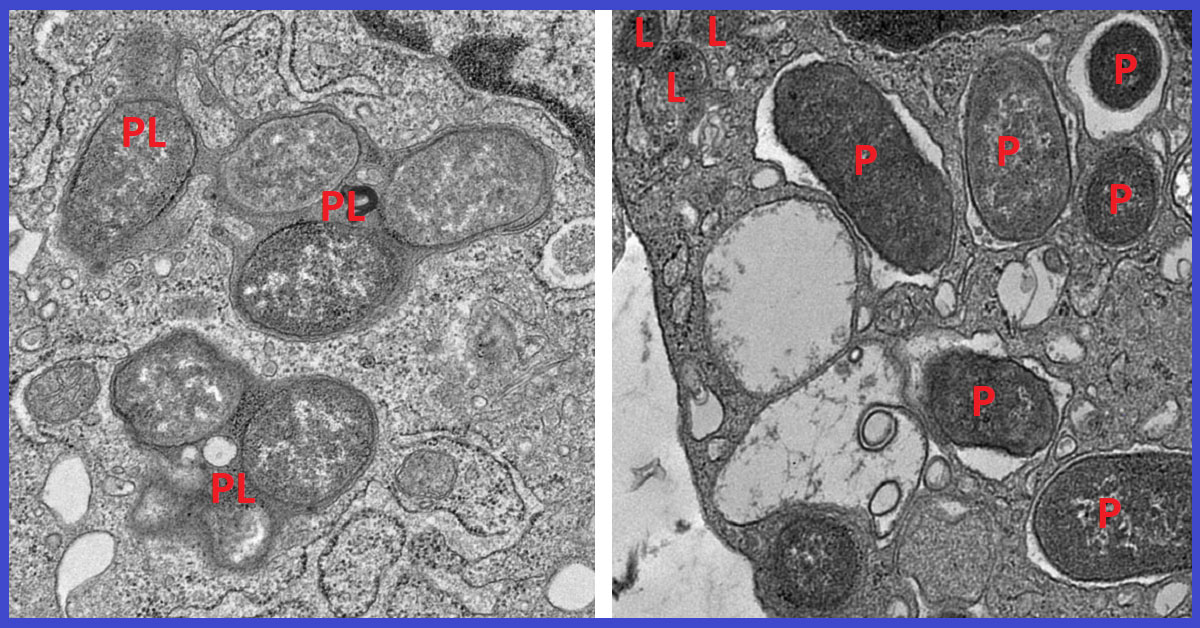
    Electron Micrographs Show How Macrophages Expressing Girdin Neutralize Pathogens by Fusing Phagosomes with the Cell’s Lysosomes
    Electron micrographs show how macrophages expressing girdin neutralize pathogens by fusing phagosomes (P) with the cell’s lysosomes (L) to form phagolysosomes (PL), compartments where pathogens and cellular debris are broken down (left). This process is crucial for maintaining cellular homeostasis. In the absence of girdin, this fusion fails, allowing pathogens to evade degradation and escape neutralization (right). Credit: UC San Diego Health Sciences

    A Gene Signature That Distinguishes Macrophage Types

    Using a powerful machine learning tool, the researchers analyzed thousands of macrophage gene expression patterns from colon tissue affected by IBD and from healthy colon tissue. They identified a macrophage gene signature consisting of 53 genes that reliably separates reactive, inflammatory macrophages from tissue-healing macrophages.

    One of these 53 genes encodes a protein called girdin. Further analysis revealed that in non-inflammatory macrophages, a specific region of the NOD2 protein binds to girdin. This suppresses runaway inflammation, clears harmful microbes, and allows for the repair of tissues damaged by IBD. But the most common Crohn’s disease mutation to the NOD2 gene deletes the section of the gene that girdin would normally bind to. This results in a dangerous imbalance between inflammatory and non-inflammatory macrophages.
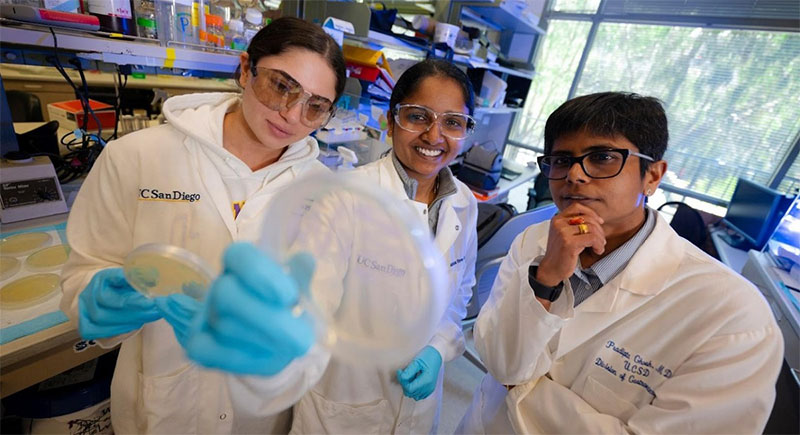
    Mahitha Shree Anandachar, Jasmin Salem and Pradipta Ghosh
    Co-first author Mahitha Shree Anandachar (center), a Ph.D. student in Biomedical Sciences at UC San Diego, with student research assistant Jasmin Salem (left) and Pradipta Ghosh, M.D. (right). Credit: UC San Diego Health Sciences

    “NOD2 functions as the body’s infection surveillance system,” said senior author Pradipta Ghosh, M.D., professor and cellular and molecular medicine at UC San Diego School of Medicine. “When bound to girdin, it detects invading pathogens and maintains gut immune balance by swiftly neutralizing them. Without this partnership, the NOD2 surveillance system collapses.”

    Confirming the NOD2–Girdin Link in Mice

    The researchers then confirmed the importance of the interaction between NOD2 and girdin by comparing mouse models of Crohn’s disease lacking the girdin protein to those with girdin intact. They found that mice without girdin suffered an imbalance in their gut microbiome and developed inflammation of the small intestine. They often died of sepsis, a condition in which the immune system mounts an excessive response to an infection, causing inflammation throughout the body and damage to vital organs.

    The gut is a battlefield, and macrophages are the peacekeepers,” said co-first author Gajanan D. Katkar, Ph.D., assistant project scientist at UC San Diego School of Medicine. “For the first time, AI has allowed us to clearly define and track the players on two opposing teams.”

    By uniting AI-driven classification, mechanistic biochemistry, and mouse models, the study resolves one of the longest-running debates in Crohn’s disease. The findings not only explain how a key genetic mutation drives the disease but could also contribute to the development of treatments aimed at restoring the relationship between girdin and NOD2.

    Reference: “Distinct colitis-associated macrophages drive NOD2-dependent bacterial sensing and gut homeostasis” by Gajanan D. Katkar, Mahitha Shree Anandachar, Stella-Rita C. Ibeawuchi, Ella G. McLaren, Megan L. Estanol, Kennith Carpio-Perkins, Shu-Ting Hsu, Celia R. Espinoza, Jane E. Coates, Yashaswat S. Malhotra, Madhubanti Mullick, Vanessa Castillo, Daniella Vo, Saptarshi Sinha and Pradipta Ghosh, 2 October 2025, The Journal of Clinical Investigation.
    DOI: 10.1172/JCI190851

    Never miss a breakthrough: Join the SciTechDaily newsletter.
    Follow us on Google and Google News.

    Artificial Intelligence Genetics Immunology Inflammation Microbiology Molecular Biology UCSD
    Share. Facebook Twitter Pinterest LinkedIn Email Reddit

    Related Articles

    Scientists Discover Hidden Cause of Alzheimer’s Hiding in Plain Sight

    AI Trained With Genetic Data Predicts How Patients With Viral Infections – Including COVID-19 – Will Fare

    DNA Evidence From Mass Grave Suggests Bubonic Plague Had Long-Term Effect on Human Immunity Genes

    Experimental Therapy For Parasitic Heart Disease – K777 – May Also Help Stop COVID-19

    Genetic Predisposition to Severe COVID-19 Discovered by Russian Researchers

    Researchers Zero In on Natural Products That Disrupt Lethal Viruses, Including the COVID-19 Coronavirus

    Development of an Effective COVID-19 Vaccine Through Comprehensive Analysis of Antibody Responses in Patients

    COVID-19 Treatment May Lie in Pangolin Genetics – May Possess Evolutionary Advantage Against Coronavirus

    Ancient Worm Reveals Way to Destroy Toxic Cells – Potential New Therapy for Huntington’s and Parkinson’s

    Leave A Reply Cancel Reply

    • Facebook
    • Twitter
    • Pinterest
    • YouTube

    Don't Miss a Discovery

    Subscribe for the Latest in Science & Tech!

    Trending News

    One of the Universe’s Largest Stars May Be Getting Ready To Explode

    Scientists Discover Enzyme That Could Supercharge Ozempic-Like Weight Loss Drugs

    Popular Sweetener Linked to DNA Damage – “It’s Something You Should Not Be Eating”

    Ancient “Rock” Microbes May Reveal How Complex Life Began

    Researchers Capture Quantum Interference in One of Nature’s Rarest Atoms

    “A Plague Is Upon Us”: The Mass Death That Changed an Ancient City Forever

    Scientists Discover Game-Changing New Way To Treat High Cholesterol

    This Small Change to Your Exercise Routine Could Be the Secret to Living Longer

    Follow SciTechDaily
    • Facebook
    • Twitter
    • YouTube
    • Pinterest
    • Newsletter
    • RSS
    SciTech News
    • Biology News
    • Chemistry News
    • Earth News
    • Health News
    • Physics News
    • Science News
    • Space News
    • Technology News
    Recent Posts
    • New Study Challenges 40-Year Puzzle About Childhood Body Fat
    • 20-Year Study Finds Daily Multivitamins Don’t Extend Lifespan
    • Landmark Study Links Never Marrying to Significantly Higher Cancer Risk
    • Revolutionary Imaging Technique Unlocks Secrets of Matter at Extreme Speeds
    • Where Does Mass Come From? Scientists Find Evidence of a New Exotic Nuclear State
    Copyright © 1998 - 2026 SciTechDaily. All Rights Reserved.
    • Science News
    • About
    • Contact
    • Editorial Board
    • Privacy Policy
    • Terms of Use

    Type above and press Enter to search. Press Esc to cancel.