
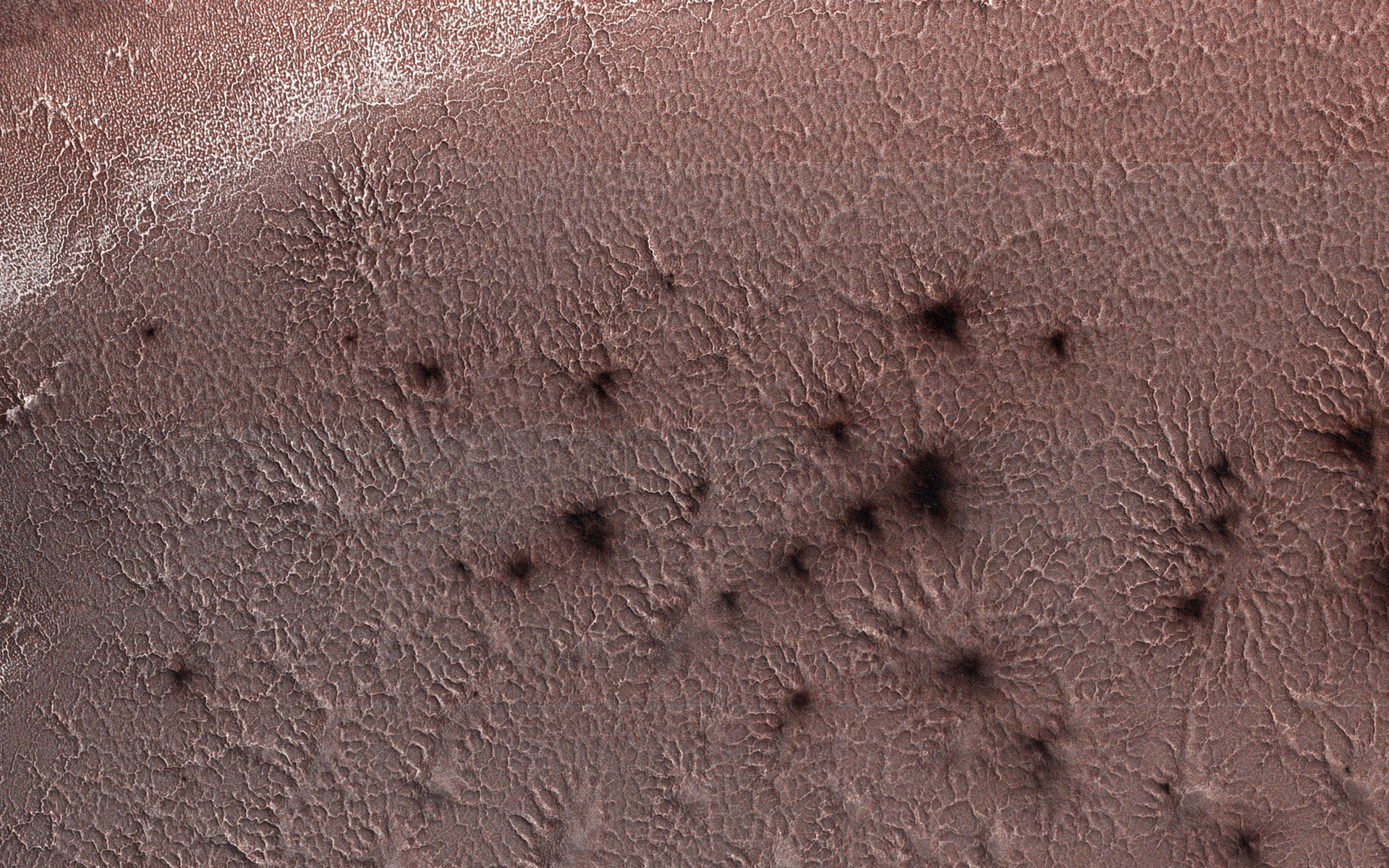
Researchers at Trinity College Dublin have been shedding light on the enigmatic “spiders from Mars,” providing the first physical evidence that these unique features on the planet’s surface can be formed by the sublimation of CO2 ice.
Spiders, more formally referred to as araneiforms, are strange-looking negative topography radial systems of dendritic troughs; patterns that resemble branches of a tree or fork lightning. These features, which are not found on Earth, are believed to be carved into the Martian surface by dry ice changing directly from solid to gas (sublimating) in the spring. Unlike Earth, Mars’ atmosphere comprises mainly CO2 and as temperatures decrease in winter, this deposits onto the surface as CO2 frost and ice.
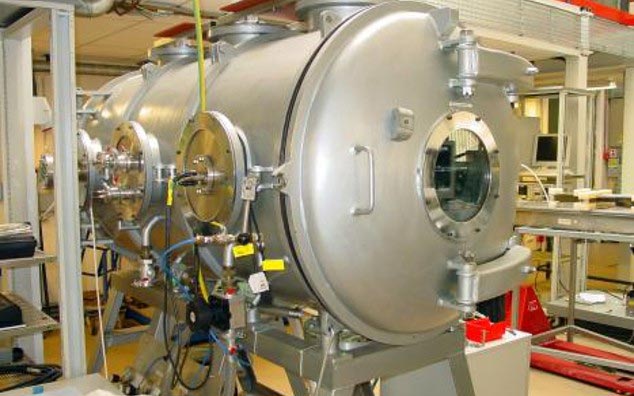
The Trinity team, along with colleagues at Durham University and the Open University, conducted a series of experiments funded by the Irish Research Council and Europlanet at the Open University Mars Simulation Chamber (pictured below), under Martian atmospheric pressure, in order to investigate whether patterns similar to Martian spiders could form by dry ice sublimation.
Its findings are detailed in a paper published on March 19, 2021, in the Nature Journal Scientific Reports: “The Formation of Araneiforms by Carbon Dioxide Venting and Vigorous Sublimation Dynamics Under Martian Atmospheric Pressure.”
First Empirical Evidence for Spider Formation
Dr. Lauren McKeown, who led this work during her PhD at Trinity and is now at the Open University, said:
“This research presents the first set of empirical evidence for a surface process that is thought to modify the polar landscape on Mars. Kieffer’s hypothesis [explained below] has been well-accepted for over a decade, but until now, it has been framed in a purely theoretical context. … The experiments show directly that the spider patterns we observe on Mars from orbit can be carved by the direct conversion of dry ice from solid to gas. It is exciting because we are beginning to understand more about how the surface of Mars is changing seasonally today.”
The research team drilled holes in the centers of CO2 ice blocks and suspended them with a claw similar to those found in arcades, above granular beds of different grain sizes. They lowered the pressure inside a vacuum chamber to Martian atmospheric pressure (6mbar) and then used a lever system to place the CO2 ice block on the surface
They made use of an effect known as the Leidenfrost Effect, whereby if a substance comes in contact with a surface much hotter than its sublimation point, it will form a gaseous layer around itself. When the block reached the sandy surface, CO2 turned directly from solid to gas and material was seen escaping through the central hole in the form of a plume
In each case, once the block was lifted, a spider pattern had been eroded by the escaping gas. The spider patterns were more branched when finer grain sizes were used and less branched when coarser grain sizes were used.
This is the first set of empirical evidence for this extant surface process.
Significance for Mars Climate and Future Missions
Dr. Mary Bourke, of Trinity’s Department of Geography, who supervised the Ph.D. research, said:
“This innovative work supports the emergent theme that the current climate and weather on Mars has an important influence not only on dynamic surface processes, but also for any future robotic and/or human exploration of the planet.”
The main hypothesis proposed for spider formation (Kieffer’s hypothesis) suggests that in spring, sunlight penetrates this translucent ice and heats the terrain beneath it. The ice will sublimate from its base, causing pressure to build up and eventually, the ice will rupture, allowing pressurized gas to escape through a crack in the ice. The paths of the escaping gas will leave behind the dendritic patterns observed on Mars today and the sandy/dusty material will be deposited on top of the ice in the form of a plume.
However, until now, it has not been known if such a theoretical process is possible and this process has never been directly observed on Mars.
Additionally, the researchers observed that when CO2 blocks were released and allowed to sublimate within the sand bed, sublimation was much more vigorous than expected and material was thrown all over the chamber. This observation will be useful in understanding models of other CO2 sublimation-related processes on Mars, such as the formation of lateral Recurring Diffusive Flows surrounding linear dune gullies on Mars.
The methodology used can be refocused to study the geomorphic role of CO2 sublimation on other active Martian surface feature formation – and indeed, can pave the way for further research on sublimation processes on other planetary bodies with no/scant atmospheres like Europa or Enceladus.
Reference: “The formation of araneiforms by carbon dioxide venting and vigorous sublimation dynamics under martian atmospheric pressure” by Lauren Mc Keown, J. N. McElwaine, M. C. Bourke, M. E. Sylvest and M. R. Patel, 19 March 2021, Scientific Reports.
DOI: 10.1038/s41598-021-82763-7
Never miss a breakthrough: Join the SciTechDaily newsletter.
Follow us on Google and Google News.
9 Comments
Those aren’t spiders. I’m from Florida and I know mosquitoes when I see them!
OK, had to do it but I’m glad I saw this article before some of my relatives started talking about Martian Spiders Attacking!
Looks like a debris field from an asteroid breaking up before hitting surface.
I think they are right gas escaping from beneath the ground would explain those cracks and since CO2 is just hot oxygen or smoke it would explain the black colour it shows
Thank you David Bowie! I’ve been wondering all of these years what it was. All along I thought it was something he smoked.
Let’s find out now for sure so Elon can get his people here to solve the problem there. Mars Pest Control. It’s going to be run by that Martian with the Roman helmet on bugs bunny.
The great rush to inhabit a planet that is unsuitable to sustain human life.
If there is carbon in the Martian atmosphere,can we find out more about its isotopes? I did some experiments currently on impacts of heavy carbon isotopes on earth’s natural environment, animals and humans..
Bowie and The Spiders From Mars were an amazing live act in 1972 and 1973. That was David Bowie at his best!
Looks like rust spots on metal