
Close Menu
    Facebook X (Twitter) Instagram
    SciTechDaily
    • Biology
    • Chemistry
    • Earth
    • Health
    • Physics
    • Science
    • Space
    • Technology
    Facebook X (Twitter) Pinterest YouTube RSS
    SciTechDaily
    Home»Biology»Resurrected 3.2-Billion-Year-Old Enzyme Could Unlock the Origins of Life
    Biology

    Resurrected 3.2-Billion-Year-Old Enzyme Could Unlock the Origins of Life

    By Utah State UniversityMarch 18, 20265 Comments4 Mins Read
    Facebook Twitter Pinterest Telegram LinkedIn WhatsApp Email Reddit
    Share
    Facebook Twitter LinkedIn Pinterest Telegram Email Reddit
    Abstract Origin of Life Cells
    Nitrogen is fundamental to life, yet most organisms cannot use it directly from the atmosphere. A new study reconstructing ancient nitrogenase enzymes offers insight into how early microbes processed nitrogen billions of years ago, revealing clues about Earth’s ancient atmosphere and the evolution of life. Credit: SciTechDaily.com

    By reconstructing ancient nitrogen-processing enzymes, scientists are uncovering new clues about how early life survived on a very different Earth.

    Nitrogen is essential for life on Earth, yet most organisms cannot use it directly from the atmosphere. Scientists now believe this element may also provide important clues about how life first developed on our planet and how it might arise elsewhere in the universe.

    “All living organisms need nitrogen to survive and, though it’s all around us, we can’t access it directly,” says Utah State University biochemist Lance Seefeldt. “Enzymes called nitrogenases enable nitrogen fixation, which converts nitrogen to a form plants, animals, humans, and other life forms can access. And we’re just beginning to understand the extent to which, over the Earth’s four-billion-year history, these nitrogenases have evolved.”

    Seefeldt worked with USU senior scientist Derek Harris and other researchers involved in the NASA-funded Metal Utilization and Selection across Eons (MUSE) project at the University of Wisconsin-Madison. Their study used synthetic biology techniques to analyze modern nitrogenases and reconstruct versions that may resemble their ancient ancestors. The team reported the findings in the journal Nature Communications.

    “Our role in the study was to characterize a library of the synthetically reconstructed ancestral nitrogenase genes,” says Harris. “Under controlled lab conditions, we measured the nitrogen isotope fractionation in the cell biomass of the engineered strains.”

    A New Way to Study Early Earth

    Seefeldt, professor and head of USU’s Department of Chemistry and Biochemistry, has spent more than 30 years studying how nitrogenase enzymes are structured and how they function. He says recreating ancient versions of these enzymes provides a powerful new approach for exploring the origins of life on Earth and for investigating how life might arise on other worlds.
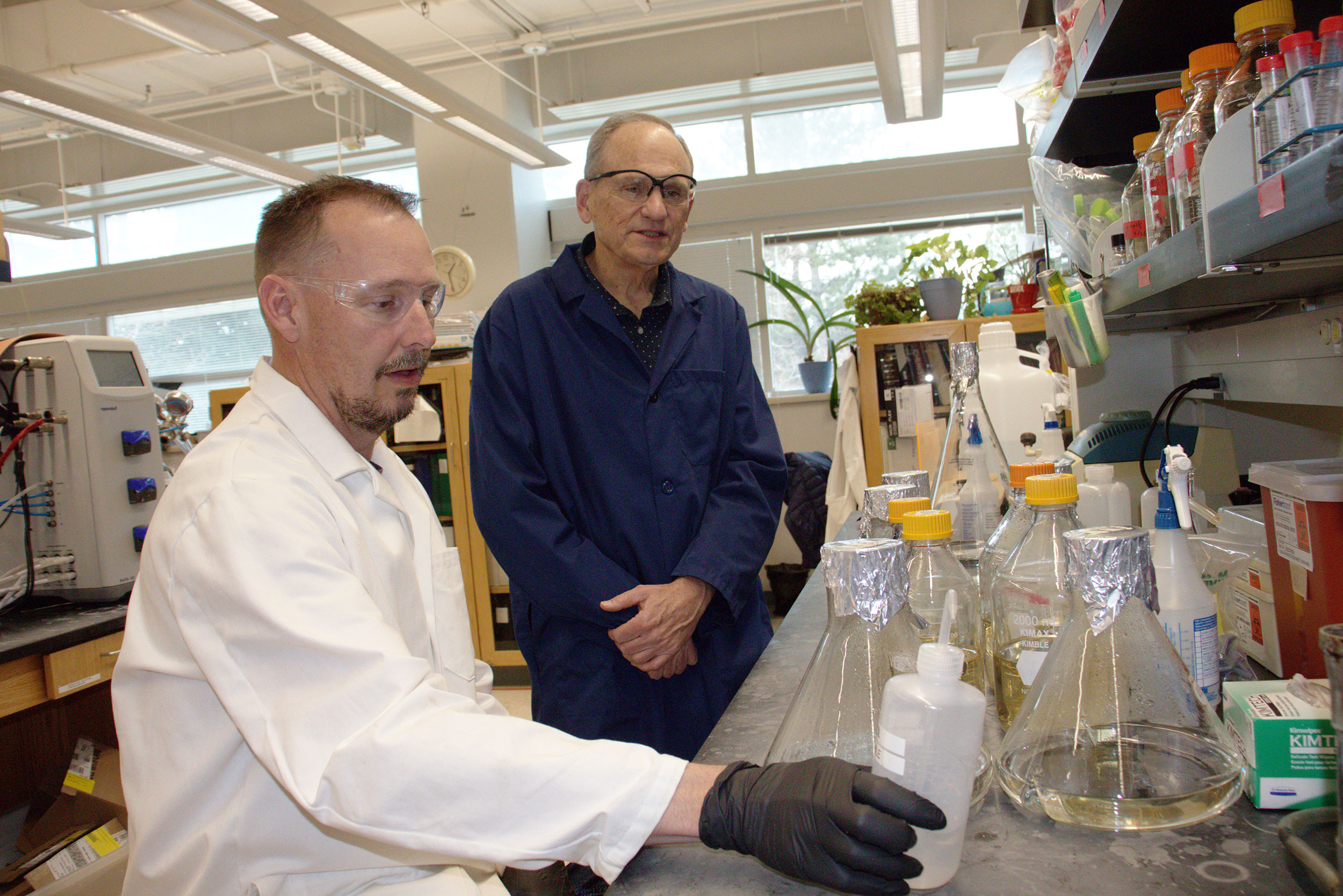
    Derek Harris and Lance Seefeldt
    Utah State University biochemists Derek Harris, left, and Lance Seefeldt, and and fellow colleagues with the NASA-funded Metal Utilization and Selection across Eons (MUSE) project at the University of Wisconsin-Madison, are authors of a Jan. 22 ‘Nature Communications’ paper describing breakthrough research on ancient enzymes responsible for life on Earth. Credit: M. Muffoletto, USU

    “Until now, science has relied on ancient rock and fossils to study early life,” he says. “Our planet was vastly different billions of years ago. Modern microbes access atmospheric sources of nitrogen through nitrogenases, which are just one family of enzymes. Study of fossilized enzymes assumes ancient enzymes produced the same isotopic signatures as modern enzymes.”

    By resurrecting these enzymes in the laboratory, scientists can investigate how they behaved long ago. According to Seefeldt, these reconstructed nitrogenases provide researchers with new insight into the composition of Earth’s atmosphere and environmental conditions in the distant past.

    Implications for Agriculture and Space Exploration

    “Understanding nitrogenases, both ancient and modern, is critical to helping us tackle current agricultural challenges in a changing climate, including areas at risk of famine due to drought and lack of access to commercial fertilizers,” he says.

    Seefeldt also notes that the research may support future efforts to produce food beyond Earth. He has previously collaborated on several NASA-funded projects focused on growing crops in space and potentially on Mars.

    Betül Kaçar, professor of bacteriology at the University of Wisconsin-Madison, director of the MUSE project, and corresponding author of the study, says the results improve scientists’ understanding of how life survived and evolved before oxygen-dependent organisms began dramatically altering the planet.

    “The search for life starts here at home, and our home is four billion years old,” she says. “So, we need to understand our own past. We need to understand life before us, if we want to understand life ahead of us and life elsewhere.”

    Reference: “Resurrected nitrogenases recapitulate canonical N-isotope biosignatures over two billion years” by Holly R. Rucker, Kunmanee Bubphamanee, Derek F. Harris, Kurt Konhauser, Lance C. Seefeldt, Roger Buick and Betül Kaçar, 22 January 2026, Nature Communications.
    DOI: 10.1038/s41467-025-67423-y

    Funding: NASA Astrobiology Institute

    Never miss a breakthrough: Join the SciTechDaily newsletter.
    Follow us on Google and Google News.

    Astrobiology Biochemistry Evolutionary Biology Life Popular Utah State University
    Share. Facebook Twitter Pinterest LinkedIn Email Reddit

    Related Articles

    New โ€œNanozyme Hypothesisโ€ Could Rewrite the Story of Lifeโ€™s Origins

    Scientists Revive a 3.2-Billion-Year-Old Enzyme To Unlock Lifeโ€™s Origins

    New Research Challenges a Key Theory About Lifeโ€™s Origins

    Primordial Beginnings: How Soda Lakes May Have Cradled Early Life

    The Unsolved Enigma of the Origin of Life: A New Strategy

    A World in a Test Tube: Removing Traces of Life in Lab Helps NASA Scientists Study Its Origins

    Alien Microorganism Research Shows Humans and Other Mammals Could Struggle to Fight Space Germs

    New Study Presents “Water World” Theory for the Emergence of Life

    New Findings Challenge Assumptions about the Origins of Life

    5 Comments

    1. John Zalewski on March 21, 2026 10:53 am

      God is the Creator. Naturalism is a bankrupt philosophy.

      Reply
      • Matthew Finlay on March 21, 2026 1:55 pm

        Amen.

        Reply
      • Jane Leverett on March 21, 2026 6:32 pm

        AMEN!

        Reply
        • Christine...York, UK ๐Ÿ‡ฌ๐Ÿ‡ง on March 22, 2026 7:01 am

          Very Interesting!!!!!๐Ÿ‘๐ŸŒŽ๐ŸŒŸ๐Ÿ’–๐Ÿ‡ฌ๐Ÿ‡ง

          Reply
    2. Alvin Fiend on March 22, 2026 8:07 am

      “That which exists through itself is called meaning” Lao Tzu

      Reply
    Leave A Reply Cancel Reply

    • Facebook
    • Twitter
    • Pinterest
    • YouTube

    Don't Miss a Discovery

    Subscribe for the Latest in Science & Tech!

    Trending News

    Scientists Uncover Potential Brain Risks of Popular Fish Oil Supplements

    Scientists Discover a Surprising Way To Make Bread Healthier and More Nutritious

    After 60 Years, Scientists Uncover Unexpected Brain Effects of Popular Diabetes Drug Metformin

    New Research Uncovers Hidden Side Effects of Popular Weight-Loss Drugs

    Scientists Rethink Extreme Warming After Surprising Ocean Discovery

    Landmark Study Links Never Marrying to Significantly Higher Cancer Risk

    Researchers Discover Unknown Beetle Species Just Steps From Their Lab

    Largest-Ever Study Finds Medicinal Cannabis Ineffective for Anxiety, Depression, PTSD

    Follow SciTechDaily
    • Facebook
    • Twitter
    • YouTube
    • Pinterest
    • Newsletter
    • RSS
    SciTech News
    • Biology News
    • Chemistry News
    • Earth News
    • Health News
    • Physics News
    • Science News
    • Space News
    • Technology News
    Recent Posts
    • Scientists Discover Caffeine Can Repair Key Memory Circuits After Sleep Loss
    • Strange 65-Foot Dinosaur Discovered in Argentina
    • Researchers Uncover Source of Strange Deformation in Earthโ€™s Largest Continental Rift
    • Scientists Solve Mystery of Where the Colorado River Vanished Millions of Years Ago
    • Not Just Alzheimerโ€™s: Scientists Uncover Clues to a Second, Overlooked Disorder
    Copyright © 1998 - 2026 SciTechDaily. All Rights Reserved.
    • Science News
    • About
    • Contact
    • Editorial Board
    • Privacy Policy
    • Terms of Use

    Type above and press Enter to search. Press Esc to cancel.