
New research from biochemists at the UNC School of Medicine offers an intriguing new view on how life began, challenging current assumptions about the origins of life.
Chapel Hill, North Carolina — Before there was life on Earth, there were molecules. A primordial soup. At some point a few specialized molecules began replicating. This self-replication, scientists agree, kick-started a biochemical process that would lead to the first organisms. But exactly how that happened — how those molecules began replicating — has been one of science’s enduring mysteries.
Now, research from UNC School of Medicine biochemist Charles Carter, PhD, appearing in the September 13 issue of the Journal of Biological Chemistry, offers an intriguing new view on how life began. Carter’s work is based on lab experiments during which his team recreated ancient protein enzymes that likely played a vital role in helping create life on Earth. Carter’s finding flies in the face of the widely-held theory that Ribonucleic Acid (RNA) self-replicated without the aid of simple proteins and eventually led to life as we know it.
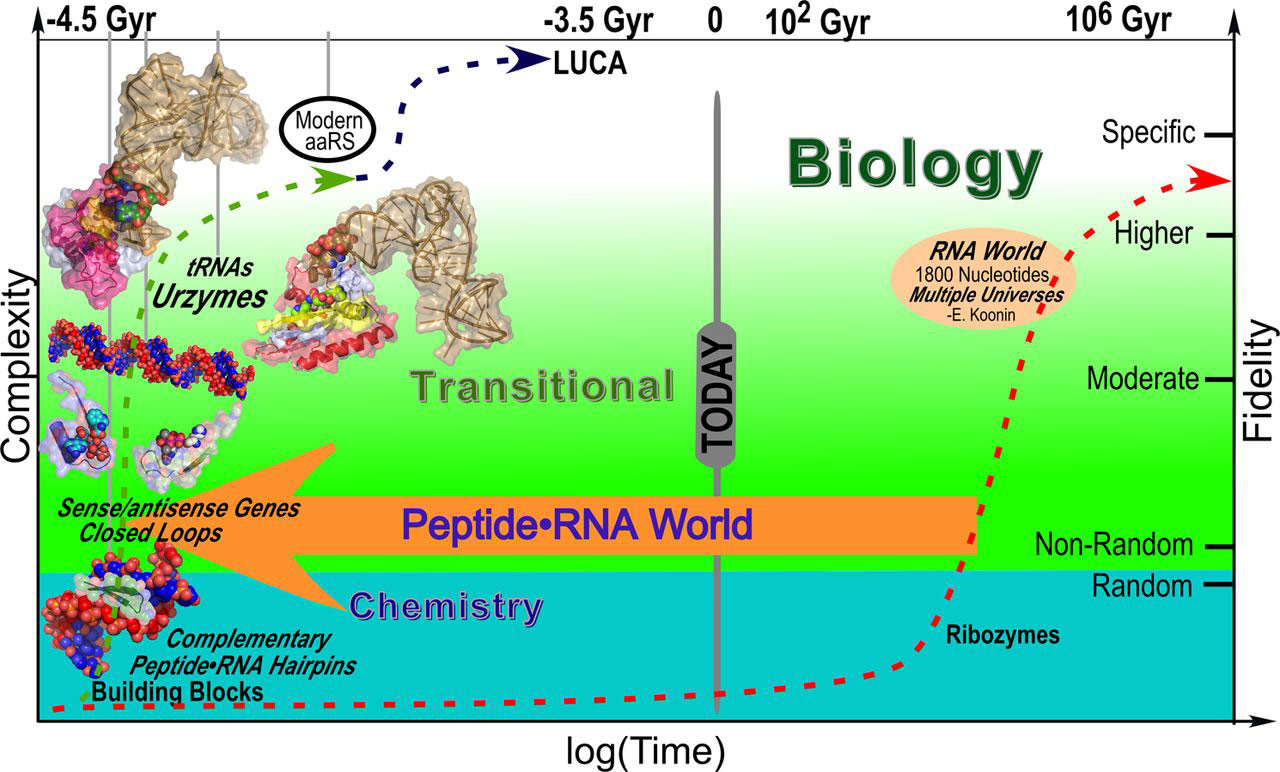
In the early 1980s, researchers found that ribozymes — RNA enzymes — act as catalysts. It was evidence that RNA can be both the blueprints and the chemical catalysts that put those blueprints into action. This finding led to the “RNA World” hypothesis, which posits that RNA alone triggered the rise of life from a sea of molecules.
But for the hypothesis to be correct, ancient RNA catalysts would have had to copy multiple sets of RNA blueprints nearly as accurately as do modern-day enzymes. That’s a hard sell; scientists calculate that it would take much longer than the age of the universe for randomly generated RNA molecules to evolve sufficiently to achieve the modern level of sophistication. Given Earth’s age of 4.5 billion years, living systems run entirely by RNA could not have reproduced and evolved either fast or accurately enough to give rise to the vast biological complexity on Earth today.
“The RNA world hypothesis is extremely unlikely,” said Carter. “It would take forever.”
Moreover, there’s no proof that such ribozymes even existed billions of years ago. To buttress the RNA World hypothesis, scientists use 21st century technology to create ribozymes that serve as catalysts. “But most of those synthetic ribozymes,” Carter said, “bear little resemblance to anything anyone has ever isolated from a living system.”
Carter, who has been an expert in ancient biochemistry for four decades, took a different approach. His experiments are deeply embedded in consensus biology.
Our genetic code is translated by two super-families of modern-day enzymes. Carter’s research team created and superimposed digital three-dimensional versions of the two super-families to see how their structures aligned. Carter found that all the enzymes have virtually identical cores that can be extracted to produce “molecular fossils” he calls Urzymes — Ur meaning earliest or original. The other parts, he said, are variations that were introduced later, as evolution unfolded.
These two Urzymes are as close as scientists have gotten to the actual ancient enzymes that would have populated the Earth billions of years ago.
“Once we identified the core part of the enzyme, we cloned it and expressed it,” Carter said. “Then we wanted to see if we could stabilize it and determine if it had any biochemical activity.” They could and it did.
Both Urzymes are very good at accelerating the two reactions necessary to translate the genetic code.
“Our results suggest that there were very active protein enzymes very early in the generation of life, before there were organisms,” Carter said. “And those enzymes were very much like the Urzymes we’ve made.”
The finding also suggests that Urzymes evolved from even simpler ancestors — tiny proteins called peptides. And over time those peptides co-evolved with RNA to give rise to more complex life forms.
In this “Peptide-RNA World” scenario, RNA would have contained the instructions for life while peptides would have accelerated key chemical reactions to carry out those instructions.
“To think that these two Urzymes might have launched protein synthesis before there was life on Earth is totally electrifying,” Carter said. “I can’t imagine a much more exciting result to be working on, if one is interested in the origin of life.”
The study leaves open the question of exactly how those primitive systems managed to replicate themselves — something neither the RNA World hypothesis nor the Peptide-RNA World theory can yet explain. Carter, though, is extending his research to include polymerases — enzymes that actually assemble the RNA molecule. Finding an Urzyme that serves that purpose would help answer that question.
Reference: “Aminoacylating Urzymes Challenge the RNA World Hypothesis” by Li Li, Christopher Francklyn and Charles W. Carter Jr., September 2013, The Journal of Biological Chemistry.
DOI: 10.1074/jbc.M113.496125
Never miss a breakthrough: Join the SciTechDaily newsletter.
Follow us on Google and Google News.
10 Comments
Just as always.. WRONG! Evolution is darwidiotism and should be banned due to lack of any credible ability. Scientists do not agree on evolution unless you have a bunch of lying atheists in the room.
…huh?
Kenny, you left your brain at the door. Get some education and read the article.
This basically just repeats the findings and hypotheses of Jakob Segal (from the ’60s) who not only postulated exactly these “new findings” but also gave possible explanations in regard to the reproduction process. A good starting point for reading would be: Die Entstehung des Lebens aus biophysikalischer Sicht (The Development of Life from biophysical point of view) from 1980 which summarizes his previous works succinctly. So glad that scientists slowly are catching up with something that could have been “known” by all for 50 years now, but was basically buried by the cold war.
Either way, it was an interesting read and I’m glad there are those engaged in this research. The “Christians” will freakin’ flip when some scientist introduces the first new living cells. They’ll have to call him/her God!
We will have to admit he/she was created by God
“Our genetic code is translated by two super-families of modern-day enzymes”
What are these and what domains of life do they encompass? Explanations, detail, examples, please.
Kenny! I don’t speak of evolution but can you answer a few things? The affinity for Carbon , Hydrogen and Oxygen to form is great and that is the result of organic chemistry. You will see such affinities in chemistry among various atoms and molecules. Is it not natural? Same way, RNA or DNA is also a special acid called Ribo-nucleic acid and De-Oxy ribinucleic acid. Their affinity to form is highest in primordial soup. They are all the duplicating chemicals which is an allied term form polymerization. Don’t you know that ordinary acetylene C2H2 polymerises to C6H6 which is Benzene easily under suitable conditions? Don’t you come across polymers or PVC of the present day which are all molecule multiplying compounds. Do we attach any godliness to its formation? Science involves in taking the knots of nature one by one till we reach the apex knot. The task is a long way to go. We know that there is an ultimate force and till we reach that please don’t put a full-stop for the scientific research by bringing in Bible which is nothing but scripture made to discipline the anarchism of mankind.Thank You.
Someone needs to figure out the recipe for that famous primordial soup.
^—–yes, it’s delicious