
New research decodes wiring of the human neocortex.
New research led by Charité – Universitätsmedizin Berlin and published in Science reveals that the wiring of nerve cells in the human neocortex differs significantly from that in mice. The study discovered that human neurons predominantly transmit signals in a unidirectional manner, whereas mouse neurons typically send signals in looping patterns. This structural difference may enhance the human brain’s ability to process information more efficiently and effectively. The findings hold potential implications for advancing artificial neural network technologies.
The neocortex, a critical structure for human intelligence, is less than five millimeters thick. There, in the outermost layer of the brain, 20 billion neurons process countless sensory perceptions, plan actions, and form the basis of our consciousness. How do these neurons process all this complex information? That largely depends on how they are “wired” to each other.
More complex neocortex – different information processing
“Our previous understanding of neural architecture in the neocortex is based primarily on findings from animal models such as mice,” explains Prof. Jörg Geiger, Director of the Institute for Neurophysiology at Charité. In those models, the neighboring neurons frequently communicate with each other as if they are in dialogue. One neuron signals another, and then that one sends a signal back. That means the information often flows in recurrent loops.”
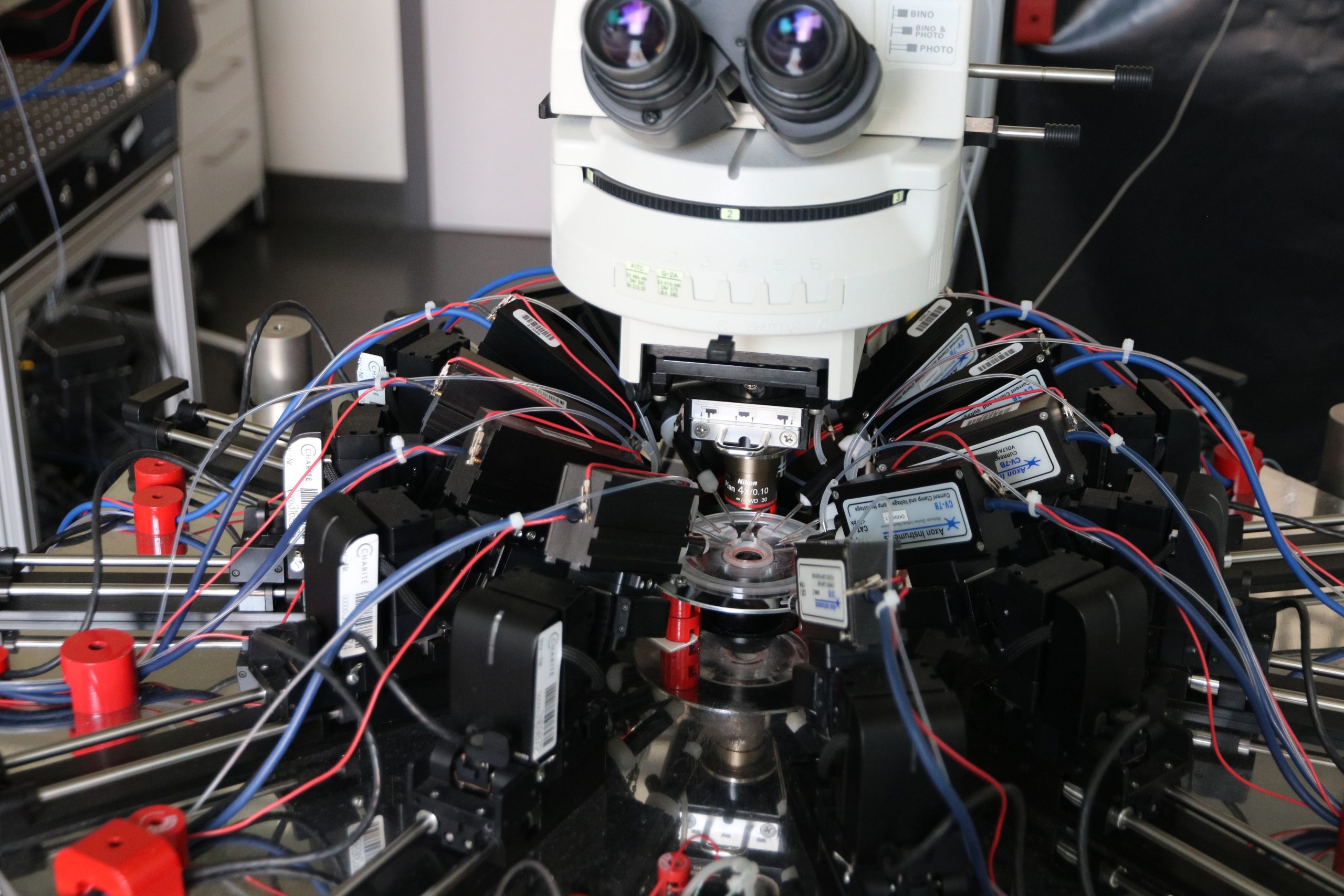
Multi-patch device with robot manipulators that automatically rinse the glass pipettes between two rounds of experiments. Credit: Charité | Yangfan Peng
The human neocortex is much thicker and more complex than that of a mouse. Nonetheless, researchers had previously assumed – in part due to lack of data – that it follows the same basic principles of connectivity. A team of Charité researchers led by Geiger has now used exceptionally rare tissue samples and state-of-the-art technology to demonstrate that this is not the case.
A clever method of listening in on neuronal communication
For the study, the researchers examined brain tissue from 23 people who had undergone neurosurgery at Charité to treat drug-resistant epilepsy. During surgery, it was medically necessary to remove brain tissue in order to gain access to the diseased structures beneath it. The patients had consented to the use of this access tissue for research purposes.
Rotating reconstruction of neurons. Credit: Charité | Sabine Grosser
To be able to observe the flows of signals between neighboring neurons in the outermost layer of the human neocortex, the team developed an improved version of what is known as the “multipatch” technique. This allowed the researchers to listen in on the communications taking place between as many as ten neurons at once. As a result, they were able to take the necessary number of measurements to map the network in the short time before the cells ceased their activity outside the body. In all, they analyzed the communication channels among nearly 1,170 neurons with about 7,200 possible connections.
Feed-forward instead of in cycles
They found that only a small fraction of the neurons engaged in reciprocal dialogue with each other. “In humans, the information tends to flow in one direction instead. It seldom returns to the starting point either directly or via cycles,” explains Dr. Yangfan Peng, first author of the publication. He worked on the study at the Institute for Neurophysiology and is now based at the Department of Neurology and the Neuroscience Research Center at Charité. The team used a computer simulation that they devised according to the same principles underlying the human network architecture to demonstrate that this forward-directed signal flow has benefits in terms of processing data.
A micropipette from the multipatch device approaches an individual neuron. Credit: Charité | Franz Mittermaier
The researchers gave the artificial neural network a typical machine learning task: recognizing the correct numbers from audio recordings of spoken digits. The network model that mimicked the human structures achieved more correct responses to this speech recognition task than the one modeled on mice. It was also more efficient, with the same performance requiring the equivalent of 380 neurons in the mouse model, but only 150 in the human one.
An economic role model for AI?
“The directed network architecture we see in humans is more powerful and conserves resources because more independent neurons can handle different tasks simultaneously,” Peng explains. “This means that the local network can store more information. It isn’t clear yet whether our findings within the outermost layer of the temporal cortex extend to other cortical regions, or how well they might explain the unique cognitive abilities of humans.”
In the past, AI developers have looked to biological models for inspiration in designing artificial neural networks, but have also optimized their algorithms independently of the biological models. “Many artificial neural networks already use some form of this forward-directed connectivity because it delivers better results for some tasks,” Geiger says. “It’s fascinating to see that the human brain also shows similar network principles. These insights into cost-efficient information processing in the human neocortex could provide further inspiration for refining AI networks.”
Reference: “Directed and acyclic synaptic connectivity in the human layer 2-3 cortical microcircuit” by Yangfan Peng, Antje Bjelde, Pau Vilimelis Aceituno, Franz X. Mittermaier, Henrike Planert, Sabine Grosser, Julia Onken, Katharina Faust, Thilo Kalbhenn, Matthias Simon, Helena Radbruch, Pawel Fidzinski, Dietmar Schmitz, Henrik Alle, Martin Holtkamp, Imre Vida, Benjamin F. Grewe and Jörg R. P. Geiger, 18 April 2024, Science.
DOI: 10.1126/science.adg8828
Never miss a breakthrough: Join the SciTechDaily newsletter.
Follow us on Google and Google News.
1 Comment
I’m always shocked that we still haven’t managed to determine the workings of the entire human brain. It would seem to be the most important task of all.