
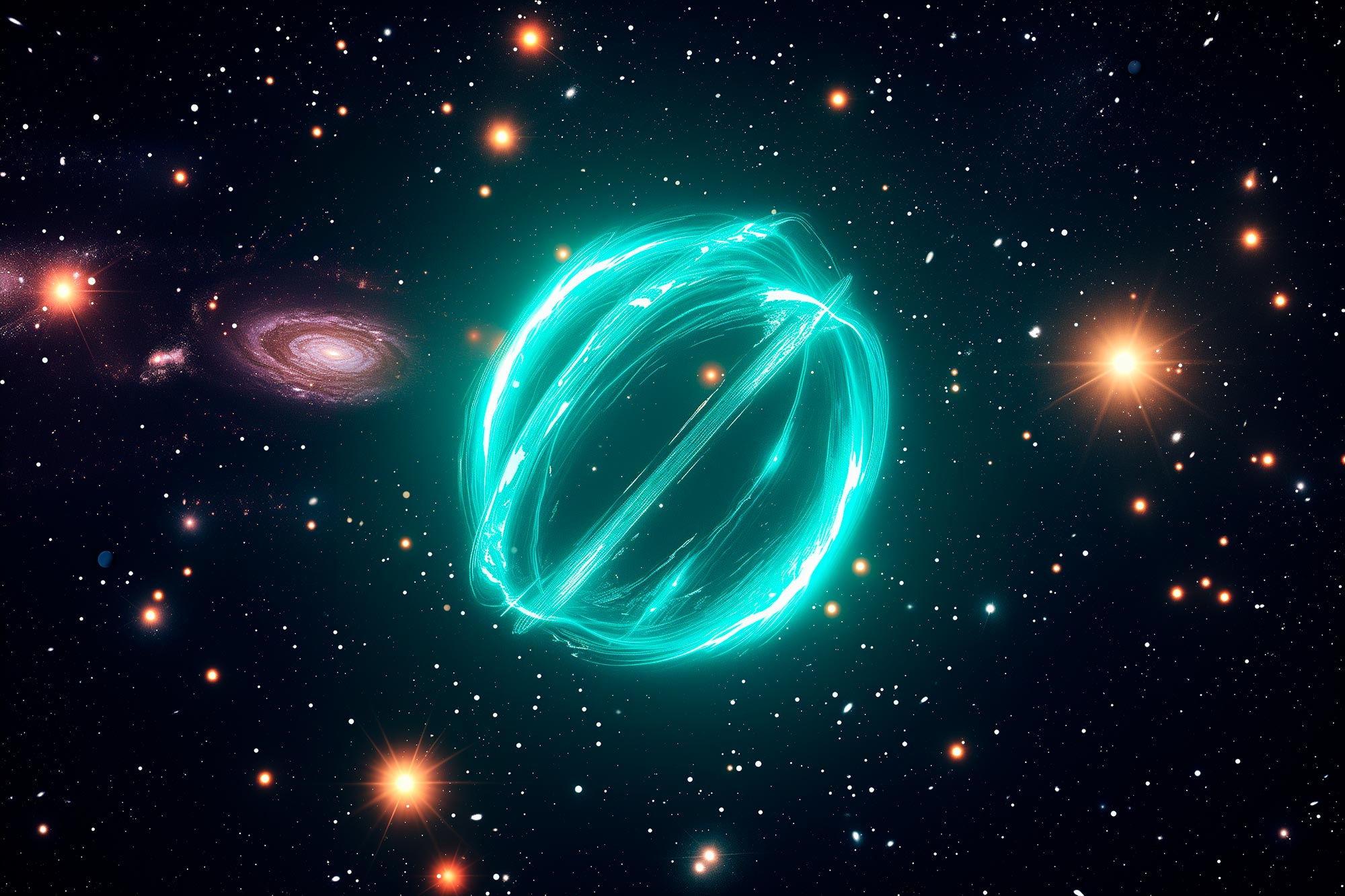
Outflowing galactic winds from exploding stars may explain the enormous rings.
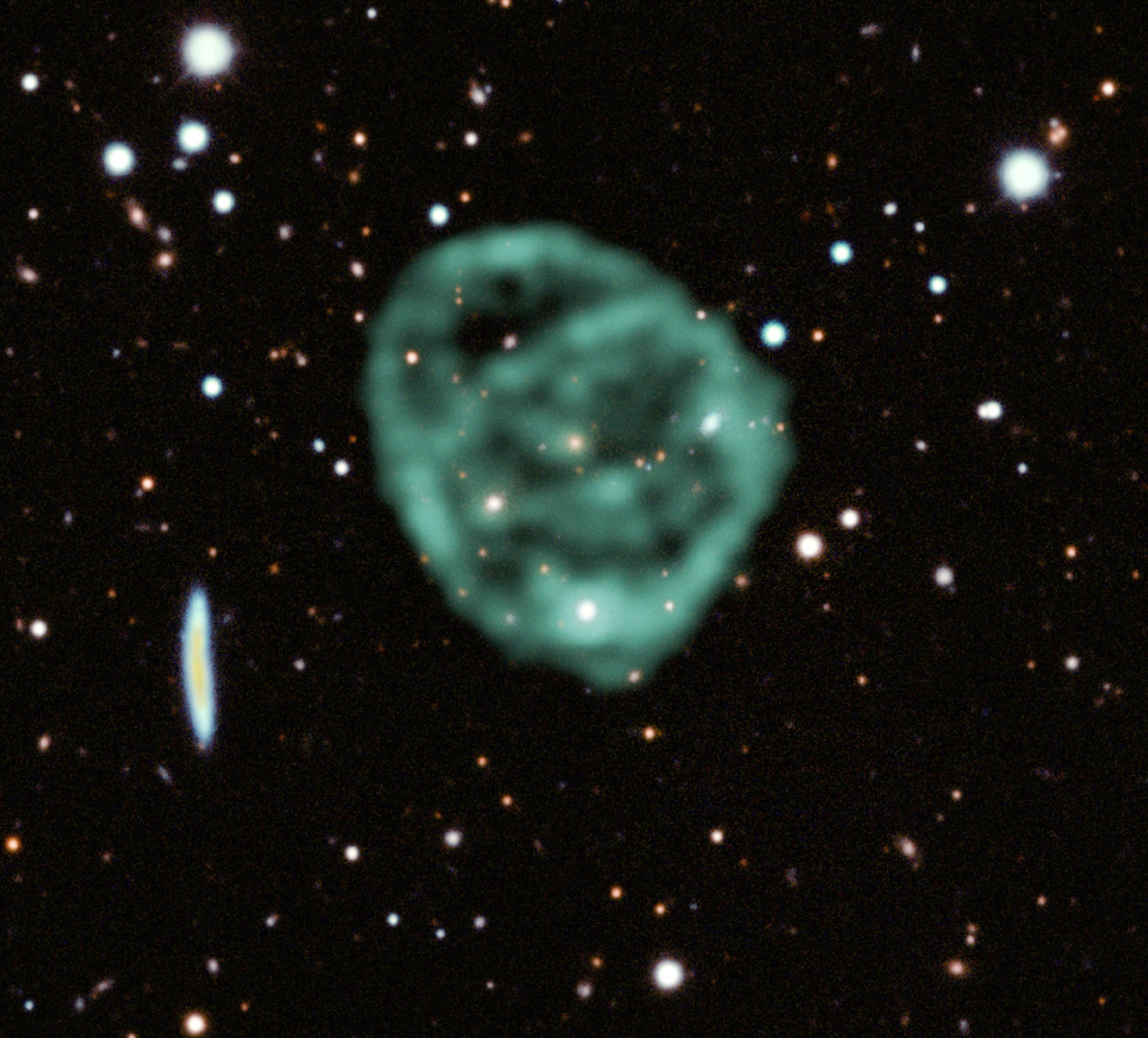
It’s not every day astronomers say, “What is that?” After all, most observed astronomical phenomena are known: stars, planets, black holes, and galaxies. But in 2019 the newly completed ASKAP (Australian Square Kilometer Array Pathfinder) telescope picked up something no one had ever seen before: radio wave circles so large they contained entire galaxies in their centers.
As the astrophysics community tried to determine what these circles were, they also wanted to know why the circles were. Now a team led by University of California San Diego Professor of Astronomy and Astrophysics Alison Coil believes they may have found the answer: the circles are shells formed by outflowing galactic winds, possibly from massive exploding stars known as supernovae. Their work is published in Nature.
Coil and her collaborators have been studying massive “starburst” galaxies that can drive these ultra-fast outflowing winds. Starburst galaxies have an exceptionally high rate of star formation. When stars die and explode, they expel gas from the star and its surroundings back into interstellar space. If enough stars explode near each other at the same time, the force of these explosions can push the gas out of the galaxy itself into outflowing winds, which can travel at up to 2,000 kilometers/second.
“These galaxies are really interesting,” said Coil, who is also chair of the Department of Astronomy and Astrophysics. “They occur when two big galaxies collide. The merger pushes all the gas into a very small region, which causes an intense burst of star formation. Massive stars burn out quickly and when they die, they expel their gas as outflowing winds.”
Massive, Rare, and of Unknown Origin
Technological developments allowed ASKAP to scan large portions of the sky at very faint limits which made odd radio circles (ORCs) detectable for the first time in 2019. The ORCs were enormous — hundreds of kiloparsecs across, where a kiloparsec is equal to 3,260 light-years (for reference, the Milky Way galaxy is about 30 kiloparsecs across).
Multiple theories were proposed to explain the origin of ORCs, including planetary nebulae and black hole mergers, but radio data alone could not discriminate between the theories. Coil and her collaborators were intrigued and thought it was possible the radio rings were a development from the later stages of the starburst galaxies they had been studying. They began looking into ORC 4 — the first ORC discovered that is observable from the Northern Hemisphere.
Up until then, ORCs had only been observed through their radio emissions, without any optical data. Coil’s team used an integral field spectrograph at the W.M. Keck Observatory on Maunakea, Hawaii, to look at ORC 4, which revealed a tremendous amount of highly luminous, heated, compressed gas — far more than is seen in the average galaxy.
With more questions than answers, the team got down to detective work. Using optical and infrared imaging data, they determined the stars inside ORC 4 galaxy were around 6 billion years old. “There was a burst of star formation in this galaxy, but it ended roughly a billion years ago,” stated Coil.
Simulations and Conclusions
Cassandra Lochhaas, a postdoctoral fellow at the Harvard & Smithsonian Center for Astrophysics specializing in the theoretical side of galactic winds and a co-author on the paper, ran a suite of numerical computer simulations to replicate the size and properties of the large-scale radio ring, including the large amount of shocked, cool gas in the central galaxy.
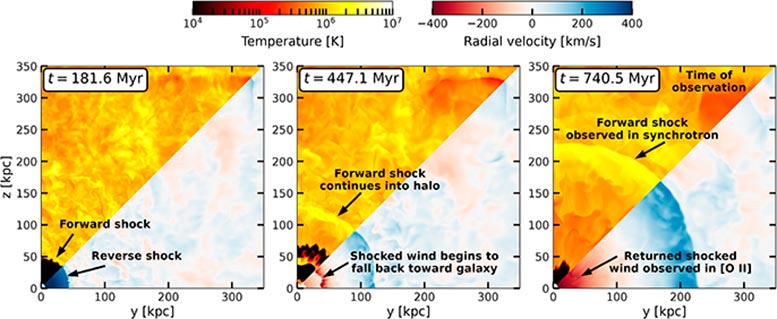
Her simulations showed outflowing galactic winds blowing for 200 million years before they shut off. When the wind stopped, a forward-moving shock continued to propel high-temperature gas out of the galaxy and created a radio ring, while a reverse shock sent cooler gas falling back onto the galaxy. The simulation played out over 750 million years — within the ballpark of the estimated one-billion-year stellar age of ORC 4.
Computer simulation of an outflowing galactic wind launched with an initial velocity of 450 kilometers per second and a mass outflow rate of 200 solar masses per year, which blows gas out of the galaxy for 200 million years into the surrounding circumgalactic medium. The left panel shows the gas temperature and the right panel show the gas density. This simulation provides a possible explanation for the origin of odd radio circles. Credit: Cassandra Lochhaas / Space Telescope Science Institute
“To make this work you need a high-mass outflow rate, meaning it’s ejecting a lot of material very quickly. And the surrounding gas just outside the galaxy has to be low density, otherwise the shock stalls. These are the two key factors,” stated Coil. “It turns out the galaxies we’ve been studying have these high-mass outflow rates. They’re rare, but they do exist. I really do think this points to ORCs originating from some kind of outflowing galactic winds.”
Not only can outflowing winds help astronomers understand ORCs, but ORCs can help astronomers understand outflowing winds as well. “ORCs provide a way for us to ‘see’ the winds through radio data and spectroscopy,” said Coil.
“This can help us determine how common these extreme outflowing galactic winds are and what the wind life cycle is. They can also help us learn more about galactic evolution: do all massive galaxies go through an ORC phase? Do spiral galaxies turn elliptical when they are no longer forming stars? I think there is a lot we can learn about ORCs and learn from ORCs.”
Reference: “Ionized gas extends over 40 kpc in an odd radio circle host galaxy” by Alison L. Coil, Serena Perrotta, David S. N. Rupke, Cassandra Lochhaas, Christy A. Tremonti, Aleks Diamond-Stanic, Drummond Fielding, James E. Geach, Ryan C. Hickox, John Moustakas, Gregory H. Rudnick, Paul Sell and Kelly E. Whalen, 8 January 2024, Nature.
DOI: 10.1038/s41586-023-06752-8
Never miss a breakthrough: Join the SciTechDaily newsletter.
Follow us on Google and Google News.
2 Comments
What a load of fake phoney science fiction baloney only low IQ brainwashed sheep believe
Could the returning gas be gas that when traveling away from the blast hits a limit of speed and forms a bearior of compression to a out flow and bounces’ back on itself.