
Close Menu
    Facebook X (Twitter) Instagram
    SciTechDaily
    • Biology
    • Chemistry
    • Earth
    • Health
    • Physics
    • Science
    • Space
    • Technology
    Facebook X (Twitter) Pinterest YouTube RSS
    SciTechDaily
    Home»Space»“Reverse Shock” – Mysterious Gamma-Ray Emitting Bubbles Around the Center of Our Galaxy Explained
    Space

    “Reverse Shock” – Mysterious Gamma-Ray Emitting Bubbles Around the Center of Our Galaxy Explained

    By Tokyo Metropolitan UniversityJanuary 1, 20232 Comments3 Mins Read
    Facebook Twitter Pinterest Telegram LinkedIn WhatsApp Email Reddit
    Share
    Facebook Twitter LinkedIn Pinterest Telegram Email Reddit
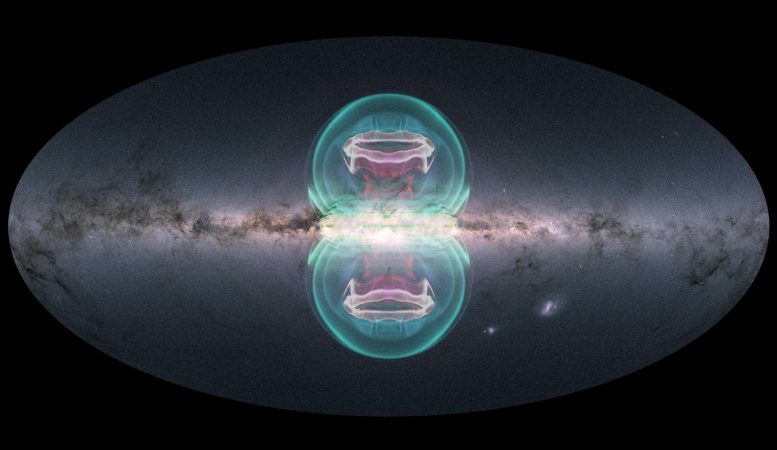
    Milky Way Gigantic Bubbles
    NASA visualization of the Milky Way’s Fermi bubbles. Credit: ESA/Gaia/DPAC

    Evidence shows strong outflowing winds responsible for the “Fermi bubbles.”

    A scientist from Tokyo Metropolitan University has shown that large gamma-ray emitting bubbles around the center of our galaxy were produced by fast-blowing outward winds and the associated “reverse shock.” Numerical simulations successfully reproduced the temperature profile observed by an X-ray telescope. Such outflows have been observed in other galaxies; this finding suggests similar winds may have been blowing in our own galaxy until quite recently.

    The universe is full of massive celestial objects which are yet to be explained. One of these is the “Fermi bubbles,” so-called because they were first discovered by the Fermi Gamma-ray Space Telescope in 2010. These bubbles are enormous gamma-ray emitting regions that extend either side of the center of our galaxy over approximately 50,000 light-years, protruding out from the plane of the galaxy like balloons as shown in the figure. Despite their mind-blowing scale, the mechanism by which they are formed is yet to be deciphered.
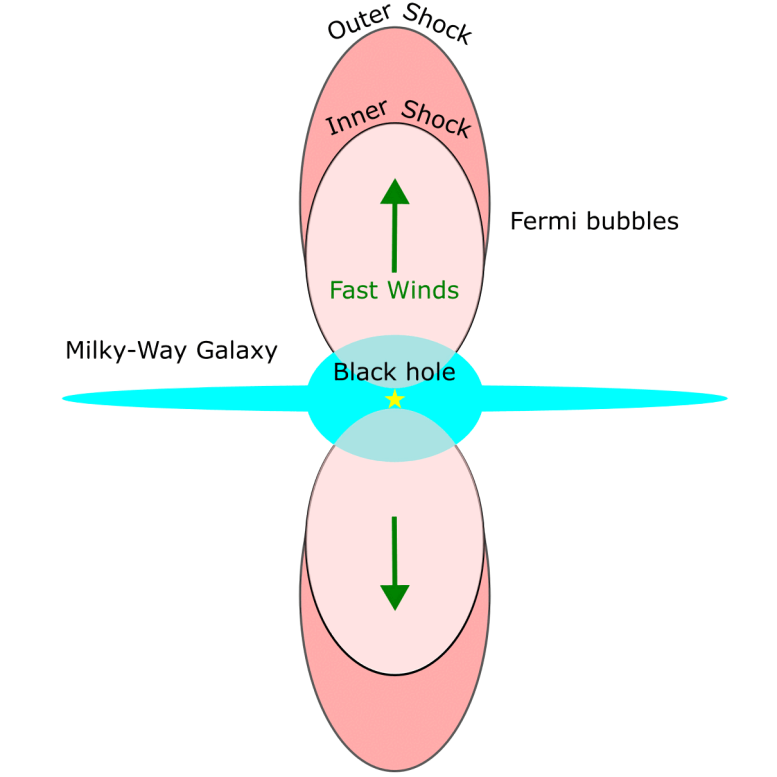
    Formation of the Fermi Bubbles Schematic
    Fast winds flowing out from the galactic center creates a forward shock and a reverse shock. The latter forms the outline of the Fermi bubbles. Credit: Tokyo Metropolitan University

    Now, Professor Yutaka Fujita from Tokyo Metropolitan University has presented theoretical evidence demonstrating how such objects may have been formed. Since their discovery, many hypotheses have been put forward about the formation of the Fermi bubbles, including an explosive activity of the central supermassive black hole, winds from the black hole, and steady star formation activity. Telling these scenarios apart is a challenging task, but the availability of state-of-the-art X-ray observations from the Suzaku satellite gives us a chance to compare measurements with what we expect from various scenarios.

    The simulations of Professor Fujita considered fast outflowing winds from the black hole injecting the necessary energy into the gas surrounding the center of the galaxy. Comparing with the measured profiles, they found that there was a good chance that the Fermi bubbles are produced by the fast outflowing winds, blowing at 1000km per second over 10 million years. These are not winds as we would experience them on earth, but streams of highly charged particles traveling at high speeds and propagating through space. These winds travel outwards and interact with surrounding “halo gas,” causing a “reverse shock” that creates a characteristic temperature peak. The Fermi bubbles correspond to the volume on the inside of this reverse shock front. Importantly, simulations also showed that an instantaneous explosion at the center could not reproduce the profiles measured by the telescope, lending weight to a scenario based on steady winds generated by the central black hole.

    The author notes that the winds predicted by the simulation are similar to outflows observed in other galaxies. The correspondence suggests the same kinds of massive outflows seen in other parts of the universe were present in our own galaxy until fairly recently.

    Reference: “Evidence for powerful winds and the associated reverse shock as the origin of the Fermi bubbles” by Yutaka Fujita, 12 November 2022, Monthly Notices of the Royal Astronomical Society.
    DOI: 10.1093/mnras/stac3312

    This work was supported by JSPS KAKENHI Grants-in-Aid (Grant Numbers 20H00181, 22H00158, and 22H01268).

    Never miss a breakthrough: Join the SciTechDaily newsletter.
    Follow us on Google and Google News.

    Astronomy Astrophysics Fermi Bubbles Milky Way Popular Tokyo Metropolitan University
    Share. Facebook Twitter Pinterest LinkedIn Email Reddit

    Related Articles

    Our Sun May Have Escaped the Milky Way’s Dangerous Center Billions of Years Ago

    Something Is Ticking Near the Milky Way’s Supermassive Black Hole

    The Center of Our Galaxy May Not Be a Black Hole

    Astronomers Reveal the Hidden Magnetic Skeleton of the Milky Way

    A Strange Glow in the Milky Way May Be Our First Glimpse of Dark Matter

    COS Observations Show Gas in Fermi Bubbles Moving at 2 Million Miles Per Hour

    Planck Space Telescope Reveals the Magnetic Field Lines of the Milky Way

    Hubble Reveals the First Visual Evidence of Changes in the Milky Way

    New Survey Maps Where Stars Are Born

    2 Comments

    1. Adrian on January 1, 2023 11:59 pm

      The thumbnail is an optical illusion: when you scroll down or up, it looks as if the thumbnail is moving

      Reply
    2. Melody on January 2, 2023 9:10 am

      Very fast winds of highly charged particles? So streams of electricity?

      Reply
    Leave A Reply Cancel Reply

    • Facebook
    • Twitter
    • Pinterest
    • YouTube

    Don't Miss a Discovery

    Subscribe for the Latest in Science & Tech!

    Trending News

    Enormous Prehistoric Insects Puzzle Scientists

    Scientists Develop Bioengineered Chewing Gum That Could Help Fight Oral Cancer

    After 37 Years, the World’s Longest-Running Soil Warming Experiment Uncovers a Startling Climate Secret

    NASA Satellite Captures First-Ever High-Res View of Massive Pacific Tsunami

    ADHD Isn’t Just a Deficit: Study Reveals Powerful Hidden Strengths

    Scientists Discover Stem Cells That Could Regrow Teeth and Bone

    Early Cannabis Use May Stall Key Brain Skills in Teens

    Popular Vitamin D Supplement Has “Previously Unknown” Negative Effect, Study Finds

    Follow SciTechDaily
    • Facebook
    • Twitter
    • YouTube
    • Pinterest
    • Newsletter
    • RSS
    SciTech News
    • Biology News
    • Chemistry News
    • Earth News
    • Health News
    • Physics News
    • Science News
    • Space News
    • Technology News
    Recent Posts
    • Quantum Breakthrough: New Algorithm Solves “Impossible” Materials in Seconds
    • Could the Universe’s Hidden Shape Solve One of Physics’ Biggest Mysteries?
    • Rewriting Dinosaur Evolution: Scientists Unearth Remarkable 150-Million-Year-Old Stegosaur Skull
    • Scientists Identify Two Simple Treatments for Cancer-Related Cognitive Impairment
    • Omega-3 Supplements Linked to Cognitive Decline in Surprising New Study
    Copyright © 1998 - 2026 SciTechDaily. All Rights Reserved.
    • Science News
    • About
    • Contact
    • Editorial Board
    • Privacy Policy
    • Terms of Use

    Type above and press Enter to search. Press Esc to cancel.