
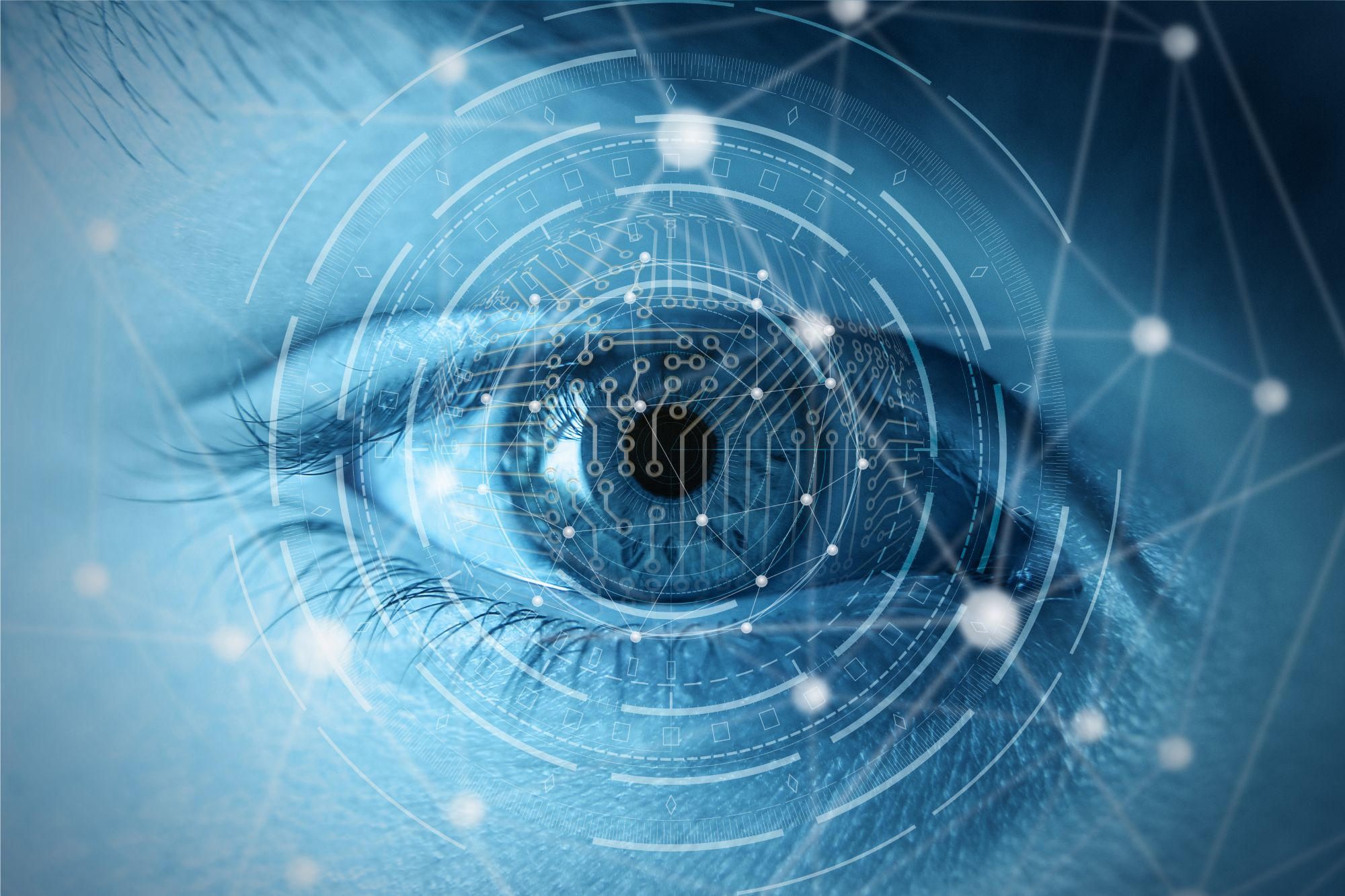
A team of international researchers, led by Francesca Santoro from Jülich, has developed a biochip that imitates the human retina. This innovation is part of a broader effort in bioelectronics aimed at repairing bodily and brain dysfunctions. The creation of this chip is a collaborative achievement involving experts from Forschungszentrum Jülich, RWTH Aachen University, Istituto Italiano di Tecnologia, and the University of Naples. Their work and findings have been published in the journal Nature Communications.
The fusion of man and machine is the epitome of a science fiction narrative. In real life, the first steps towards such cyborgs have long been taken: people have pacemakers to treat arrhythmias or cochlear implants to improve hearing, and retinal implants help people who are almost blind to see at least a little. A new chip could help retinal implants fuse even better with the human body in the future. It is based on conductive polymers and light-sensitive molecules that can be used to imitate the retina, complete with visual pathways. It was developed by Francesca Santoro’s research group at Jülich’s Institute for Bioelectronics (IBI-3) in collaboration with RWTH Aachen University, the Istituto Italiano di Tecnologia in Genoa and the University of Naples.
“Our organic semiconductor recognizes how much light falls on it. Something similar happens in our eyes. The amount of light that hits the individual photoreceptors ultimately creates the image in the brain,” explains Santoro, who is Professor of Neuroelectronic Interfaces at RWTH Aachen University and also a visiting researcher at the Istituto Italiano di Tecnologia.
Versatile chip
What is exceptional about the new semiconductor is that it consists entirely of non-toxic organic components, is flexible, and works with ions, that is, with charged atoms or molecules. It can thus be integrated into biological systems much better than conventional semiconductor components made of silicon, which are rigid and only work with electrons. “Our body cells specifically use ions to control certain processes and exchange information,” explains the researcher. However, the development is, so far, only a “proof-of-concept”, she emphasizes. The material was synthesized and then characterized: “We were able to show that the typical properties of the retina can be imitated with it,” she says.
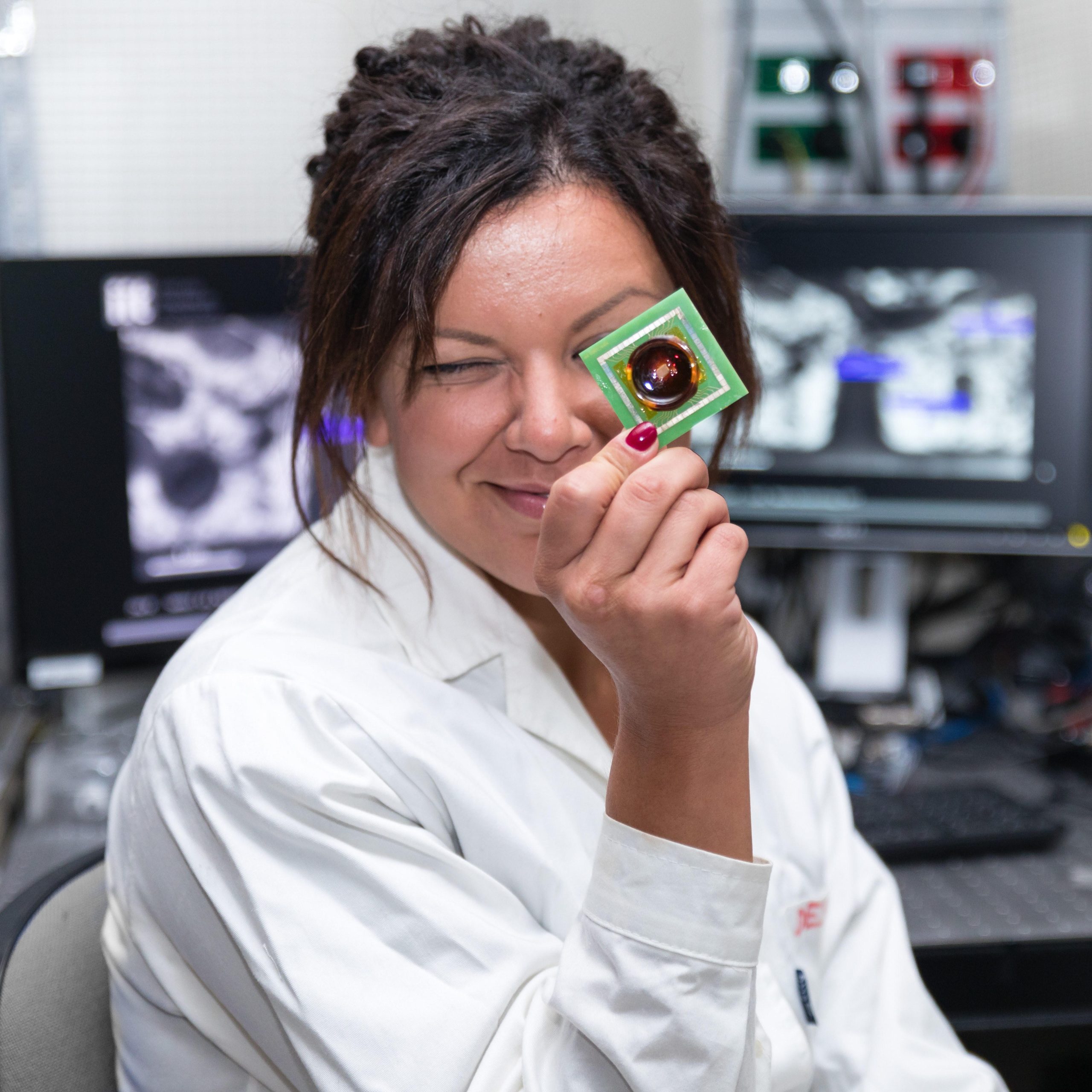
The researchers are already thinking about another possible application: the chip could also function as an artificial synapse as light irradiation changes the conductivity of the polymer that is used in the short and long term. Real synapses work in a similar way: by passing on electrical signals, they change their size and efficiency, for example, which is the basis for our brain’s learning and memory capacity. Santoro is looking ahead: “In future experiments, we want to couple the components with biological cells and connect many individual ones together.”
Understanding neurons
In addition to the artificial retina, Santoro’s team is developing other approaches for bioelectronic chips that can interact in a similar way with the human body, specifically the cells of the nervous system. “On the one hand, we are trying to replicate the three-dimensional structure of nerve cells and, on the other hand, we are also trying to replicate their functions, for example, processing and storing information.”
The biopolymers they used in the artificial retina proved to be a suitable starting material for this. “We can use them to reproduce the branched structure of human nerve cells with their many dendrites. You can imagine it a bit like a tree,” the scientist explains. This is important because real cells prefer such branched three-dimensional structures to smooth surfaces and thus establish close contacts with the artificial ones.
Firstly, the different biochips can be used to study real neurons – for example, the cellular exchange of information. Secondly, Santoro and her team hope that someday they will be able to use their components to actively intervene in the communication pathways of the cells in order to trigger certain effects. For example, Santoro is thinking here of correcting errors in the processing and transmission of information that occur in neurodegenerative diseases such as Parkinson’s or Alzheimer’s disease, or of supporting organs that no longer function properly. In addition, such components could also serve as an interface between artificial limbs or joints.
Computer technology could benefit as well. Due to their properties, the chips are predestined to serve as hardware for artificial neural networks. So far, AI programs are still working with classical processors that cannot adapt their structure. They merely imitate the self-learning operating principle of changing neural networks by means of sophisticated software. This is very inefficient. Artificial neurons could remedy this previous deficiency: “They would enable computer technology that imitates the way the brain works at all levels,” says Santoro.
Reference: “Azobenzene-based optoelectronic transistors for neurohybrid building blocks” by Federica Corrado, Ugo Bruno, Mirko Prato, Antonio Carella, Valeria Criscuolo, Arianna Massaro, Michele Pavone, Ana B. Muñoz-García, Stiven Forti, Camilla Coletti, Ottavia Bettucci and Francesca Santoro, 2 November 2023, Nature Communications.
DOI: 10.1038/s41467-023-41083-2
Never miss a breakthrough: Join the SciTechDaily newsletter.
Follow us on Google and Google News.
1 Comment
…