
HKUST’s new cooling device breaks world records with a 75 K temperature lift and a 48% efficiency boost, using eco-friendly materials.
Researchers from the School of Engineering at the Hong Kong University of Science and Technology (HKUST) have developed an eco-friendly refrigeration device with record-breaking cooling performance. With a boost in efficiency of over 48%, the new elastocaloric cooling technology opens a promising avenue for accelerating the commercialization of this disruptive technology and addressing the environmental challenges associated with traditional cooling systems.
Challenges and Innovations in Cooling Technology
Traditional vapor compression refrigeration technology relies on refrigerants that have a high global warming potential. Solid-state elastocaloric refrigeration based on latent heat in the cyclic phase transition of shape memory alloys (SMAs) provides an environmentally friendly alternative, with its characteristics of greenhouse gas-free, 100% recyclable, and energy-efficient SMA refrigerants. However, the relatively small temperature lift between 20 and 50 K, which is a critical performance indicator of the cooling device’s ability to transfer heat from a low-temperature source to a high-temperature sink, has hindered the commercialization of this emerging technology.
World Record in Cooling Efficiency
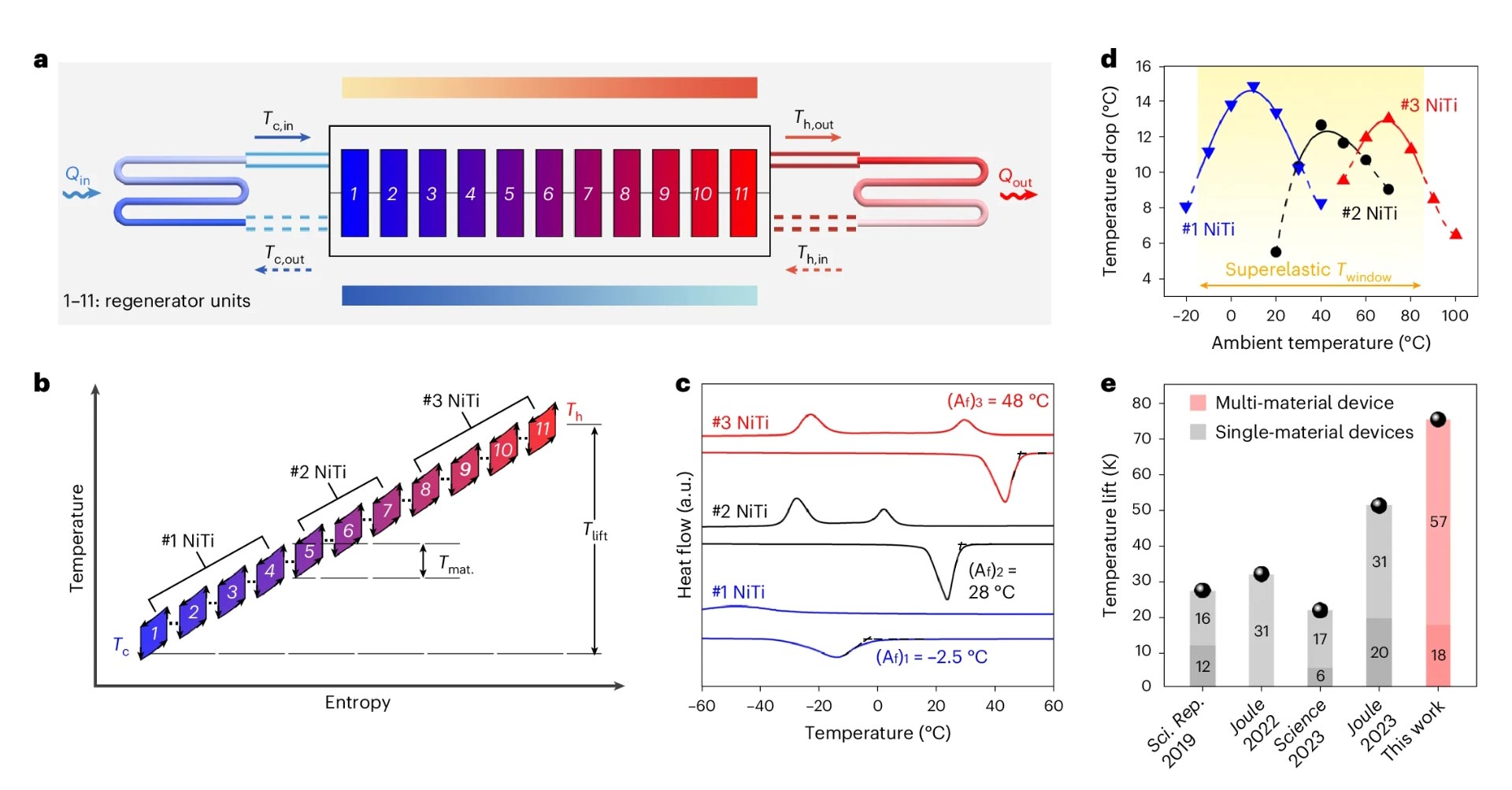
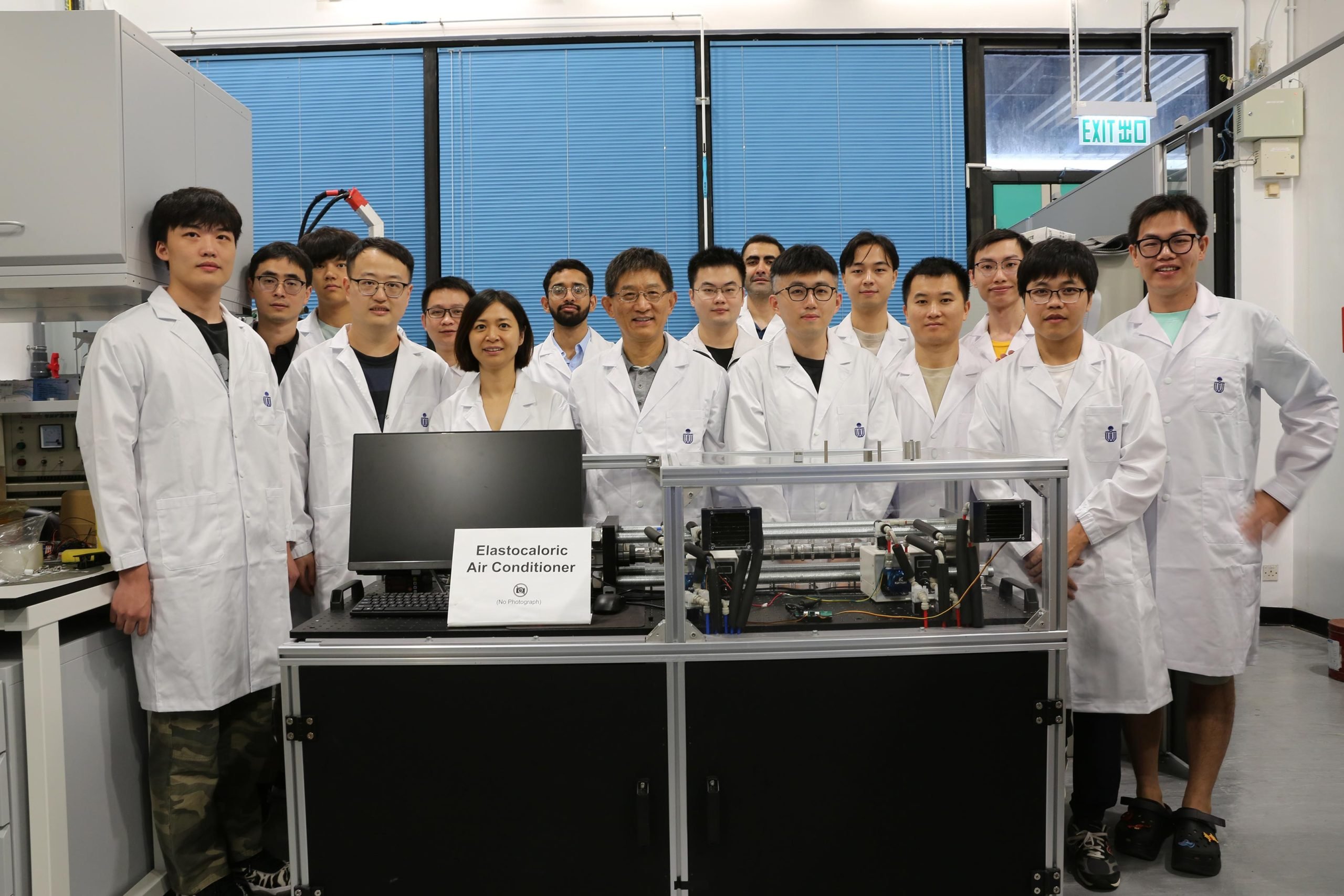
To overcome the challenge, the research team led by Prof. Sun Qingping and Prof. Yao Shuhuai from the Department of Mechanical and Aerospace Engineering has developed a multi-material cascading elastocaloric cooling device made of nickel-titanium (NiTi) shape memory alloys and broke the world record in its cooling performance.
They selected three NiTi alloys with different phase transition temperatures to operate at the cold end, intermediate end, and hot end, respectively. By matching the working temperatures of each unit with the corresponding phase transition temperatures, the overall device’s superelastic temperature window was expanded to over 100 K and each NiTi unit operated within its optimal temperature range, significantly enhancing the cooling efficiency. The multi-material cascading elastocaloric cooling device achieved a temperature lift of 75 K on the water side, surpassing the previous world record of 50.6 K. Their research was recently published in Nature Energy.
Future Prospects and Environmental Impact
Building on the success in developing elastocaloric cooling materials and architectures with many patents and papers published in leading journals, the research team plans to further develop high-performance shape memory alloys and devices for sub-zero elastocaloric cooling and high-temperature heat pumping applications. They will continue to optimize material properties and develop high-energy efficient refrigeration systems to drive the commercialization of this innovative technology.
Space cooling and heating account for 20% of the world’s total electricity consumption and, according to industry estimates, are projected to become the second-largest source of global electricity demand by 2050.
“In the future, with the continuous advancement of materials science and mechanical engineering, we are confident that elastocaloric refrigeration can provide next-generation green and energy-efficient cooling and heating solutions to feed the huge worldwide refrigeration market, addressing the urgent task of decarbonization and global warming mitigation,” Prof. Sun said.
Reference: “A multi-material cascade elastocaloric cooling device for large temperature lift” by Guoan Zhou, Zexi Li, Qiuhong Wang, Yuxiang Zhu, Peng Hua, Shuhuai Yao and Qingping Sun, 23 May 2024, Nature Energy.
DOI: 10.1038/s41560-024-01537-3
Never miss a breakthrough: Join the SciTechDaily newsletter.
Follow us on Google and Google News.
1 Comment
I’m a degreed mechanical engineer, with an interest in the fields of air conditioning(which is a technical term that refers to heating, cooling, and humidity control), and alternative energy/energy efficiency. It’s become clear to me that the more or less 20 year cycle of legally mandated refrigerant replacement is not what it seems.
The reasons given are always environmental, and who can argue with protecting the earth’s surface from excessive UV, or avoiding a runaway greenhouse effect? Isn’t is strange though, these changes always seem to come about around the time the wonderful new refrigerant from 20 years ago, approved by the very agency that now condemns it goes out of patent?
There was a good refrigerant called R-22 used mostly in domestic, and vehicular AC. Industry was forced to abandon it, and R-410A was the more or less mandated replacement. It was not a drop in replacement, as it required much higher pressures for operation, and thus much more expensive heat exchangers, and other components.
The thing is, there already existed drop in replacements, that could be used to refill R-22 equipment, and allow people to continue buying new less expensive already being manufactured equipment. The prime example, highly refined propane, which actually gives better thermal performance! The reason given it is not used is flammability, but isn’t natural gas used in homes? I’m pretty sure natural gas is flammable, and used in unlimited amounts, not a pound here, and a pound there over years. Besides, almost all refrigerant leaks are slow, and undetected. If an outside unit gets damaged, by say an automobile, the propane would be vented to atmosphere.
Anyway, if the budgets of corporations were not considered more important than that of you, and me, my heat pump would be using propane right now!