
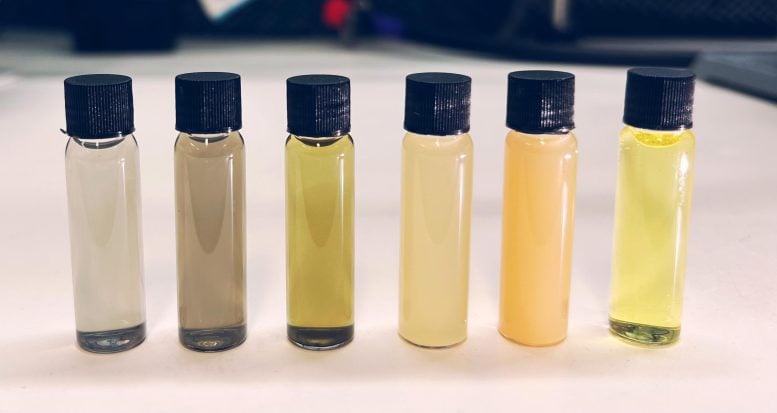
Phase change inks using nanotechnology have been developed to control temperature and provide passive climate control, reducing energy consumption. The versatile inks have potential applications in buildings, electronics, and clothing, and could become a sustainable solution to address climate change.
World-first ‘phase change inks’ that could transform how we heat and cool buildings, homes, and cars – to achieve sophisticated ‘passive climate’ control – have been developed, with enormous potential to help reduce energy use and global greenhouse gas emissions.
New research published in The Royal Society of Chemistry’s Journal of Materials Chemistry A led by Dr. Mohammad Taha, documents proof-of-concept ‘phase change inks’ that use nanotechnology to control the temperature in everyday environments. They achieve this by adjusting the amount of radiation that can pass through them, based on the surrounding environment.
Dr. Taha said these inks could be used to develop coatings to achieve passive heating and cooling, reducing our need to rely on energy creation to regulate temperatures.
“Humans use a lot of energy to create and maintain comfortable environments – heating and cooling our buildings, homes, cars, and even our bodies,” Dr. Taha said.
“We can no longer only focus on energy generation from renewable resources to reduce our environmental impact. We also need to consider reducing our energy consumption as part of our proposed energy solutions, as the impacts of climate change become a reality.
“By engineering our inks to respond to their surroundings, we not only reduce the energy expenditure, but we also remove the need for auxiliary control systems to control temperatures, which is an additional energy waste.”
Versatile Applications of Phase Change Inks
Passive climate control would enable comfortable living conditions without expending energy unnecessarily. For example, to provide comfortable heating in winter, the inks applied on a building façade could automatically transform to allow greater sun radiation to pass through during the day, and greater insulation to keep warmth in at night. In summer, they could transform to form a barrier to block heat radiation from the sun and the surrounding environment.
The versatile ‘phase change inks’ are a proof-of-concept that can be laminated, sprayed or added to paints and building materials. They could also be incorporated into clothing, regulating body temperature in extreme environments, or in the creation of large-scale, flexible and wearable electronic devices like bendable circuits, cameras and detectors, and gas and temperature sensors.
Dr. Taha said: “Our research removes the previous restrictions on applying these inks on a large scale cheaply. It means existing structures and building materials can be retrofitted. With manufacturing interest, the inks could reach market in five to 10 years.
“Through collaboration with industry, we can scale up and integrate them into existing and new technologies as part of a holistic approach to tackling the world’s climate change energy challenges.
“The potential of this material is huge as it can be used for so many different purposes – like preventing heat build-up in laptop electronics or on car windshields. But the beauty of this material is that we can adjust its heat absorption properties to suit our needs.
“Already, a different type of phase change material is used to manufacture smart glass, but our new material means we can engineer smarter bricks and paint. This new nanotechnology can help retrofit existing buildings to make them more efficient. It’s better for the environment and sustainable for the future.”
Revolutionizing Energy Efficiency with Nanotechnology
The breakthrough was achieved by discovering how to modify one of the main components of ‘phase change materials’ – vanadium oxide (VO2). Phase change materials use triggers, like heat or electricity, to create enough energy for the material to transform itself under stress. However, phase change materials previously needed to be heated to very high temperatures for their ‘phase changing’ properties to be activated.
“We used our understanding of how these materials are put together to test how we could trigger the insulator to metal (IMT) reaction, where the material basically acts as a switch to block heat beyond a particular temperature – near-room temperature (30-40oC),” Dr. Taha said.
Dr. Taha said the next step will involve taking the research, patented by the University of Melbourne, to production.
Reference: “Infrared modulation via near-room-temperature phase transitions of vanadium oxides & core–shell composites” by Mohammad Taha, Sivacarendran Balendhran, Peter C. Sherrell, Nick Kirkwood, Dingchen Wen, Shifan Wang, Jiajun Meng, James Bullock, Kenneth B. Crozier and Len Sciacca, 21 March 2023, Journal of Materials Chemistry A.
DOI: 10.1039/D2TA09753B
Never miss a breakthrough: Join the SciTechDaily newsletter.
Follow us on Google and Google News.