
A new study indicates that plant-based polymers can degrade within a seven-month period.
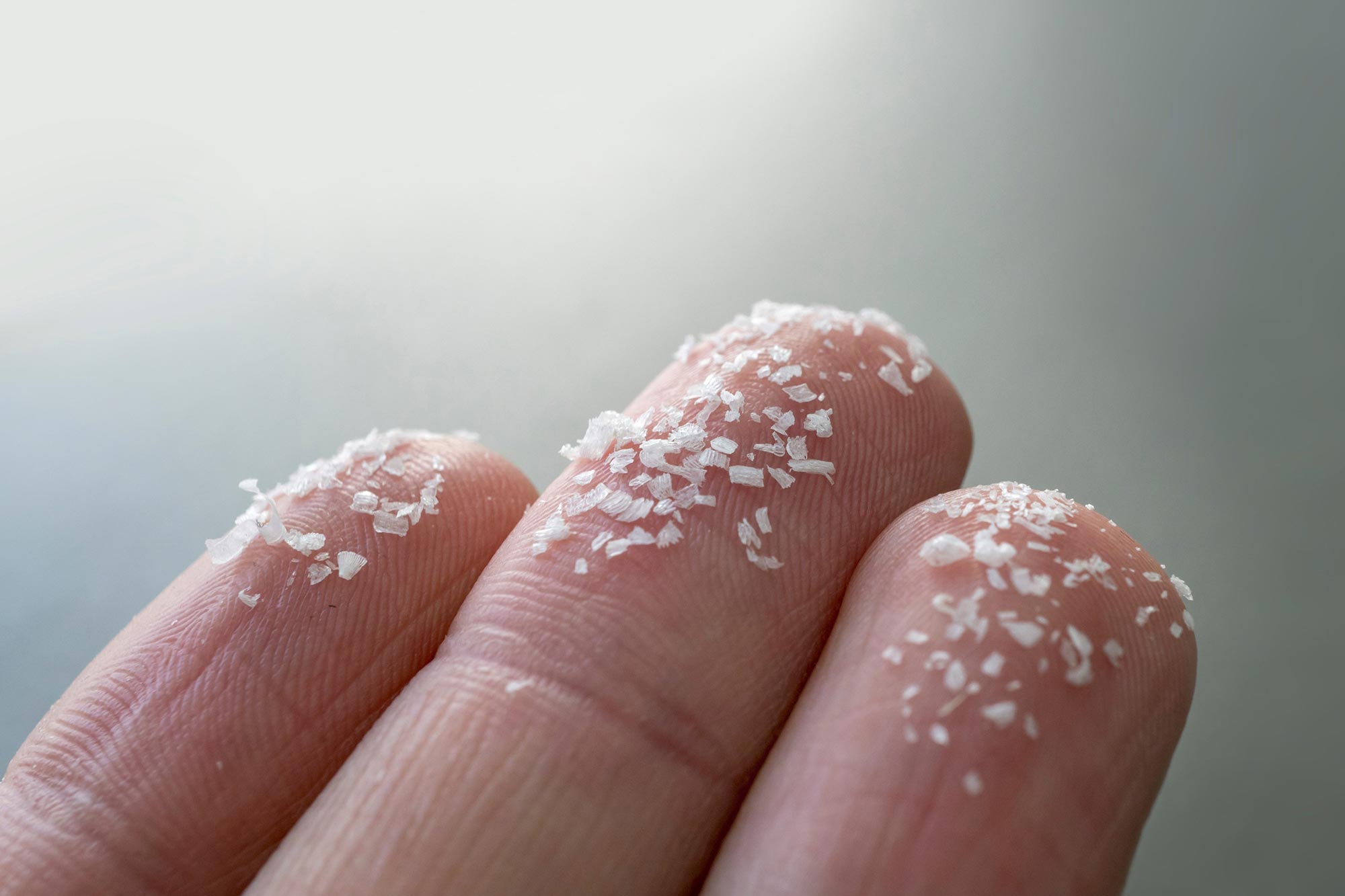
Microplastics are tiny, nearly indestructible fragments shed from everyday plastic products. As we learn more about microplastics, the news keeps getting worse. Already well-documented in our oceans and soil, we’re now discovering them in the unlikeliest of places: our arteries, lungs, and even placentas. Microplastics can take anywhere from 100 to 1,000 years to break down and, in the meantime, our planet and bodies are becoming more polluted with these materials every day.
Finding viable alternatives to traditional petroleum-based plastics and microplastics has never been more important. New research from scientists at the University of California San Diego and materials science company Algenesis shows that their plant-based polymers biodegrade — even at the microplastic level — in under seven months. The paper, whose authors are all UC San Diego professors, alumni, or former research scientists, appears in the journal Scientific Reports.
“We’re just starting to understand the implications of microplastics. We’ve only scratched the surface of knowing the environmental and health impacts,” stated Professor of Chemistry and Biochemistry Michael Burkart, one of the paper’s authors and an Algenesis co-founder. “We’re trying to find replacements for materials that already exist, and make sure these replacements will biodegrade at the end of their useful life instead of collecting in the environment. That’s not easy.”
“When we first created these algae-based polymers about six years ago, our intention was always that it be completely biodegradable,” said another of the paper’s authors, Robert Pomeroy, who is also a professor of chemistry and biochemistry and an Algenesis co-founder. “We had plenty of data to suggest that our material was disappearing in the compost, but this is the first time we’ve measured it at the microparticle level.”
Putting it to the test
To test its biodegradability, the team ground their product into fine microparticles, and used three different measurement tools to confirm that, when placed in a compost, the material was being digested by microbes.
The first tool was a respirometer. When the microbes break down compost material, they release carbon dioxide (CO2), which the respirometer measures. These results were compared to the breakdown of cellulose, which is considered the industry standard of 100% biodegradability. The plant-based polymer matched the cellulose at almost one hundred percent.
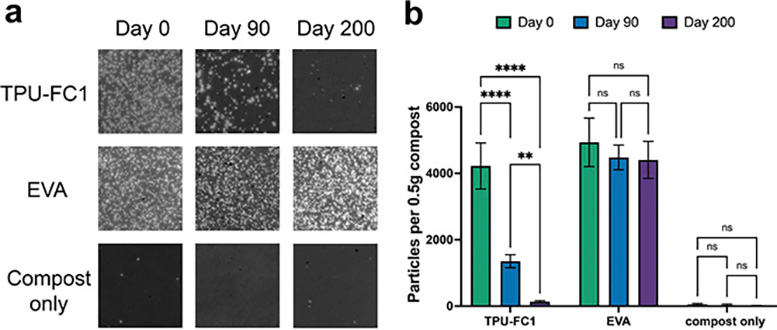
Next the team used water flotation. Since plastics are not water soluble and they float, they can easily be scooped off the surface of water. At intervals of 90 and 200 days, almost 100% of the petroleum-based microplastics were recovered, meaning none of it had biodegraded. On the other hand, after 90 days, only 32% of the algae-based microplastics were recovered, showing that more than two-thirds of it had biodegraded. After 200 days, only 3% was recovered indicating that 97% of it had disappeared.
The last measurement involved chemical analysis via gas chromatography/mass spectrometry (GCMS), which detected the presence of the monomers used to make the plastic, indicating that the polymer was being broken into its starting plant materials. Scanning-electron microscopy further showed how microorganisms colonize the biodegradable microplastics during composting.
“This material is the first plastic demonstrated to not create microplastics as we use it,” said Stephen Mayfield, a paper coauthor, School of Biological Sciences professor and co-founder of Algenesis. “This is more than just a sustainable solution for the end-of-product life cycle and our crowded landfills. This is actually plastic that is not going to make us sick.”
Creating an eco-friendly alternative to petroleum-based plastics is only one part of the long road to viability. The ongoing challenge is to be able to use the new material on pre-existing manufacturing equipment that was originally built for traditional plastic, and here Algenesis is making progress. They have partnered with several companies to make products that use the plant-based polymers developed at UC San Diego, including Trelleborg for use in coated fabrics and RhinoShield for use in the production of cell phone cases.
“When we started this work, we were told it was impossible,” stated Burkart. “Now we see a different reality. There’s a lot of work to be done, but we want to give people hope. It is possible.”
Reference: “Rapid biodegradation of microplastics generated from bio-based thermoplastic polyurethane” by Marco N. Allemann, Marissa Tessman, Jaysen Reindel, Gordon B. Scofield, Payton Evans, Robert S. Pomeroy, Michael D. Burkart, Stephen P. Mayfield and Ryan Simkovsky, 12 March 2024, Scientific Reports.
DOI: 10.1038/s41598-024-56492-6
This research was supported by funding from the Department of Energy (DE-SC0019986 and DE-EE0009295).
Disclosure: Burkart, Mayfield and Pomeroy are co-founders of and hold equity positions in Algenesis Corporation.
Never miss a breakthrough: Join the SciTechDaily newsletter.
Follow us on Google and Google News.
5 Comments
HILARIOUS!
THERE ARE HUMANS, WHO INVENT AND/OR PRODUCE DESTRUCTION MATERIAL, WHICH WOULD PLAY ROLE TO DESTROY MOTHER EARH/HUMNA KIND.
AND THERE ARE HUMANS, WHO INVENT / PRODUCE FOR THE SAVIOUR OF MOTHER EARTH AND HUMAN KIND. LOVE YOU GUYS❤… YOU HAVE SAVED US FROM THE CURSE OF COMING GENERATION FOR DOING NOTHING BUT TO SOAK LIFE JUST FOR THE SAKE OF SUPREMACY.
LONG LIVE SUCH HUMANS AND HUMANITY. GOOD LUCK FOR REACHING TO THE NOBLE GOAL.
WITH LOTS OF BLESSINGS… MUAAAH!
I am 65 year old (Male) Science Graduate, into consultancy for registration and awareness towards hazards and disposal of Petroleum based Policy (EPR), introduced by Govt. of India.
The motive of EPR (Extended Producer Responsibility) Policy is to make aware the hazards of use of Petroleum based Plastic and fixing responsibility on the manufacturers, Producers and Corporates(Brand Owners) for its proper disposal in recycling or on the end of its life cycle.
Please do share everything new on this front to further spread for the good of our Mother Earth and Human kind.
Thanks and regards
Atul Sharma
+91 9414042150
Wonderful discovery but it will take another 20 years before it reaches the public at a price MOST can’t afford soooo its a practical waste
👍😎 Love it! Aloha, Mike
I’m torn between wanting a solution for the Endocrine Disruption, and other serious matters, that Micro-Plastics, especially with BPA, etc., pose. However, I feel it’s best to accept the fact that if they are curtailed, the group that has unleashed them on Americans will create something more diabolical, as they always do; PFOAS, PFAS, PFOS, GenX, etc., more than 14,000 varieties. It’s best to allow them to believe their poisoning is being accepted as-is, because if they move on to the next substance it’s likely to be far worse.