
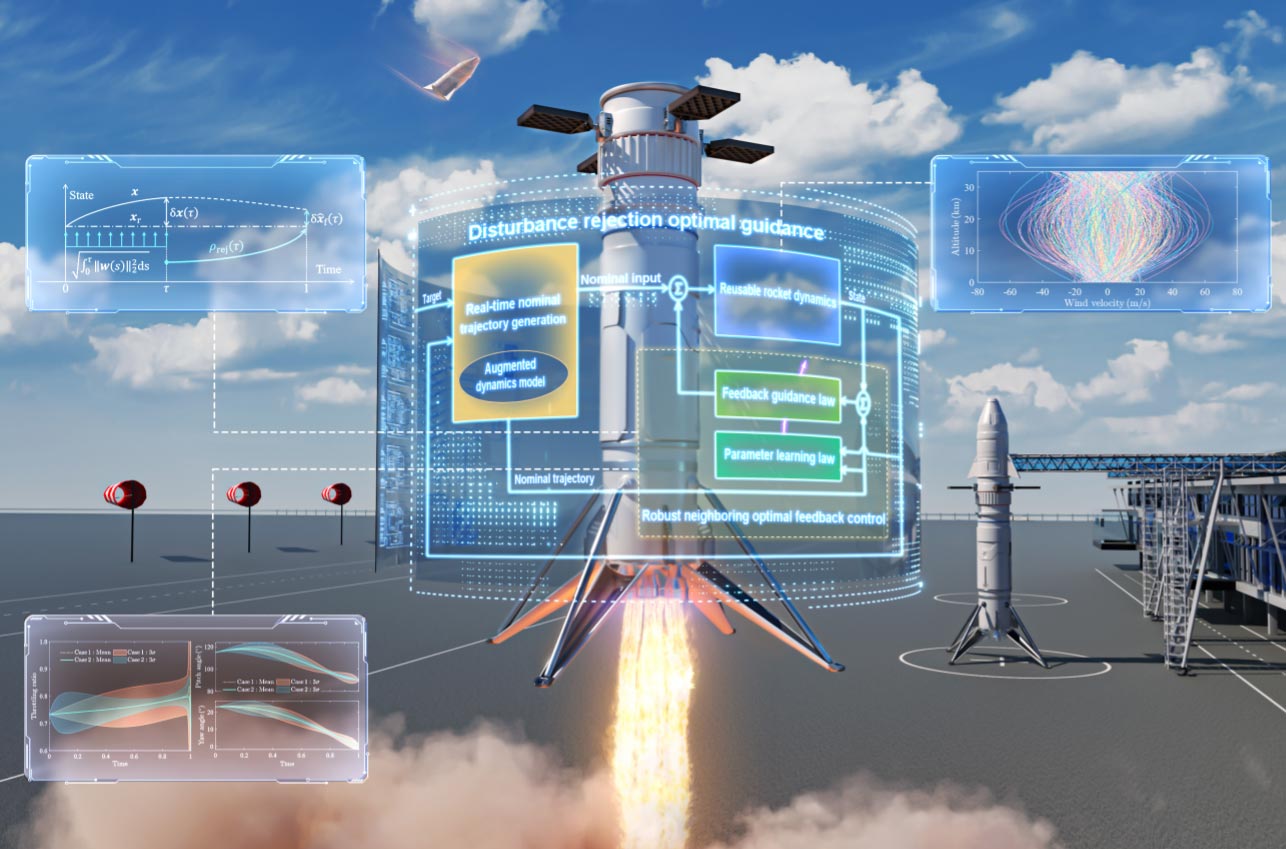
Beihang University researchers introduced Endo-PDG-DR, a powered descent guidance method for reusable rockets that combines disturbance rejection with optimal control. Using advanced algorithms, they addressed both modeled and unmodeled disturbances, achieving robust, real-time guidance.
Powered descent guidance (PDG) is a crucial technology for enabling reusable rockets to achieve precise landings on Earth. Unlike the well-established PDG systems developed for lunar and planetary landings, endoatmospheric powered descent guidance must address the challenges posed by nonlinear dynamics and harsher flight conditions within Earth’s atmosphere. These challenges include engine thrust fluctuations, aerodynamic uncertainties, and wind disturbances.
For instance, wind disturbances can impose continuous aerodynamic forces on the rocket, which may significantly reduce landing accuracy, increase propellant consumption, and even lead to unstable guidance commands. Although existing approaches incorporate six-degree-of-freedom dynamics and aerodynamic models, they often fall short of systematically addressing disturbances during guidance design.
To overcome this limitation, it is essential to develop guidance strategies capable of rejecting disturbances in endoatmospheric nonlinear optimal guidance. The goal is to generate guidance commands that direct the rocket along a trajectory meeting terminal landing conditions while optimizing performance metrics, such as minimizing propellant consumption, even in the presence of disturbances.
A Novel Guidance Approach: Endo-PDG-DR
Recently, a team of researchers led by Huifeng Li and Ran Zhang from Beihang University, China proposed an optimal feedback guidance method with disturbance rejection objective. This work represents an advanced engineering design methodology that is capable of unifying optimal guidance performance and disturbance rejection level.
The team published their work in the Chinese Journal of Aeronautics on December 14, 2024.
“In this work, we formulated a novel problem called Endoatmospheric Powered Descent Guidance with Disturbance Rejection (Endo-PDG-DR) by dividing and conquering disturbances. The disturbances are divided into two parts, modeled and unmodeled disturbances; as a result, two different disturbance rejection strategies are accordingly adopted to deal with the two kinds of disturbances: the modeled disturbance is proactively exploited by optimizing the formulated guidance problem where the modeled disturbance is augmented as a new state of the dynamics model; the unmodeled disturbance is reactively attenuated by adjusting the second-order partial derivative of the Hamiltonian of the optimal guidance problem with a parameterized time-varying quadratic performance index,” said Huifeng Li, professor at School of Astronautics at Beihang University (China), a senior expert whose research interests focus on the field of flight vehicle guidance and control.
Pseudospectral Differential Dynamic Programming (PDDP) Method
“A new Pseudospectral Differential Dynamic Programming (PDDP) method is developed to solve the Hamilton-Jacobi-Bellman equation of the Endo-PDG-DR problem, and correspondingly a robust neighboring optimal state feedback law is obtained with a simple affine form that is favorable for real-time implementation. More importantly, the obtained optimal feedback guidance law unifies two synergistic functionalities, i.e., adaptive optimal steering and disturbance attenuation. The adaptive optimal steering accommodates the modeled disturbance, and the disturbance attenuation compensates for the state perturbation effect induced by the remaining unmodeled disturbance.” said Huifeng Li.
“Using the derived optimal feedback guidance law, a disturbance rejection level is quantitatively measured by rigorously characterizing an input-output property from the unmodeled disturbance to the predicted guidance error. Based on the quantified disturbance rejection level, a simple and practical quadratic weighting parameter tuning law is proposed to attenuate the adverse effect of unmodeled disturbance,” said Huifeng Li.
However, more delicate research works are still needed to explore guidance robustness. In this regard, Li also put forward three major development directions may be pursued in future works including online model identification, highly constrained optimal trajectory generation, and guidance parameter learning.
Reference: “Optimal feedback guidance with disturbance rejection for endoatmospheric powered descent” by Xinglun CHEN, Ran ZHANG and Huifeng LI, 14 December 2024, Chinese Journal of Aeronautics.
DOI: 10.1016/j.cja.2024.103336
Other contributors include Ran Zhang and Xinglun Chen from the School of Astronautics at Beihang University (China).
This work was supported by the National Natural Science Foundation of China (No. 62103014).
Never miss a breakthrough: Join the SciTechDaily newsletter.
Follow us on Google and Google News.